

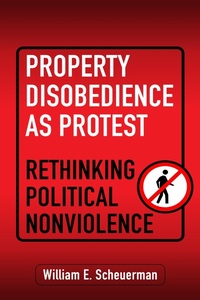
Property Disobedience as Protest
Description

William E. Scheuerman's book explores when, if ever, politically motivated property harms are justifiable
In 2020, Black Lives Matter activists toppled Confederate monuments and occasionally vandalized police vehicles and stations. Climate activists have damaged natural gas pipelines and famous artworks. In Hong Kong, pro-democracy students targeted businesses sympathetic to the mainland government. On January 6, 2021, far-right groups at the US Capitol mistreated public and private property as part of their efforts to disrupt finalizing election results. Property damage constitutes an increasingly commonplace feature of global political protest. How then to interpret and evaluate its proliferation? The media regularly describes such acts as "violent," as do most scholars. However, William E. Scheuerman's book pushes back against conflating politically motivated violations of property rights with violence. Political violence has no place in democratic politics. Yet indiscriminately grouping property damage together with acts destructive of and harmful to persons is conceptually confusing and politically misleading. After all, Americans celebrate the Boston Tea Party. So why do most of us now categorically condemn many seemingly parallel acts?
Scheuerman tackles challenging and politically timely questions. When, if ever, are politically motivated property harms justifiable? What standards should we expect of those pursuing them to meet, under democratic conditions? How are those standards undermined by the rise of authoritarian populism around the world? Focusing on identifiably nonviolent varieties of what Scheuerman calls property disobedience, his book explores a variety of real-life examples, both past and present, to understand how and why such acts may be politically justifiable-or should instead be viewed as beyond the pale.
More details
Other editions
Additional editions
Person
Content
- Cover
- Series page
- Title page
- Copyright page
- Contents
- Introduction. Protest and Property Damage
- Chapter 1. Why Property Disobedience?
- Chapter 2. Violence and Property
- Chapter 3. Symbolic Property Disobedience
- Chapter 4. Disruptive Property Disobedience
- Chapter 5. Property Seizures
- Chapter 6. Revisiting Property
- Chapter 7. Goodbye to Nonviolence?
- Notes
- Index
- Acknowledgments
