

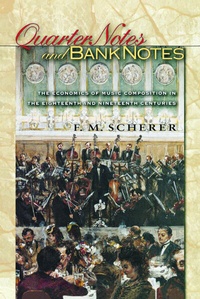
Quarter Notes and Bank Notes
The Economics of Music Composition in the Eighteenth and Nineteenth Centuries
1st Edition
Published on 19. November 2018
280 pages
978-0-691-18809-6 (ISBN)
Description

In 1700, most composers were employees of noble courts or the church. But by the nineteenth century, Chopin, Schumann, Brahms, Verdi, and many others functioned as freelance artists teaching, performing, and selling their compositions in the private marketplace. While some believe that Mozart's career marks a clean break between these two periods, this book tells the story of a more complex and interesting transition.
F. M. Scherer first examines the political, intellectual, and economic roots of the shift from patronage to a freelance market. He describes the eighteenth-century cultural "arms race" among noble courts, the spread of private concert halls and opera houses, the increasing attendance of middle-class music lovers, and the founding of conservatories. He analyzes changing trends in how composers acquired their skills and earned their living, examining such impacts as demographic developments and new modes of transportation. The book offers insight into the diversity of composers' economic aspirations, the strategies through which they pursued success, the burgeoning music publishing industry, and the emergence of copyright protection. Scherer concludes by drawing some parallels to the economic state of music composition in our own times.
Written by a leading economist with an unusually broad knowledge of music, this fascinating account is directed toward individuals intrigued by the world of classical composers as well as those interested in economic history or the role of money in art.
F. M. Scherer first examines the political, intellectual, and economic roots of the shift from patronage to a freelance market. He describes the eighteenth-century cultural "arms race" among noble courts, the spread of private concert halls and opera houses, the increasing attendance of middle-class music lovers, and the founding of conservatories. He analyzes changing trends in how composers acquired their skills and earned their living, examining such impacts as demographic developments and new modes of transportation. The book offers insight into the diversity of composers' economic aspirations, the strategies through which they pursued success, the burgeoning music publishing industry, and the emergence of copyright protection. Scherer concludes by drawing some parallels to the economic state of music composition in our own times.
Written by a leading economist with an unusually broad knowledge of music, this fascinating account is directed toward individuals intrigued by the world of classical composers as well as those interested in economic history or the role of money in art.
More details
Other editions
Additional editions
F. M. Scherer
Quarter Notes and Bank Notes
The Economics of Music Composition in the Eighteenth and Nineteenth Centuries
Book
06/2012
Princeton University Press
€30.30
Shipment within 10-20 days
F. M. Scherer
Quarter Notes and Bank Notes
The Economics of Music Composition in the Eighteenth and Nineteenth Centuries
Book
12/2003
Princeton University Press
€64.48
Article exhausted; check different version
Person
F. M. Scherer is Aetna Professor Emeritus at Harvard University's Kennedy School of Government, Lecturer at the Woodrow Wilson School, Princeton University, and the author of many books.
Content
- Cover
- Title Page
- Copyright Page
- CONTENTS
- List of Figures and Tables
- Foreword
- CHAPTER ONE: Introduction
- CHAPTER TWO: The Political, Social, and Economic Milieu
- CHAPTER THREE: Music Composition as a Profession
- CHAPTER FOUR: Composers' Backgrounds, Aspirations, and Economic Rewards
- CHAPTER FIVE: The Geography of Composer Supply and Demand
- CHAPTER SIX: Changes in Transportation and Composers' Mobility
- CHAPTER SEVEN: The Economics of Music Publishing
- CHAPTER EIGHT: Conclusion
- APPENDIX TO CHAPTER ONE A Currency Conversion Matrix
- APPENDIX TO CHAPTER FOUR Consumption Outlays of Robert and Clara Schumann, 1841
- Notes
- References
- Index
