

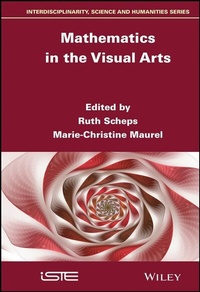
Mathematics in the Visual Arts
Description

A living example of this interdisciplinarity would be the sculptures of Jean Letourneur, a specialist in both chaos sciences and carving, as evidenced in his stonework. This book also exemplifies the geometry and life of forms through contemporary works of art - including fractal art - which have never before been represented in this type of work.
More details
Other editions
Additional editions
Persons
Ruth Scheps holds a doctorate in biochemistry from the Weizmann Institute of Science, Israel. She is also a radio producer and editor of the magazine Mikhtav Hadash.
Marie-Christine Maurel is a biologist and Professor at Sorbonne University, France. She is also a researcher at the Institut de Systématique, Évolution, Biodiversité (CNRS, MNHN, SU and EPHE).
Content
Introduction ix
Ruth SCHEPS and Marie-Christine MAUREL
Chapter 1 Infinity of God and Space of Men in Painting, Conditions of Possibility for the Scientific Revolution 1
Giuseppe LONGO and Sara LONGO
1.1 A brief introduction to infinity 1
1.2 Infinity in painting and the invention of mathematical space 2
1.3 Geometrical optics and the subject in projective space 8
1.4 The limit of time, calculus and algebra 16
1.5 Rational spaces: from trade to physics 18
1.6 Setting a priori conditions of representation and knowledge 20
1.7 Spaces of possibilities for the evolution of life? 23
1.8 Conclusion and opening: heterogeneous spaces of biological evolution 25
Chapter 2 Geometry and the Life of Forms 29
Ruth SCHEPS
2.1 Introduction 29
2.2 Taking form 30
2.2.1 Early geometries 30
2.2.2 Geometrizing complexity 31
2.2.3 Morphogeneses 35
2.3 Art and geometry 37
2.3.1 Geometric art before its time 37
2.3.2 From geometric abstraction to digital art 38
2.3.3 Three legatees of geometric art 42
2.4 Beyond geometry 46
2.4.1 Quantic and cosmic 47
2.4.2 Outline and content 49
2.4.3 From form to the sublime 50
Chapter 3 Among the Trees: Iterating Geneses of Forms, in Art and Nature 53
Giuseppe LONGO and Sara LONGO
Chapter 4 The Passion of Flight: From Leonardo da Vinci to Jean Letourneur 63
Bruno CHANETZ
4.1 Introduction: from legend to reality 63
4.2 Leonardo da Vinci and the basis of the theory of flight 64
4.2.1 Chief engineer to Francis I of France 64
4.2.2 The flying propeller 65
4.2.3 Flapping-wing flight 67
4.2.4 Why can't man fly like a bird? 68
4.2.5 The basis of Leonardo da Vinci's theory of flight 69
4.3 Pioneers of the air and the first fluid movement visualizations 70
4.3.1 Clément Ader (1841 - 1925), a distant successor of Leonardo da Vinci, invents the aeroplane 70
4.3.2 The oil king presides over the surge in flight 71
4.3.3 From Magnus to Lanchester: the difficult gestation of the theory of flight 71
4.3.4 Gustave Eiffel highlights the suction component of lift force 72
4.3.5 Étienne-Jules Marey takes the first images of fluid movement 72
4.4 From Henri Werlé to Jean Letourneur, the sculptor of fluid movement 75
4.4.1 Henri Werlé or "the Master" of ONERA's water tunnel 75
4.4.2 Jean Letourneur, interpreter of snapshots 77
4.4.3 As the 21st Century dawns, Jean Letourneur gathers momentum 79
4.5 Conclusion 81
4.6 Appendix: additions to the chapter entitled "Why Can't Man Fly?", which refers to the article by Marielle Vergès and Kamil Fadel (see footnote 15) 81
Chapter 5 Sculptor of Fluid Movement 83
Jean LETOURNEUR
5.1 References 101
Chapter 6 Internal Geometry of "Salvator Mundi" (The "Cook Version", Attributed to Leonardo da Vinci) 103
Jean-Pierre CRETTEZ
6.1 Introduction 103
6.2 Distinctive features of the works of Leonardo da Vinci 104
6.3 Presentation of the Salvator Mundi, Cook version 106
6.4 Investigating the compositional mesh 108
6.5 Compositional format 112
6.6 Elements of the internal geometry of the Salvator Mundi, Cook version 112
6.7 A detailed look at the ellipses of the head of the Salvator Mundi 114
6.8 Visual consonance 115
6.9 Properties of the type 1 ellipse 116
6.10 Other applications of the type 1 ellipse 117
6.11 The decoration of two intersecting bands of the stole 118
6.12 The internal geometry of the Salvator Mundi (Ganay version) 123
6.13 Conclusion 125
6.14 References 126
Chapter 7 Internal Geometry of a Night Scene by Georges de La Tour: "The Apparition of the Angel to St Joseph" 127
Jean-Pierre CRETTEZ
7.1 Introduction 127
7.2 Methodology 128
7.3 Distinctive features of the work of Georges de La Tour 129
7.4 Internal geometry of The Appearance of the Angel to St Joseph 130
7.5 The search for the compositional mesh 132
7.6 Compositional format 134
7.6.1 Position of the two protagonists' heads 134
7.7 The compositional architecture 135
7.8 The ellipse of light 136
7.9 Curved or elliptical forms 137
7.10 Internal geometry of the two protagonists' heads 139
7.11 Discussion 140
7.12 Compositional construction 141
7.13 Conclusion 141
7.14 References 142
Chapter 8 Emergilience, an Art Research Project 143
Sophie LAVAUD
8.1 Background of the project Emergilience 143
8.1.1 Preamble 143
8.1.2 The artistic challenges 146
8.1.3 A little bit of art history 146
8.2 Description of the Emergilience project 150
8.2.1 A continually developing research in progress 150
8.2.2 What has already been achieved? 151
8.2.3 Future developments 168
8.3 Let us finish with a conclusion that looks to the future 171
8.4 References 173
List of Authors 175
Index 177
1
Infinity of God and Space of Men in Painting, Conditions of Possibility for the Scientific Revolution1
1.1. A brief introduction to infinity
There is no space in Greek geometry. By drawing lines, using a ruler and a compass as we would say today, measurements are made and figures are constructed, with no mathematical "infinite container" - a plane or a space - "behind" them. Symmetries - rotations and translations - provide proof in the finite. And potential infinity (apeiron, without limit, without bounds) is constructed by using extensions and iterations: a segment can be extended with no finite limit in a straight line (the second axiom), eis apeiron. If we take a set of prime numbers, we can construct a new prime which is greater than each of the elements in that set (Euclid's theorem on the infinitude of primes). An extension and an endless iteration of the finite, from the act of drawing a line to the construction of integers. Time is infinite in this sense, never present in its entirety in our minds. Infinity is not beyond that in which there is nothing, Aristotle tells us in his Physics, that in the beyond there is always something. It is a becoming, a potentiality.
Paolo Zellini2 explains that the Aristotelian distinction between this mathematical infinity, which must be constructed step by step, potential, and the infinity which is "already" there, in actuality, and is all-encompassing, was to resurface in medieval metaphysical debate. God is an all-enveloping, all-inclusive infinity, beyond which nothing is a given. However, this concept of actual infinity is not an easy matter. For Aristotelians, it was embodied in negation, as in Aristotle, and God cannot have a negative attribute. However, St. Thomas convinced people by excluding the existence of this kind of infinity in actuality, except as an attribute of God and God alone. And this concept of actual infinity was to grow in strength and acquire a positive identity in people's minds. This reached the point where, in 1277, the Bishop of Paris, Etienne Templier, decreed that actual infinity was a positive attribute of God and His Creation. God, when He so wishes, introduces actual infinity into the world; for example, by bestowing Full and Infinite Grace upon a finite being, a woman, Mary - and for those who disagreed, burning at stake awaited. There is no doubt that this uncompromising "axiomatic posture" helped stabilize the concept of actual infinity.
Zellini quite rightly stressed the significance of this debate for the birth of a cosmology of infinity, that was to find fulfillment, first mystical and then scientific, in the infinite Universe and "gli infiniti mondi" of Nicolas of Cusa (1401-1464) and Giordano Bruno (1548-1600).
1.2. Infinity in painting and the invention of mathematical space
The concept of actual infinity was clarified in a metaphysical debate, circumscribing infinity as a single "entity" and forcing the mind to envisage it in its totality. How would the "entity" pass into mathematics, where it will be turned into a specific object of discourse, and indeed an element of proof?
The transition came about through the invention of perspective (prospettiva) in Italian Renaissance painting3.
The problem of depicting the scenes where narrative figures were to be placed became a central issue for painters from the late 13th Century onwards. Giottesque "boxes" (dolls' houses with one wall missing, exposed to the viewer) are scenes whose purpose is to contain the historia and to render its theological teachings intelligible. In a contiguous arrangement, the spatial scenes (boxes, landscape, hills) punctuate the narrative - we will come back to this later.
Figure 1.1. Giotto di Bondone, Life of St. Francis, fresco, around 1290. Assisi, Basilica of St. Francis
The geometrical perspective which Filippo Brunelleschi experimented with in 1417, and which was defined in 1435 by Leon Battista Alberti, is a revolution: not only does it construct a single compositional space (and thus, with a few rare exceptions, a unified narrative) but, above all, it is the result of a construction where man is the source of every measurement (see Alberti, De Pictura, I, 19) and where actual infinity, the point of convergence of the orthogonal lines at the bottom of the painting, is contained, enclosed within the representational framework. Since the second half of the last century, in response to Erwin Panofsky's inaugural article (Perspective as Symbolic Form, 1925), art historians including Pierre Francastel, Hubert Damisch and Louis Marin from the École des Hautes Etudes en Sciences Sociales, in Paris, have highlighted the importance of this pictorial revolution.
According to Erwin Panofsky's foundational essay, published in Germany in 1927 but translated into English in 1991, the representation of a space by the geometry of orthogonal lines has led to the development of "the concept of an infinity, an infinity not only prefigured in God, but indeed actually embodied in empirical reality"4. Erwin Panofsky noted that Ambrogio Lorenzetti's Annunciation (below), painted a century before Alberti formulated his theory, is the first geometrical construction where the receding lines converge not towards a single point but towards a single vertical axis (in the picture plane, the column separating Gabriel from Mary). Daniel Arasse went further, extending this insight to the quite remarkable upsurge in complex geometric constructions, in scenes of the Annunciation to Mary.
His argument is very relevant to our discussion topic: the special affinity that existed in the 15th Century between Annunciation and perspective is due to the fact that in Christian history, the moment at which the infinite enters into the finite is the moment when the son of God miraculously appears in human flesh, through the meeting of God and the Madonna, full of Grace. Daniel Arasse discusses this idea by highlighting what he calls a "theological-pictorial" problem, which toys with the effects and the effectiveness of images: with a back and forth between depth and surface, the paradoxes internal to the spatial structures of certain Annunciations demonstrate the impossibility of depicting God within the space of human geometry. This research in painting could be closely linked to a conception of the divine that is not excluded, as Panofsky said, but present in the picture.
To support his argument, Arasse makes particular reference to a sermon delivered by St. Bernardine of Siena in 1427: the Annunciation is the moment when "immensity comes into measure [.], the unfigurable into figure, the uncircumscribable into place, the invisible into vision [.], length into brevity, width into narrowness, height into lowness"5 . all these conceptual paradoxes have given rise to spatial paradoxes from painters. Daniel Arasse also highlights how the most ingenious perspectivists enjoy toying with the rules of geometric perspective in order to show the paradox of the infinite entering into the finite.
Figure 1.2. Ambrogio Lorenzetti, Annunciation, tempera on wood, Siena, Pinacoteca Nazionale, 1344
In this Annunciation, there is a column, often a symbol of Christ, very substantial at floor level and becoming fainter towards the top where it overlays and obscures the receding axis, which we could say, at infinity, is an explicit reference to God. Here, in 1344, we have an extraordinary innovation: a rigorously drawn projective space. And then, through the effect of the geometry of the floor that goes from (wo)man to God, a new scene unfolds: God has His place here, hidden, far away at infinity, but present in the story that is being told. The Madonna, too, has a new human depth: her solid, three-dimensional body ushers in the expression of an emerging humanism. Perspective introduces God as the actual limit, at infinity, thus as the limit of a space that everything encompasses, including human spaces that replenish themselves. The very first pictures painted in prospettiva were annunciations, unique scenes where infinite meets finite6. Then, with Piero della Francesca, this metaphysical dissertation in paint went on to also become a technique, without necessarily losing its religious essence. Piero's book De Prospectiva Pingendi (1475) is actually a treatise on "practical" projective geometry, and was the most significant mathematical text of his time, as Vasari wrote.
Hence, prospettiva allows the painter to arrange the space of men and objects and to choose a viewpoint. The choice of where to place a vanishing point determines the spectator's viewpoint; it proposes/imposes a line of sight - for instance, viewing, humbly from below, Antonello da Messina's Saint Sebastian the Martyr (1476).
Figure 1.3. Antonello da Messina, St. Sebastian, tempera on wood transposed onto canvas, Dresden, Gemäldegalerie, 1476
And now this metaphysical and religious cosmology became a geometry of space: God, the stars and men found a new place in it, arranged in a unifying and...
