

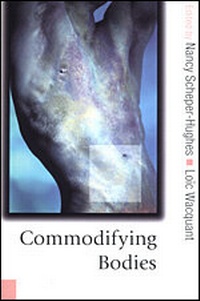
Commodifying Bodies
1st Edition
Published on 10. October 2002
200 pages
978-1-84920-660-0 (ISBN)
Description

Increasingly the body is a possession that does not belong to us. It is bought and sold, bartered and stolen, marketed wholesale or in parts. The professions - especially reproductive medicine, transplant surgery, and bioethics but also journalism and other cultural specialists - have been pliant partners in this accelerating commodification of live and dead human organisms. Under the guise of healing or research, they have contributed to a new 'ethic of parts' for which the divisible body is severed from the self, torn from the social fabric, and thrust into commercial transactions -- as organs, secretions, reproductive capacities, and tissues -- responding to the dictates of an incipiently global marketplace.
Breaking with established approaches which prioritize the body as 'text', the chapters in this book examine not only images of the body-turned-merchandise but actually existing organisms considered at once as material entities, semi-magical tokens, symbolic vectors and founts of lived experience. The topics covered range from the cultural disposal and media treatment of corpses, the biopolitics of cells, sperm banks and eugenics, to the international trafficking of kidneys, the development of 'transplant tourism', to the idioms of corporeal exploitation among prizefighters as a limiting case of fleshly commodity.
This insightful and arresting volume combines perspectives from anthropology, law, medicine, and sociology to offer compelling analyses of the concrete ways in which the body is made into a commodity and how its marketization in turn remakes social relations and cultural meanings.
Breaking with established approaches which prioritize the body as 'text', the chapters in this book examine not only images of the body-turned-merchandise but actually existing organisms considered at once as material entities, semi-magical tokens, symbolic vectors and founts of lived experience. The topics covered range from the cultural disposal and media treatment of corpses, the biopolitics of cells, sperm banks and eugenics, to the international trafficking of kidneys, the development of 'transplant tourism', to the idioms of corporeal exploitation among prizefighters as a limiting case of fleshly commodity.
This insightful and arresting volume combines perspectives from anthropology, law, medicine, and sociology to offer compelling analyses of the concrete ways in which the body is made into a commodity and how its marketization in turn remakes social relations and cultural meanings.
Reviews / Votes
"The book is provocative, compelling and theoretically sophisticated, yet clear. It would be excellent for advanced undergraduate and graduate courses." -- Margot WeissAll prices
More details
Series
Language
English
Place of publication
London
United Kingdom
Target group
Professional and scholarly
ISBN-13
978-1-84920-660-0 (9781849206600)
Copyright in bibliographic data and cover images is held by Nielsen Book Services Limited or by the publishers or by their respective licensors: all rights reserved.
Schweitzer Classification
Other editions
Additional editions
Nancy Scheper-Hughes | Loic Wacquant
Commodifying Bodies
Book
10/2002
1st Edition
SAGE Publications Inc
€227.50
Shipment within 15-20 days
Nancy Scheper-Hughes | Loic Wacquant
Commodifying Bodies
Book
10/2002
1st Edition
SAGE Publications Inc
€86.80
Shipment within 15-20 days
Persons
Nancy Scheper-Hughes is Professor of Medical Anthropology at the University of California, Berkeley where she directs the doctoral program in Critical Studies in Medicine, Science, and the Body. Scheper-Hughes' lifework concerns the violence of everyday life examined from a radical existentialist and politically engaged perspective. Her examination of structural and political violence, of what she calls "small wars and invisible genocides" has allowed her to develop a so-called 'militant' anthropology, which has been broadly applied to medicine, psychiatry, and to the practice of anthropology. She is perhaps best known for her books on schizophrenia among bachelor farmers in County Kerry (Saints, Scholars and Schizophrenics: Mental Illness in Rural Ireland) and on the madness of hunger, maternal thinking, and infant mortality in Brazil (Death without Weeping: the Violence of Everyday Life in Brazil). During the early 1980s she undertook an ethnographic study on the deinstitutionalization of the severely mentally ill in South Boston and on the homeless mentally ill in Berkeley. In 1994-1995 Scheper-Hughes moved to South Africa to take up a temporary post as Chair of Anthropology at the Department of Social Anthropology at the University of Cape Town during the political transition. While there she began an on-going ethnographic study of the role of political and everyday violence in the pre and post-transition periods. She has written a series of essays to be published under the title Undoing: the Politics of the Impossible in the New South Africa.
Her most recent books are: Commodifying Bodies (co-edited with Loic Waquant), 2002, London: Sage (Theory, Culture and Society series). (Commodifying Bodies will appear later this year in an Italian edition with Ombre Courte, Verona, Italia); and Violence in War and Peace: an Anthology (co-edited with Philippe Bourgois), 2003, London and Malden, Mass: Basil Blackwell.
Scheper-Hughes has conducted research, written on, and been politically engaged in topics ranging from AIDS and human rights in Cuba, death squads and the extermination of street kids in Brazil, the Catholic Church, clerical celibacy, and child sex abuse, to the repatriation of the brain of a famous Yahi Indian, Ishi (kept as a specimen in the Smithsonian Institution) to the Pit River people of Northern California. Her most recent research is a multi-sited ethnographic study of the global traffic in humans for their organs which she interprets as a form of invisible and sacrificial violence. Her next book, The Ends of the Body: the Global Traffic in Organs, is to be published by Farrar, Straus & Giroux.
She is co-founder and Director of Organs Watch, a medical human rights project and she is currently an advisor to the World Health Organization (Geneva) on issues related to global transplantation. Scheper-Hughes has lectured internationally and has been a research professor in residence at the Ecole des Hautes Etudes en Sciences in Paris in 1993 (and will take up that post again in the fall of 2004). Read the Berkeley News article, UC Berkeley anthropology professor working on organs trafficking, dated April 30, 2004. Loic Wacquant is Professor of Sociology at the University of California, Berkeley, and Researcher at the Centre europeen de sociologie et de science politique, Paris. He is a MacArthur Foundation Fellow and recipient of the 2008 Lewis Coser Award of the American Sociological Association. His work spans urban inequality, ethnoracial domination, the penal state, embodiment, and social theory and the politics of reason. He is a founder and past editor of the interdisciplinary journal Ethnography and was a regular contributor to Le Monde Diplomatique for a decade. Wacquant's books have been translated in some dozen languages and include Body and Soul: Ethnographic Notebooks of an Apprentice Boxer (2004), Urban Outcasts: A Comparative Sociology of Advanced Marginality (2008), Punishing the Poor: The Neoliberal Government of Social Insecurity (2009), Prisons of Poverty (2009), and Deadly Symbiosis: Race and the Rise of the Penal State (forthcoming).
Her most recent books are: Commodifying Bodies (co-edited with Loic Waquant), 2002, London: Sage (Theory, Culture and Society series). (Commodifying Bodies will appear later this year in an Italian edition with Ombre Courte, Verona, Italia); and Violence in War and Peace: an Anthology (co-edited with Philippe Bourgois), 2003, London and Malden, Mass: Basil Blackwell.
Scheper-Hughes has conducted research, written on, and been politically engaged in topics ranging from AIDS and human rights in Cuba, death squads and the extermination of street kids in Brazil, the Catholic Church, clerical celibacy, and child sex abuse, to the repatriation of the brain of a famous Yahi Indian, Ishi (kept as a specimen in the Smithsonian Institution) to the Pit River people of Northern California. Her most recent research is a multi-sited ethnographic study of the global traffic in humans for their organs which she interprets as a form of invisible and sacrificial violence. Her next book, The Ends of the Body: the Global Traffic in Organs, is to be published by Farrar, Straus & Giroux.
She is co-founder and Director of Organs Watch, a medical human rights project and she is currently an advisor to the World Health Organization (Geneva) on issues related to global transplantation. Scheper-Hughes has lectured internationally and has been a research professor in residence at the Ecole des Hautes Etudes en Sciences in Paris in 1993 (and will take up that post again in the fall of 2004). Read the Berkeley News article, UC Berkeley anthropology professor working on organs trafficking, dated April 30, 2004. Loic Wacquant is Professor of Sociology at the University of California, Berkeley, and Researcher at the Centre europeen de sociologie et de science politique, Paris. He is a MacArthur Foundation Fellow and recipient of the 2008 Lewis Coser Award of the American Sociological Association. His work spans urban inequality, ethnoracial domination, the penal state, embodiment, and social theory and the politics of reason. He is a founder and past editor of the interdisciplinary journal Ethnography and was a regular contributor to Le Monde Diplomatique for a decade. Wacquant's books have been translated in some dozen languages and include Body and Soul: Ethnographic Notebooks of an Apprentice Boxer (2004), Urban Outcasts: A Comparative Sociology of Advanced Marginality (2008), Punishing the Poor: The Neoliberal Government of Social Insecurity (2009), Prisons of Poverty (2009), and Deadly Symbiosis: Race and the Rise of the Penal State (forthcoming).
Content
Bodies for Sale - Whole or in Parts - Nancy Scheper-Hughes
The Other Kidney - Lawrence Cohen
Biopolitics Beyond Recognition
Commodity Fetishism in Organs Trafficking - Nancy Scheper-Hughes
The Alienation of Body Tissues and the Biopolitics of Immortalized Cell Lines - Margaret Lock
The Immigrating Body and the Body Politic - Meira Weiss
The 'The Yeminite Children Affair' and Body Commodification in Israel
The Cremated Catholic - Stanley Brandes
The Ends of a Deceased Guatemalan
Bodies That Don't Matter - Eric Klinenberg
Death and Dereliction in Chicago
Semen as Gift, Semen as Goods - Diane M Tober
Reproductive Workers and The Market in Altruism
Excess Scarcity and Desire among Drug-Using Sex Workers - Maria E Epele
Whores, Slaves and Stallions - Loic Wacquant
Languages of Exlpoitation and Accommodation among Professional Boxers
The Other Kidney - Lawrence Cohen
Biopolitics Beyond Recognition
Commodity Fetishism in Organs Trafficking - Nancy Scheper-Hughes
The Alienation of Body Tissues and the Biopolitics of Immortalized Cell Lines - Margaret Lock
The Immigrating Body and the Body Politic - Meira Weiss
The 'The Yeminite Children Affair' and Body Commodification in Israel
The Cremated Catholic - Stanley Brandes
The Ends of a Deceased Guatemalan
Bodies That Don't Matter - Eric Klinenberg
Death and Dereliction in Chicago
Semen as Gift, Semen as Goods - Diane M Tober
Reproductive Workers and The Market in Altruism
Excess Scarcity and Desire among Drug-Using Sex Workers - Maria E Epele
Whores, Slaves and Stallions - Loic Wacquant
Languages of Exlpoitation and Accommodation among Professional Boxers
