

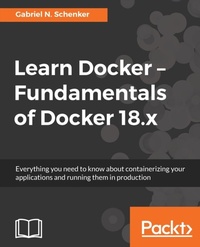
Learn Docker - Fundamentals of Docker 18.x
Everything you need to know about containerizing your applications and running them in production
1st Edition
Published on 3. June 2024
398 pages
978-1-78899-579-5 (ISBN)
Description

Enhance your software deployment workflow using containersKey Features - ?Get up-and-running with basic to advanced concepts of Docker
- ?Get acquainted with concepts such as Docker containers, Docker images, orchestrators and so on.
- ?Practical test-based approach to learning a prominent containerization tool
Book DescriptionDocker containers have revolutionized the software supply chain in small and big enterprises. Never before has a new technology so rapidly penetrated the top 500 enterprises worldwide. Companies that embrace containers and containerize their traditional mission-critical applications have reported savings of at least 50% in total maintenance cost and a reduction of 90% (or more) of the time required to deploy new versions of those applications. Furthermore they are benefitting from increased security just by using containers as opposed to running applications outside containers. This book starts from scratch, introducing you to Docker fundamentals and setting up an environment to work with it. Then we delve into concepts such as Docker containers, Docker images, Docker Compose, and so on. We will also cover the concepts of deployment, orchestration, networking, and security. Furthermore, we explain Docker functionalities on public clouds such as AWS. By the end of this book, you will have hands-on experience working with Docker containers and orchestrators such as SwarmKit and Kubernetes. What you will learn - ?Containerize your traditional or microservice-based application
- ?Share or ship your application as an immutable container image
- ?Build a Docker swarm and a Kubernetes cluster in the cloud
- ?Run a highly distributed application using Docker Swarm or Kubernetes
- ?Update or rollback a distributed application with zero downtime
- ?Secure your applications via encapsulation, networks, and secrets
- ?Know your options when deploying your containerized app into the cloud
Who this book is forThis book is targeted at system administrators, operations engineers, DevOps engineers, and developers or stakeholders who are interested in getting started with Docker from scratch. No prior experience with Docker Containers is required.
- ?Get acquainted with concepts such as Docker containers, Docker images, orchestrators and so on.
- ?Practical test-based approach to learning a prominent containerization tool
Book DescriptionDocker containers have revolutionized the software supply chain in small and big enterprises. Never before has a new technology so rapidly penetrated the top 500 enterprises worldwide. Companies that embrace containers and containerize their traditional mission-critical applications have reported savings of at least 50% in total maintenance cost and a reduction of 90% (or more) of the time required to deploy new versions of those applications. Furthermore they are benefitting from increased security just by using containers as opposed to running applications outside containers. This book starts from scratch, introducing you to Docker fundamentals and setting up an environment to work with it. Then we delve into concepts such as Docker containers, Docker images, Docker Compose, and so on. We will also cover the concepts of deployment, orchestration, networking, and security. Furthermore, we explain Docker functionalities on public clouds such as AWS. By the end of this book, you will have hands-on experience working with Docker containers and orchestrators such as SwarmKit and Kubernetes. What you will learn - ?Containerize your traditional or microservice-based application
- ?Share or ship your application as an immutable container image
- ?Build a Docker swarm and a Kubernetes cluster in the cloud
- ?Run a highly distributed application using Docker Swarm or Kubernetes
- ?Update or rollback a distributed application with zero downtime
- ?Secure your applications via encapsulation, networks, and secrets
- ?Know your options when deploying your containerized app into the cloud
Who this book is forThis book is targeted at system administrators, operations engineers, DevOps engineers, and developers or stakeholders who are interested in getting started with Docker from scratch. No prior experience with Docker Containers is required.
More details
Other editions
Additional editions
Gabriel N. Schenker
Learn Docker - Fundamentals of Docker 18.x
Everything you need to know about containerizing your applications and running them in production
Book
04/2018
Packt Publishing
€51.80
Shipment within 3-4 weeks
Person
Schenker Dr. Gabriel N. :
Dr. Gabriel N. Schenker has more than 25 years of experience as an independent consultant, architect, leader, trainer, mentor, and developer. Currently, Gabriel works as Lead Solution Architect at Techgroup Switzerland. Prior to that, Gabriel worked as Lead Curriculum Developer at Docker and at Confluent. Gabriel has a Ph.D. in Physics, and he is a Docker Captain, a Certified Docker Associate, a Certified Kafka Developer and Operator, and an ASP Insider. When not working, Gabriel enjoys time with his wonderful wife Veronicah and his children.
Dr. Gabriel N. Schenker has more than 25 years of experience as an independent consultant, architect, leader, trainer, mentor, and developer. Currently, Gabriel works as Lead Solution Architect at Techgroup Switzerland. Prior to that, Gabriel worked as Lead Curriculum Developer at Docker and at Confluent. Gabriel has a Ph.D. in Physics, and he is a Docker Captain, a Certified Docker Associate, a Certified Kafka Developer and Operator, and an ASP Insider. When not working, Gabriel enjoys time with his wonderful wife Veronicah and his children.
Content
Table of Contents - What Are Containers and Why Should I Use Them?
- Setting up a Working Environment
- Working with Containers
- Creating and Managing Container Images
- Data Volumes and System Management
- Distributed Application Architecture
- Single-Host Networking
- Docker Compose
- Orchestrators
- Introduction to Docker Swarm
- Zero Downtime Deployments and Secrets
- Introduction to Kubernetes
- Deploying, Updating and Securing an Application with Kubernetes
- Running a Containerized App in the Cloud
- Setting up a Working Environment
- Working with Containers
- Creating and Managing Container Images
- Data Volumes and System Management
- Distributed Application Architecture
- Single-Host Networking
- Docker Compose
- Orchestrators
- Introduction to Docker Swarm
- Zero Downtime Deployments and Secrets
- Introduction to Kubernetes
- Deploying, Updating and Securing an Application with Kubernetes
- Running a Containerized App in the Cloud
