

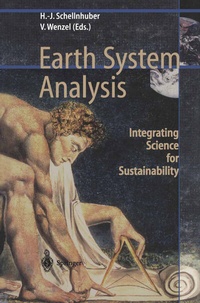
Earth System Analysis
Integrating Science for Sustainability
Published on 6. December 2012
XXIX, 530 pages
978-3-642-52354-0 (ISBN)
Description

As humanity approaches the 3rd millennium, the sustainability of our present way of life becomes more and more questionable. New paradigms for the long-term coevolution of nature and civilization are urgently needed in order to avoid intolerable and irreversible modifications of our planetary environment. Earth System Analysis is a new scientific enterprise that tries to perceive the earth as a whole, a unique system which is to be analyzed with methods ranging from nonlinear dynamics to macroeconomic modelling. This book, resulting from an international symposium organized by the Potsdam Institute, has 2 aims: first, to integrate contributions from leading researchers and scholars from around the world to provide a multifaceted perspective of what Earth System Analysis is all about, and second, to outline the scope of the scientific challenge and elaborate the general formalism for a well-defined transdisciplinary discourse on this most fascinating issue.
More details
Other editions
Additional editions
Hans-Joachim Schellnhuber | Volker Wenzel
Earth System Analysis
Integrating Science for Sustainability
Book
07/2012
Springer
€53.49
Shipment within 7-9 days
Hans-Joachim Schellnhuber | Volker Wenzel
Earth System Analysis
Integrating Science for Sustainability
Book
09/1998
Springer
€85.59
Article exhausted; check different version
Content
1. Earth System Analysis - The Concept.- Discourse: Earth System Analysis - The Scope of the Challenge.- Commentary: Earth System Analysis - Explorations in a Research Frontier.- Commentary: Surprises in the Climate Change Course.- Commentary: Sustainable Development - Teleology and Ambiguity.- 2. Natural Dimensions.- 1: Ecology and the Earth System.- Commentary on "Ecology and the Earth System".- Commentary: Eco-System Modelling and the Social Sciences.- 2: Climate Change and Land Use: Global and Regional Analyses.- Commentary: On the Inconsistency at the Interface of Climate Impact Studies and Global Climate Simulations.- 3: Sustainable Development in Agricultural Landscapes.- Commentary on "Sustainable Development in Agricultural Landscapes".- Commentary: Towards a Socially Accepted, Sustainable Management of Agricultural Landscapes.- 3. Human Dimensions.- 1: Modelling Global Environmental Change: Improving Human Dimensions Components.- 2: Internationally Tradeable Emission Certificates - Efficiency and Equity in Linking Environmental Protection with Economic Development.- Commentary: Criteria for an Equitable Distribution of Internationally Tradeable Emission Certificates.- 3: New Models of Wealth.- Commentary on "New Models of Wealth".- Commentary on "New Models of Wealth".- 4: Urban Metabolism and Disaster Vulnerability in an Era.- 4. Integration for Sustainability.- 1: Multi-actor Optimization of Greenhouse Gas Emission Paths Using Coupled Integral Climate Response and Economic Models.- Commentary: Short Remarks on the Problem of Integrated Modelling.- Commentary: Global Environment and Society (GES) Models, a Problem of Multiple Control Theory.- 2: Global Change and Sustainable Development: Towards an Integrated Conceptual Model.-Commentary on "Global Change and Sustainable Development".- Commentary on "Global Change and Sustainable Development".- 3: From a Fictional Globe to Poetic Ecosystems: Modelling Human Interactions with the Environment.- Commentary on "Modelling Human Interactions with the Environment".- Commentary on "Modelling Human Interactions with the Environment".- 4: Is Global Modelling Feasible?.- Commentary on "Is Global Modelling Feasible?".- Commentary on "Is Global Modelling Feasible?".- Register of Persons.
