

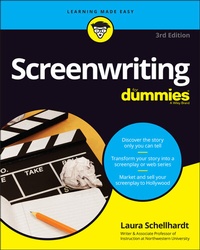
Screenwriting For Dummies
Description

Behind every blockbuster film and binge-worthy show, there's a screenwriter--and that writer could be you! Turn your brainstorming sessions into dynamic scripts with the help of Screenwriting For Dummies. Create believable worlds with relatable characters, gripping dialogue, and narrative structures that will keep even the showbiz bigwigs on the edge of their seats. Once you've polished your product, it's time to bring it to market. This book is full of advice that will help you get eyes on your screenplays so you can sell your work and find success as a screenwriter. From web series to movie musicals to feature films, this book shows you how to develop and hone your craft.
* Learn to think like a screenwriter and turn story ideas into visually driven, relatable scripts that will get noticed
* Study the elements of a story, like plot structure (beginning, middle, and end) and characterization (wait, who's that, again?)
* Hop over the hurdle of writer's block, and tackle other obstacles that stand in the way of your scriptwriting career
* Get insider insight into finding an agent and meeting with studio execs, plus alternative markets for your finished work
This updated edition covers the latest trends and opportunities--and there are lots of them--for today's writers. Let Dummies help you map out your story and put your script on the road to production. Thank us when your work goes viral!
More details
Other editions
Additional editions
Person
Content
Chapter 1
Introducing the Art of Screenwriting
IN THIS CHAPTER
Thinking visually and developing a writer's mind
Approaching screenwriting as a craft
Finding inspiring stories
Putting your ideas on paper
Revising your work
Adapting ideas from other sources
Selling your script
Screenwriting is a craft, and like any craft worth pursuing, you can never know too much about it. You wouldn't tell a doctor to stop scrutinizing advances in medicine, would you? Can a teacher ever learn enough about education? This chapter provides a glimpse of screenwriting and tells you where in the book you can go to find more information on each topic mentioned. Consider this chapter your preview of coming attractions.
In The Mind's Eye
Quick - in what children's book does a character require green glasses to enter a city? If you answered The Wizard of Oz, you're right. Dorothy needs green glasses to enter the Emerald City. And while they cut this detail in the film version, the example is nevertheless relevant to screenwriting. It's a question of vision - what do you need in order to see where you're going?
Screenwriting requires a unique vision, eyes trained to scan the world with particular acuity. It seems silly to say that screenwriters look at the world with a visual eye. Of course, they do. Doesn't everybody? After all, looking is a visual act.
And yet, there's a distinct difference between what screenwriters see and what people in other occupations see. Screenwriters break the world down into visual clips or scenes - in other words, into moving pictures. Also, screenwriters visualize these scenes while doing more than observing the world around them. Consider for a second that it's also possible to see moving pictures while
- Reading a novel, a play, or a poem
- Reading the newspaper
- Listening to music
- Listening to someone else's story
Screenwriters look for moving pictures in everything, though some sources yield more than others. Want to know how your vision stacks up? Find a public place, sit down with a pad and pen, and write down what you notice. Then flip to Chapter 2 and find out how visual your eye really is.
Developing the Writer's Mind
Imagine a storage facility, with aisles of file cabinets, some overflowing and some empty but for one scrap of paper. Or imagine a playground full of children, yes, but also with people you wouldn't expect to see. Maybe two construction workers are playing basketball, or a few CEOs are eating donuts on a bench; people of all ages and from all walks of life are occupying the same space. Or imagine a long hallway full of doors. Occasionally, people emerge, have an exchange of some sort, and return behind those doors. Now imagine a blank canvas. Paints and brushes sit nearby, but they remain as of yet unused. Any one of these spaces may resemble the mind of a writer.
Writers collect and store tons of details. They amass images, scraps of conversation, intriguing characters, sounds, expressions, slang, and more. They also design what they discover. Add some boots, some dust, and a gun - voilà. You're in a western. Dim the lights, strip away the color, and give everyone a cigar - presto! You have the black-and-white, suspense-filled world of a film noir. Introduce a robot and a time machine, and suddenly, the world becomes science fiction. This is how writers spend much of their time - not exactly a dull profession. So I suppose that the question here is, "What does your mind look like?" If you want to find out, turn to Chapter 3.
Approaching Screenwriting as a Craft
Writers take their vocation seriously. They'll do almost anything to inspire that muse, and I do mean anything. Rumor has it that
- Alexander Dumas color coordinated his paper with the type of fiction that he was writing. Blue paper was for novels, yellow paper was for poetry, and rose-colored pages were reserved for nonfiction.
- Mark Twain and Truman Capote had to write lying down.
- Ernest Hemingway sharpened dozens of pencils before he wrote.
- Willa Cather read the Bible before writing each day.
- Poet John Donne liked to lie in an open coffin before picking up a pen. Now there's a story for you.
I'm not implying that to take up writing you have to become an eccentric, but that may happen of its own accord. Writing is both fun and frustrating; it requires flights of whimsy as well as hard work. It's equal parts imagination and preparation. Striking a balance between the two worlds is a constant challenge. Catching the muse is one thing, but keeping it with you is another - that's where the tools of the trade come in handy. If you want a glimpse of some of those tools, turn to Chapter 4 where I discuss the craft of screenwriting. You find advice on how to flex your imagination, channel it onto the page, and maintain the writing schedule necessary to do both.
Finding Your Screenplay's Story
So how do writers find material? It depends on the writer, of course, but in their ongoing quest for stories, writers resemble any or all of the following:
- Archaeologists
- Detectives
- Gardeners (plant a seed, and it will grow)
- Reporters
- Research analysts
- Scavengers
- Secret agents
- Voyeurs
Great stories abound; you just have to know how to catch them, or hunt them down, as the case may be. You should also know what details attract you to a story. Are you a people person? Do locations draw you in? Are you compelled by certain kinds of events? You want to consider these questions before your story search begins. Chapter 5 helps you pinpoint your interests and unpack your idea in the quest for the story only you can write.
Working through the Writing Process
Once you find an idea, you have to develop that idea. The development process isn't unlike chaperoning several restless children across the country in a small car. You're likely to hear the following questions over and over:
- How does the whole thing start?
- What happens next?
- Who are these people?
- What happens next?
- What's the problem?
- Does that make sense?
- What happens next?
- Can we go any faster?
- Are we there yet?
- Why, why, why, why, why?
The journey can drive you nuts without a good road map, and in screenwriting terms, that map is known as plot. I consider plot to be so important that I dedicate three chapters to it - Chapters 6, 7, and 8. After all, every story has a beginning, middle, and an ending (though they're not always shown in that order), and the same questions apply to each part. There's another set of questions for character building in Chapter 9 and yet another chapter (you guessed it - Chapter 10) dedicated to orchestrating language for those characters once you know who they are. As you may suspect, without a navigation panel, you're in for a long, bumpy ride. So if you want to pacify that back-seat yammering, turn to Part 2 and start reading. Otherwise, you're liable to pull the car over and walk home.
Formatting Your Screenplay
Here are a few things that I've figured out about the screenwriting trade:
- Always look before you leap.
- People do judge a book by its cover.
- Actions speak louder than words.
- Brevity is the soul of wit (and most films, I might add).
- Show, don't tell.
- You never get another chance to make a first impression.
You don't have much control over most aspects of the screenwriting profession. Ideas often arrive unbidden, characters sometimes dictate what they want to say, the ending of your story may change several times, and you may wind up in a different genre. And when you're talking about Hollywood, forget it. The business is always in flux. One day, they're looking for war films, and the next day, they want candy and roses. Often, industry executives don't know what they want until someone bucks all the trends and writes something fresh.
One of the only things a writer has complete control over is the script's appearance, and in this industry, appearance is everything (at least at the beginning). So how wide should your margins be? How do you introduce a scene? Where do you insert special effects? And how long is too long? Getting readers to flip past the cover is half the battle, and correct formatting may ensure that they do so. For more on formatting your script, flip to Chapter 15, and if it's formatting templates you're after, we have an appendix for that.
Constructing Your First Draft
By the time you sit down to write your first draft, you'll be armed and dangerous. Among other things, your arsenal will include the following:
- Strong characters with goals and dreams
- Equally strong conflicts
- Pivotal locations
- A sequence of action-packed events
- Remedies for writer's block
- A solid writing routine
So now that...
