

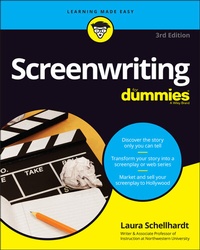
Screenwriting For Dummies
3rd Edition
Published on 5. November 2021
448 pages
978-1-119-83576-9 (ISBN)
Description

Suspend your disbelief--you can make it as a screenwriter
Behind every blockbuster film and binge-worthy show, there's a screenwriter--and that writer could be you! Turn your brainstorming sessions into dynamic scripts with the help of Screenwriting For Dummies. Create believable worlds with relatable characters, gripping dialogue, and narrative structures that will keep even the showbiz bigwigs on the edge of their seats. Once you've polished your product, it's time to bring it to market. This book is full of advice that will help you get eyes on your screenplays so you can sell your work and find success as a screenwriter. From web series to movie musicals to feature films, this book shows you how to develop and hone your craft.
* Learn to think like a screenwriter and turn story ideas into visually driven, relatable scripts that will get noticed
* Study the elements of a story, like plot structure (beginning, middle, and end) and characterization (wait, who's that, again?)
* Hop over the hurdle of writer's block, and tackle other obstacles that stand in the way of your scriptwriting career
* Get insider insight into finding an agent and meeting with studio execs, plus alternative markets for your finished work
This updated edition covers the latest trends and opportunities--and there are lots of them--for today's writers. Let Dummies help you map out your story and put your script on the road to production. Thank us when your work goes viral!
Behind every blockbuster film and binge-worthy show, there's a screenwriter--and that writer could be you! Turn your brainstorming sessions into dynamic scripts with the help of Screenwriting For Dummies. Create believable worlds with relatable characters, gripping dialogue, and narrative structures that will keep even the showbiz bigwigs on the edge of their seats. Once you've polished your product, it's time to bring it to market. This book is full of advice that will help you get eyes on your screenplays so you can sell your work and find success as a screenwriter. From web series to movie musicals to feature films, this book shows you how to develop and hone your craft.
* Learn to think like a screenwriter and turn story ideas into visually driven, relatable scripts that will get noticed
* Study the elements of a story, like plot structure (beginning, middle, and end) and characterization (wait, who's that, again?)
* Hop over the hurdle of writer's block, and tackle other obstacles that stand in the way of your scriptwriting career
* Get insider insight into finding an agent and meeting with studio execs, plus alternative markets for your finished work
This updated edition covers the latest trends and opportunities--and there are lots of them--for today's writers. Let Dummies help you map out your story and put your script on the road to production. Thank us when your work goes viral!
More details
Other editions
Additional editions
Content
- Intro
- Title Page
- Copyright Page
- Table of Contents
- Foreword
- Introduction
- About This Book
- Foolish Assumptions
- Icons Used in This Book
- Beyond the Book
- Where to Go from Here
- Part 1 So You Want to Write for Pictures
- Chapter 1 Introducing the Art of Screenwriting
- In The Mind's Eye
- Developing the Writer's Mind
- Approaching Screenwriting as a Craft
- Finding Your Screenplay's Story
- Working through the Writing Process
- Formatting Your Screenplay
- Constructing Your First Draft
- Rewriting Your Script
- Adapting Your Screenplay from an Outside Source
- Selling Your Screenplay to Show Business
- Chapter 2 Preparing to Think Visually
- Is It Cinema? Considering Other Mediums
- Is it a screenplay or a novel?
- Is it film or theater?
- Is it a movie, visual art, or poetry?
- It's probably a screenplay if . . .
- What You See Is What You Get: The Visual Life of a Screenplay
- Crafting images from the outside in
- Crafting images from the inside out
- Chapter 3 Diving Into the Screenwriter's Mind
- Finding Your Feet: How to Learn From Other Writers
- Reading for dramatic intent
- Recognizing a screenplay's genre
- Art and Life: What's the Difference?
- Developing an Artistic Sensibility
- What a writer sees
- What a writer hears
- What a writer remembers and what a writer forgets
- Recognizing a Story When You See One
- Identifying the call to write
- The four important P's of story
- Finding an opening image
- Chapter 4 Approaching Screenwriting as a Craft
- Invoking the Muse: Examining the Creative Process
- Imagination: Your Creative Arsenal
- Flexing the imagination
- Putting the imagination to work
- Identifying your writing voice
- Craft: A Vehicle for Your Imagination
- Form
- Technique
- Discipline
- Part 2 Breaking Down the Elements of a Story
- Chapter 5 Unpacking Your Idea
- I Have This Great Idea. Now What?
- Identifying your interest in the idea
- Documenting your interest in the idea
- Getting to Know Your Audience
- Matching the story to the audience
- Connecting with your audience
- Knowing What Happened Before Your Story Began: Creating the Backstory
- Identifying the elements of a backstory
- Developing a screenplay through backstory
- Identifying the Tone of Your Piece
- Establishing Your Story's Time Clock
- Deciding When to Start Your Story
- Getting to Know Aristotle: A Dramatist's Best Friend
- What's It All About?: Writing an Effective Synopsis
- Chapter 6 Plot Part I: Beginnings
- Crafting an Eye-Opening Opener
- What to show first: person, place, or thing?
- Conflict: What's wrong with this picture?
- Possible ways to begin your story
- Three Compelling (and Contrasting) Movie Beginnings
- Jaws
- Lady Bird
- Moonlight
- Chapter 7 Plot Part II: Middles
- Muddling through the Middle
- From Lights to Camera to . . . ACTION!
- Action versus activity
- Revisiting the story's time clock
- Status: Where's the Upper Hand?
- What's Your Problem? Introducing Conflicts and Obstacles
- Exposition: From Clunky to Creative
- Sharing info the characters know
- Sharing info the characters may not know
- Determining What to Write from What You've Written
- Three Compelling (and Contrasting) Movie Middles
- Jaws
- Lady Bird
- Moonlight
- Chapter 8 Plot Part III: Endings
- Are We There Yet? How to Know When You're Done
- Tracking the change: What's different now?
- Crafting your story's conclusion
- Danger Will Robinson: Threats to an Otherwise Healthy Plot
- Would that really happen? The probable versus the possible
- Scenes where nothing happens: Two final threats to watch for
- Ultimate Success: Tracking Three Movies through Their Triumphant Conclusions
- Jaws
- Lady Bird
- Moonlight
- Chapter 9 Character Building
- Portrait of a Person: Constructing a Physical World
- Your character's physical being
- Your character's physical environment
- The Good, the Bad, and the Ugly: Constructing an Internal World
- Dreams, desires, and passions
- Your character's engine: Needs versus wants
- Talents and expertise
- Internal obstacles
- Your character's argument
- From the Inside Out: Making the Inner World Visible
- Balancing character dialogue with character action
- Crafting concrete character goals
- Providing character opportunities
- Establishing routines that change
- Forcing your characters to choose
- Using a mentor
- Using a narrator
- Crafting secondary characters
- Chapter 10 Delivering Dynamic Dialogue
- Diction: What's in a Word?
- Isn't versus ain't: Diction's determining factors
- The highs and the lows of language
- Name That Tune: Crafting Your Character's Music
- Sound 101: Using poetry as a guide
- Fascinating rhythm: Crafting your script's pulse
- Letting the Listener Lead
- Putting It Together: Characters in Conversation
- Setting the scene
- Dialogue do's and don'ts
- Chapter 11 The Nontraditional Film
- Breaking with Tradition: Other Ways to Get the Job Done
- Tinkering with Time
- Song and Dance: The Movie Musical
- How much music is too much music?
- Original musicals
- Musical adaptations
- One Click Away: Writing a Web Series
- Show me the money!
- Tackling the pre-production work for a web series
- Getting involved in web series production
- Successfully steering the web series post-production process
- Scripting the Short (Film)
- Finding the Festival for You
- Chapter 12 Maintaining an Audience's Trust
- Screenwriting and Ethics
- Screenwriting and Responsibility
- What are you willing to put your name on?
- The immunity factor
- Is this story for you? Appropriation and authenticity
- A Gift for Gab: How to Conduct a Meaningful Interview
- Preparing for an interview
- Setting up an interview
- Conducting an interview
- Part 3 Turning Your Story into a Script
- Chapter 13 Mapping Out Your Screenplay
- Conceptualizing Your Concept
- How to Treat Your Treatment
- Before you begin
- Putting it on the page
- Exploring the Ins and Outs of an Outline
- One beat at a time
- Filling in the gaps
- Crafting the conclusion
- What to Do When the Outline's Through
- Chapter 14 Surviving Writer's Block
- Moving from Panic to Peace
- The top reasons for writer's block
- A survival guide
- Reevaluating Your Routine
- Seeking Outside Help
- Chapter 15 Formatting Your Screenplay
- How the Screenplay Looks on the Page
- Formatting a title page
- Setting up the seven components of a page
- Setting your typeface and margins
- Spacing your script correctly
- Making your computer work for you
- Creating a PDF
- Making Your Format Flow
- Cinematic description
- Slug lines
- Character introductions
- Location, choreography, and action
- Sound and special effects
- Transitional directions
- Camera concerns
- Sample Scenes
- Chapter 16 Putting It Together: Structuring Your First Draft
- Traversing the Three-Act Structure
- Act I: Introductions
- Your opening moments
- The first fifteen pages
- The inciting incident
- Plot point one
- Act II: Salting the Wound
- Know where the action is
- The about-face
- The midpoint
- Plot point two
- Act III: The Final Frontier
- The climax
- The resolution
- A Note on Subplots
- Variations on the Routine
- The five-act structure
- The eight-sequence structure
- Chapter 17 Take Two: Rewriting Your Script
- Downshifting between Drafts
- How to work when you're not working
- Your first time back: Read-through #1
- A second glance: Read-through #2
- Back in the Saddle Again: Rewrites
- Recruiting a Reader
- Capitalizing on Your Critique
- Chapter 18 Adaptation and Collaboration: Two Alternate Ways to Work
- Procuring Primary Material
- Knowing when you need a copyright
- Comprehending copyrights
- Procuring permission
- Assessing how much to adapt
- Navigating between Forms
- From fiction to film
- From stage to screen
- From meter to movies
- Mastering the Process of Adaptation
- How to approach an original work
- What to do when you're stuck
- Studying the Art of Collaboration
- What to look for in a writing partner
- How to approach collaboration
- Learning collaboration from the pros
- Part 4 Selling Your Script to Show Business
- Chapter 19 Before You Send It: Pre-Marketing Considerations
- Understanding the "Biz" in Showbiz
- Getting to know the players: The Hollywood hierarchy
- Getting to know the buyers: The studio hierarchy
- Getting a "grip": Hollywood jargon
- Preparing Yourself for the Biz
- Putting on a happy face: The art of attitude
- Organizing your records
- Reaching out to the right resources
- Setting personal goals
- Polishing the Copy You Send
- Checking last-minute details
- Finessing your front page
- Protecting Your Work
- Registering with the Writers Guild of America
- Pursuing the "poor-man's copyright"
- Chapter 20 Getting Your Screenplay Noticed
- Designing Your Own Package
- Highlighting the universal
- Gaining the competitive edge
- Considering the reader
- Preparing to Pitch
- Perfecting the teaser pitch
- Selling the story pitch
- Finding a Manager or Agent
- Approaching an Agent or Manager
- Sending a query
- Pitching Your Script without an Agent
- What to Do When They Say Yes
- Meeting with an agent
- Meeting with executives
- Looking Ahead: Upon Achieving Success
- A Final Note
- Part 5 The Part of Tens
- Chapter 21 Ten Screenwriters You Should Know
- Sofia Coppola
- Nora Ephron
- William Goldman
- Charlie Kaufman
- Spike Lee
- John Logan
- Jordan Peele
- Issa Rae
- Taika Waititi
- Phoebe Waller-Bridge
- Chapter 22 Ten Screenwriting Myths
- I Have to Live in Los Angeles to Write Screenplays
- I Have to Go to Grad School to Learn How to Write
- If I Can Write for Film, I Can Write for TV
- I Haven't Written Before and It's Too Late to Start
- Writing Is a Lonely Profession
- Hollywood Has No Ethics
- It'll Ruin the Integrity of My Script
- It's Not What I Know
- It's Who I Know That Matters
- I Have Too Many Obligations to Be a Writer
- I'm Only as Successful as the Last Screenplay I Sold
- I'm Not Talented Enough to Be a Writer
- Appendix Sample Scenes and Online Resources
- Formatting: A Crash Course
- Traditional Format: Examples
- Voice-Over Examples
- Series of Shots Examples
- Split Screen Example
- Point of View Example
- Intercut Example
- Movie Musical Examples
- Additional Online Resources
- Index
- EULA
