

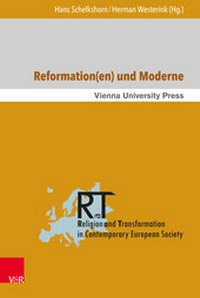
Reformation(en) und Moderne
Description

Luther ist nur eine Stimme unter den spätmittelalterlichen Reformbewegungen. Die historische Forschung stellt die Lutherische Reformation inzwischen in den breiten Strom christlicher Reformbewegungen seit dem 13. Jahrhundert. Vor diesem Hintergrund muss auch das aufklärerische Bild von Luther als einem Protagonisten der Neuzeit revidiert werden. Die Vielfalt spätmittelalterlicher Reformbewegungen bis hin zum Trienter Konzil bildet zusammen mit dem Renaissancehumanismus ein reiches Reservoir an geistigen Aufbrüchen, von denen zahlreiche Beziehungen zur Moderne ausgehen. Mit diesem komplexen Geflecht zwischen christlichen Reformation(en) und Moderne beschäftigen sich die ausgewählten Studien in diesem Band sowohl aus theologischer als auch philosophischer Perspektive.
The contemporary historical research situates Luther's Reformation in a much larger context of Christian reform movements that emerge in the late medieval and early modern period. Against this background the enlightened view of Luther as protagonist of the modern era is in need of revision. The variety of reform movements together with the Renaissance humanism compose a rich reservoir of spiritual reforms that will all influence the further development of the modern era. In this volume, this complex of the variety of Christian reforms relative to modernity is elaborated through exemplary studies from a philosophical-theological perspective.
More details
Other editions
Additional editions
Persons
Content
- Intro
- Title Page
- Copyright
- Table of Contents
- Body
- Hans Schelkshorn / Herman Westerink: Einleitung
- Hans Schelkshorn: Anbruch einer Zweiten Achsenzeit. Renaissance-Humanismus und "christliche Reform" im Diskurs über die Moderne
- 1. Drei Paradigmen des "Diskurses über die Moderne"
- 2. Renaissance und Reformation im aufklärerischen Diskurs über die Moderne
- 2.1. Luther als Protagonist der Aufklärung?
- 2.2. Renaissance und Reformation im Kontext des Historismus
- 3. Renaissance und Reformation in machttheoretischen Modernediskursen
- 4. Renaissance und Reformation im kulturalistischen Diskurs über die Moderne
- 5. Renaissance und Reformation als Anbruch einer "Zweiten Achsenzeit"
- a) Christliche Reformbewegungen und die Falle der Disziplinierung
- b) Aufbruch in ein globales Zeitalter: Martin Luther, Antonio de Montesinos und Bartolomé de las Casas
- c) Der Streit über die philosophische Reinterpretation des Christentums: Erasmus und Luther
- d) Die offene Frage nach einer alternativen sozialen Ordnung
- Literatur
- Christian Danz: Die Realisierung des religiösen Heils in der Geschichte. Anmerkungen zur Transformation des Gottesgeistes zwischen Reformation und Aufklärung
- 1. Aneignung des Heils: Martin Luthers Neudeutung des Gottesgeistes
- 2. Das ewige Evangelium: Lessings Umdeutung der Geistlehre
- 3. Heiliger und absoluter Geist: Hegels Reformulierung des Gottesgeistes
- Literatur
- Gerrit Steunebrink: Hegel's Cultural-Protestantism as a Remedy against Schizophrenia and Hypocrisy
- 1. Criticism of modern culture and Rousseau
- 2. Romanticism and hypocrisy
- 3. The return of Protestant Christianity
- 4. Christianity and the acceptance of secular reality in art
- 5. The life of the individual as the subject of Christian art
- 6. The modern individual and its development (Bildung)
- 7. Culture Protestantism: Secular culture as Christian culture
- Literature
- Herman Westerink: Modernity as the Variety of Hermeneutics of the Self: Faith and Despair in the Tragic History of Francesco Spira
- 1. The Case of Francesco Spira
- 2. Theoretical considerations, perspectives and problems
- 3. In-depth Christianization and the modern hermeneutics of the self
- Literature
- Ronald K. Rittgers: Suffering and Consolation in the Age of Reform: Reflections on the Origins of Modernity
- 1. Late medieval Christianity as a religion of consolation
- 2. The reformation of suffering
- 3. Preparing the ground for modern inwardness
- Literature
- Inigo Bocken: The Idea of Reform in the Spiritual Exercises of Ignatius of Loyola
- 1. The Exercises of Ignatius of Loyola
- 2. Theory and practice of reform in Christian spirituality
- 3. Form and reform of the Exercises
- 4. Reform and the tradition of the Devotio Moderna
- 5. Performance of consolatio and desolatio
- 6. Ignatius' meditations and Descartes' exercises
- 7. Conclusion
- Literature
- Juan Antonio Senent de Frutos: Ignatian Modernity as another Kind of Modernity
- 1. Significance of this research and hypothesis
- 2. What modernity? Hegemonic modernity and other kinds of modernities
- 3. Ignatian modernity. A short systematic outline
- 4. Another modernity of 'Principle and Foundation' in the Spiritual Exercises (No. 23)
- a) The subject and God
- b) The subject and things
- c) The subject, things, and God
- d) The method
- 5. Imperium mundi or domus est mundus? Geopolitics, dialogue, and coexistence
- 6. Conclusions
- Literature
- Autoren
