

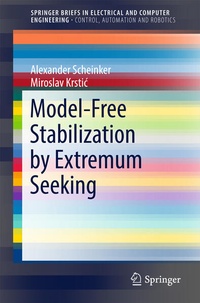
Model-Free Stabilization by Extremum Seeking
Description

With this brief, the authors present algorithms for model-free stabilization of unstable dynamic systems. An extremum-seeking algorithm assigns the role of a cost function to the dynamic system's control Lyapunov function (clf) aiming at its minimization. The minimization of the clf drives the clf to zero and achieves asymptotic stabilization. This approach does not rely on, or require knowledge of, the system model. Instead, it employs periodic perturbation signals, along with the clf. The same effect is achieved as by using clf-based feedback laws that profit from modeling knowledge, but in a time-average sense. Rather than use integrals of the systems vector field, we employ Lie-bracket-based (i.e., derivative-based) averaging.
The brief contains numerous examples and applications, including examples with unknown control directions and experiments with charged particle accelerators. It is intended for theoretical control engineers and mathematicians, and practitioners working in various industrial areas and in robotics.
Reviews / Votes
"This monograph presents a novel extension and applications of extremum seeking, as a technique for the stabilization of unknown control systems, including trajectory tracking and on-line optimization. . The monograph will be useful to researchers and graduate students interested in extremum-seeking control and model-free and adaptive stabilization methods." (Nicolas Hudon, Mathematical Reviews, November, 2018)"The results of the book are based on the main theoretical results represented by the weak-limit averaging theorem that can be considered as an interesting alternative to other stabilization methods. The book is worth being consulted by mathematics and control theory students and researchers." (Liviu Goras, zbMATH 1380.37004, 2018)
More details
Other editions
Additional editions
Persons
Alexander Scheinker is with the radio frequency control group at Los Alamos National Laboratory. His research is in dynamical systems and control theory with applications to uncertain, nonlinear, and time-varying systems with a focus on utilizing extremum seeking as feedback control for unknown, open-loop unstable systems. He has been working at the Los Alamos Neutron Science Center linear particle accelerator, developing new algorithms and implementing various control algorithms in hardware.
Miroslav Krsti c holds the Alspach endowed chair and is the founding director of the Cymer Center for Control Systems and Dynamics at UC San Diego. He also serves as Associate Vice Chancellor for Research at UCSD. Krstic is Fellow of IEEE, IFAC, ASME, SIAM, and IET (UK), Associate Fellow of AIAA, and foreign member of the Academy of Engineering of Serbia. He has received the PECASE, NSF Career, and ONR Young Investigator awards, the Axelby and Schuck paperprizes, the Chestnut textbook prize, the ASME Nyquist Lecture Prize, and the first UCSD Research Award given to an engineer. Krstic has also been awarded the Springer Visiting Professorship at UC Berkeley, the Distinguished Visiting Fellowship of the Royal Academy of Engineering, the Invitation Fellowship of the Japan Society for the Promotion of Science, and the Honorary Professorships from the Northeastern University (Shenyang), Chongqing University, Donghua University, and Dalian Maritime University, China. Krstic has coauthored eleven books on adaptive, nonlinear, and stochastic control, extremum seeking, control of PDE systems including turbulent flows, and control of delay systems.