

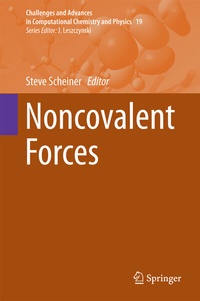
Noncovalent Forces
1st Edition
Published on 16. April 2015
VIII, 532 pages
978-3-319-14163-3 (ISBN)
Description

Computational methods, and in particular quantum chemistry, have taken the lead in our growing understanding of noncovalent forces, as well as in their categorization. This volume describes the current state of the art in terms of what we now know, and the current questions requiring answers in the future. Topics range from very strong (ionic) to very weak (CH--p) interactions. In the intermediate regime, forces to be considered are H-bonds, particularly CH--O and OH--metal, halogen, chalcogen, pnicogen and tetrel bonds, aromatic stacking, dihydrogen bonds, and those involving radicals. Applications include drug development and predictions of crystal structure.
More details
Series
Language
English
Place of publication
Cham
Switzerland
Publishing group
Springer International Publishing
Target group
Professional and scholarly
Product notice
Reflowable
Illustrations
VIII, 532 p. 256 illus., 200 illus. in color.
File size
17,61 MB
ISBN-13
978-3-319-14163-3 (9783319141633)
DOI
10.1007/978-3-319-14163-3
Schweitzer Classification
Other editions
Additional editions
Person
Currently, Prof. of Computational Chemistry, Utah State University, USA
Education
B.S. (Chemistry) City College of New York
May, 1972
A.M. (Chemistry) Harvard University
May, 1974
Ph.D. (Chemical Physics) Harvard University
Education
B.S. (Chemistry) City College of New York
May, 1972
A.M. (Chemistry) Harvard University
May, 1974
Ph.D. (Chemical Physics) Harvard University
Content
Ionic interactions.- Ionic H-bonds.- Interactions.- Unusual H-bonds.- Charge-inverted HBs.- Dihydrogen bonds.- Cooperativity on Supramolecular Level.- Moderate Strength.- Halogen bonds.- Chalcogen Bonds.- Pnicogen Bonds.- Aromatic.- Attraction.- Radicals.- Weaker Forces.- Aromatic stacking.- Rare gases.
