

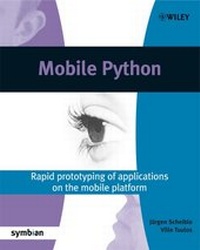
Mobile Python
Rapid prototyping of applications on the mobile platform
Published on 2. August 2008
348 pages
978-0-470-51802-1 (ISBN)
Description

Mobile Python is the introduction of Python programminglanguage to the mobile space. This practical hands-on bookteaches readers how to realize their application ideas on the Symbian OS. Programming onthe Symbian mobile platform has been difficult and time consumingin the past. This innovative new title will remedy thisproblem.
Chapters deal with topics that are based on Python S60 featuresand presented in an order that lets the user learn first the"simple to code" ones and then increasing incomplexity.
Chapters deal with topics that are based on Python S60 featuresand presented in an order that lets the user learn first the"simple to code" ones and then increasing incomplexity.
More details
Other editions
Additional editions
Jürgen Scheible | Ville Tuulos
Mobile Python
Rapid prototyping of applications on the mobile platform
Book
10/2007
Wiley
€43.90
Article exhausted; check different version
Persons
Jurgen Scheible is a designer, media artist and musician whoholds a degree in telecommunications from Karlsruhe, Germany. Aftergraduating, he worked for eight years at Nokia in Finland pursuingvarious positions such as programmer, product manager andcompetence transfer manager. Besides his occupation, he performedand produced music as well as media art under the pseudonym Lenin'sGodson.
In 2003, he left his engineering career to concentrate full-timeon his creative career, because he felt his heart was much more inhis artistic works that in engineering. In 2004, he became adoctoral student at the media Lab at the University of Artand Design, Helsinki, where he established the Mobile Hub, aprototype development environment for mobile client and serverapplications. it has a strong focus on artistic approaches andcreative design, and serves as a resource to art and designstudents who use mobile technology as part of their projects. Hisdoctoral research focuses on designing multimodal user interfacesfor creating and sharing interactive artistic experiences.
Since 2004, he has been evangelizing Python for S60 as one ofits pioneers. he is internationally active having given talks andtaught innovation workshops in both academic and professionalsettings on more than 40 occasions, in places such as StanfordUniversity, MIT, NTU Taiwan, Yahoo research Berkeley, TsinghuaUniversity Beijing, Nokia and Nokia Siemens Networks, in more than17 countries. His focus is on rapid mobile application prototypingusing creative approaches for innovation.
In 2006, he spent several months as a visiting scientist at MIT,Boston in the Computer Science and Artificial IntelligenceLaboratory (CSAIL). Jurgen was recognized as a Forum Nokia Championin 2006 and 2007 for his driving vision of building bridges betweenart, engineering and research. He was one of the winners of the ACMComputers in Entertainment Scholarship Award in 2006 and of theBest Arts Paper Award at ACM Multimedia 2005 conference.
The philosophy behind his works is to bring back the depth ofhuman feelings and emotional aspects to the digital world which, inhis opinion, were lost with the arrival of the fast-paced digitalproduction technology. By inspiring other with his works, he getsinspired himself. This leads him to many new ides for designing newkinds of interactive experiences for people, especially in the areof mobile phone application that fuse the real and the virtualworlds. He believes this era will change the way we live andcommunicate in the future and it will transform societies.Therefore it is important, in his opinion, to design for thesecoming applications.
Ville Tuulos is currently a researcher in the Departmentof Computer Science, University of Helsinki, Finland. He has morethan 15 years' experience of creative hacking, including datavisualization, web research engines, and machine-learningalgorithms. He has been an enthusiastic Pythonista since 2000 andhe has been exploring and extending the limits of python for S60since 2005. He has used it to implement, among others, real-timeimage processing algorithms, various positioning techniques and anurban game for 200 players in New York City.
In 2003, he left his engineering career to concentrate full-timeon his creative career, because he felt his heart was much more inhis artistic works that in engineering. In 2004, he became adoctoral student at the media Lab at the University of Artand Design, Helsinki, where he established the Mobile Hub, aprototype development environment for mobile client and serverapplications. it has a strong focus on artistic approaches andcreative design, and serves as a resource to art and designstudents who use mobile technology as part of their projects. Hisdoctoral research focuses on designing multimodal user interfacesfor creating and sharing interactive artistic experiences.
Since 2004, he has been evangelizing Python for S60 as one ofits pioneers. he is internationally active having given talks andtaught innovation workshops in both academic and professionalsettings on more than 40 occasions, in places such as StanfordUniversity, MIT, NTU Taiwan, Yahoo research Berkeley, TsinghuaUniversity Beijing, Nokia and Nokia Siemens Networks, in more than17 countries. His focus is on rapid mobile application prototypingusing creative approaches for innovation.
In 2006, he spent several months as a visiting scientist at MIT,Boston in the Computer Science and Artificial IntelligenceLaboratory (CSAIL). Jurgen was recognized as a Forum Nokia Championin 2006 and 2007 for his driving vision of building bridges betweenart, engineering and research. He was one of the winners of the ACMComputers in Entertainment Scholarship Award in 2006 and of theBest Arts Paper Award at ACM Multimedia 2005 conference.
The philosophy behind his works is to bring back the depth ofhuman feelings and emotional aspects to the digital world which, inhis opinion, were lost with the arrival of the fast-paced digitalproduction technology. By inspiring other with his works, he getsinspired himself. This leads him to many new ides for designing newkinds of interactive experiences for people, especially in the areof mobile phone application that fuse the real and the virtualworlds. He believes this era will change the way we live andcommunicate in the future and it will transform societies.Therefore it is important, in his opinion, to design for thesecoming applications.
Ville Tuulos is currently a researcher in the Departmentof Computer Science, University of Helsinki, Finland. He has morethan 15 years' experience of creative hacking, including datavisualization, web research engines, and machine-learningalgorithms. He has been an enthusiastic Pythonista since 2000 andhe has been exploring and extending the limits of python for S60since 2005. He has used it to implement, among others, real-timeimage processing algorithms, various positioning techniques and anurban game for 200 players in New York City.
Content
Contributors.
About the Authors.
Authors' Acknowledgments.
Symbian Press Acknowledgments.
Forewords.
1. Introduction and Basics.
1.1 Why Does Python Make a Difference?
1.2 How to Use this Book.
1.3 Who Is this Book For?
1.4 What Are Symbian OS, S60 and Python for S60?
1.5 Python Terminology in this Book.
1.6 Democratizing Innovation on the Mobile Platform.
1.7 The Process of Rapid Prototyping with Python S60.
1.8 Summary.
2. Getting Started.
2.1 Installing Python for S60 on 3rd Edition Devices.
¯2.2 Installing Python for S60 on 2nd Edition Devices.
¯2.3 Writing a Program in Python for S60.
¯2.4 White Space in Python Code.
¯2.5 Troubleshooting.
¯2.6 Summary.
¯3. Graphical User Interface Basics.
¯3.1 Using Modules.
¯3.2 Native UI Elements - Dialogs, Menus and Selection Lists.
¯3.3 Messages.
¯3.4 Summary.
¯4. Application Building and SMS Inbox.
¯4.1 Functions.
¯4.2 Application Structure.
¯4.3 String Handling.
¯4.4 SMS Inbox.
¯4.5 SMS Game Server.
¯4.6 Summary.
¯5. Sound, Interactive Graphics and Camera.
¯5.1 Sound.
¯5.2 Keyboard Keys.
¯5.3 Graphics.
¯5.4 Camera.
¯5.5 Mobile Game: UFO Zapper.
¯5.6 Summary.
¯6. Data Handling.
¯6.1 File Basics.
¯6.2 Reading and Writing Text.
¯6.3 Local Database.
¯6.4 GSM and GPS Positioning.
¯6.5 Vocabulector: A Language-Learning Tool.
¯6.6 Summary.
¯7. Bluetooth and Telephone Functionality.
¯7.1 Bluetooth Pairing.
¯7.2 OBEX and RFCOMM.
¯7.3 Phone-to-Phone Communication.
¯7.4 Phone-to-PC Communication.
¯7.5 Communication with GPS and Other Devices.
¯7.6 Telephone Functionality and Contacts.
¯7.7 System Information.
¯7.8 Summary.
¯8. Mobile Networking.
¯8.1 Simple Web Tasks.
¯8.2 Setting up the Development Environment.
¯8.3 Communication Protocols.
¯8.4 Server Software.
¯8.5 Pushing Data to a Phone.
¯8.6 Peer-to-Peer Networking.
¯8.7 Using a Phone as a Web Server.
¯8.8 Summary.
¯9. Web Services.
¯9.1 Basic Principles.
¯9.2 MopyMaps! Mobile Yahoo! Maps.
¯9.3 Eventful: Finding Eventful Events.
¯9.4 InstaFlickr: Shoot and Upload Photos to Flickr.
¯9.5 Summary.
¯10. Effective Python for S60.
¯10.1 Powerful Language Constructs.
¯10.2 Introspection.
¯10.3 Custom Modules and Automatic Updating.
¯10.4 Program Patterns.
¯10.5 Summary.
¯11. Combining Art and Engineering.
¯11.1 MobiLenin.
¯11.2 Manhattan Story Mashup.
¯11.3 MobileArtBlog - Image-Composition Tool.
¯11.4 ArduuinoBT Micro-Controller Board.
¯11.5 Controlling Max/MSP with a Phone.
¯11.6 OpenSound Control.
¯11.7 Robotics.
¯11.8 Summary.
¯Appendix A: Platform Security.
¯Appendix B: Bluetooth Console.
¯Appendix C: Debugging.
¯Appendix D: How to Use the Emulator.
¯References.
¯Glossary.
¯Examples.
¯Python Language Lessons.
¯Python for S60 Modules.
¯Index.
About the Authors.
Authors' Acknowledgments.
Symbian Press Acknowledgments.
Forewords.
1. Introduction and Basics.
1.1 Why Does Python Make a Difference?
1.2 How to Use this Book.
1.3 Who Is this Book For?
1.4 What Are Symbian OS, S60 and Python for S60?
1.5 Python Terminology in this Book.
1.6 Democratizing Innovation on the Mobile Platform.
1.7 The Process of Rapid Prototyping with Python S60.
1.8 Summary.
2. Getting Started.
2.1 Installing Python for S60 on 3rd Edition Devices.
¯2.2 Installing Python for S60 on 2nd Edition Devices.
¯2.3 Writing a Program in Python for S60.
¯2.4 White Space in Python Code.
¯2.5 Troubleshooting.
¯2.6 Summary.
¯3. Graphical User Interface Basics.
¯3.1 Using Modules.
¯3.2 Native UI Elements - Dialogs, Menus and Selection Lists.
¯3.3 Messages.
¯3.4 Summary.
¯4. Application Building and SMS Inbox.
¯4.1 Functions.
¯4.2 Application Structure.
¯4.3 String Handling.
¯4.4 SMS Inbox.
¯4.5 SMS Game Server.
¯4.6 Summary.
¯5. Sound, Interactive Graphics and Camera.
¯5.1 Sound.
¯5.2 Keyboard Keys.
¯5.3 Graphics.
¯5.4 Camera.
¯5.5 Mobile Game: UFO Zapper.
¯5.6 Summary.
¯6. Data Handling.
¯6.1 File Basics.
¯6.2 Reading and Writing Text.
¯6.3 Local Database.
¯6.4 GSM and GPS Positioning.
¯6.5 Vocabulector: A Language-Learning Tool.
¯6.6 Summary.
¯7. Bluetooth and Telephone Functionality.
¯7.1 Bluetooth Pairing.
¯7.2 OBEX and RFCOMM.
¯7.3 Phone-to-Phone Communication.
¯7.4 Phone-to-PC Communication.
¯7.5 Communication with GPS and Other Devices.
¯7.6 Telephone Functionality and Contacts.
¯7.7 System Information.
¯7.8 Summary.
¯8. Mobile Networking.
¯8.1 Simple Web Tasks.
¯8.2 Setting up the Development Environment.
¯8.3 Communication Protocols.
¯8.4 Server Software.
¯8.5 Pushing Data to a Phone.
¯8.6 Peer-to-Peer Networking.
¯8.7 Using a Phone as a Web Server.
¯8.8 Summary.
¯9. Web Services.
¯9.1 Basic Principles.
¯9.2 MopyMaps! Mobile Yahoo! Maps.
¯9.3 Eventful: Finding Eventful Events.
¯9.4 InstaFlickr: Shoot and Upload Photos to Flickr.
¯9.5 Summary.
¯10. Effective Python for S60.
¯10.1 Powerful Language Constructs.
¯10.2 Introspection.
¯10.3 Custom Modules and Automatic Updating.
¯10.4 Program Patterns.
¯10.5 Summary.
¯11. Combining Art and Engineering.
¯11.1 MobiLenin.
¯11.2 Manhattan Story Mashup.
¯11.3 MobileArtBlog - Image-Composition Tool.
¯11.4 ArduuinoBT Micro-Controller Board.
¯11.5 Controlling Max/MSP with a Phone.
¯11.6 OpenSound Control.
¯11.7 Robotics.
¯11.8 Summary.
¯Appendix A: Platform Security.
¯Appendix B: Bluetooth Console.
¯Appendix C: Debugging.
¯Appendix D: How to Use the Emulator.
¯References.
¯Glossary.
¯Examples.
¯Python Language Lessons.
¯Python for S60 Modules.
¯Index.
