

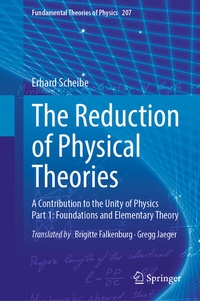
The Reduction of Physical Theories
Description

Using simple physical examples, this work by Erhard Scheibe presents an important and powerful approach to the reduction of physical theories. Novel to the approach is that it is not based, as usual, on a single reduction concept that is fixed once and for all, but on a series of recursively constructed reductions, with which all reductions appear as combinations of very specific elementary reductions. This leaves the general notion of theory reduction initially open and is beneficial for the treatment of the difficult cases of reduction from the fields of special and general relativity, thermodynamics, statistical mechanics,and quantum mechanics, which are treated in the second volume. The book is systematically organized and intended for readers interested in philosophy of science as well as physicists without deep philosophical knowledge.
More details
Other editions
Additional editions
Persons
Translators:
Brigitte Falkenburg holds a Ph.D. in Physics from the University of Heidelberg, a Ph.D. in Philosophy from the University of Bielefeld, and a Physics Diploma from the Technische Universität Berlin. She is Full Professor (emeritus) at the Technische Universität Dortmund. Her work focuses on the philosophy of physics and the history of philosophy (Kant, Neokantianism). In addition to almost 100 journal articles and book chapters in philosophy of physics, history of philosophy, and related subjects, Prof. Falkenburg has published six monographs on Kant, Hegel, philosophy of physics, and the philosophy of neuroscience. She has edited several books, among them Erhard Scheibe's "Selected Papers in the Philosophy of Physics".
Gregg Jaeger holds a Ph.D. in Physics from Boston University and B.Sc. degrees in Mathematics, Philosophy, and Physics from the University of Wisconsin-Madison. He is currently an Associate Professor of Natural Sciences and Mathematics at Boston University. His work focuses primarily on quantum theory. In addition to more than 70 journal articles in theoretical and experimental physics, history of science, philosophy, and mathematics, Prof. Jaeger has published three monographs in physics and the philosophy of science, edited two books and a number of conference proceedings in the foundations of quantum theory, and has written numerous book chapters in these fields.
Content
The Problem.- Physical Theories.- Corroboration and Empirical Progress.- Exact Reductions.- Approximate Reductions.- Partial Reductions.
