

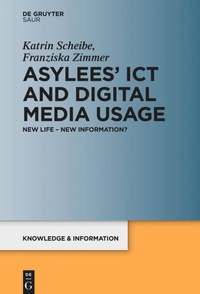
Asylees' ICT and Digital Media Usage
Description

By the time refugees flee from their home country, they likewise leave behind their former life, their relatives and acquaintances. Building a new life in their country of destination requires them to learn a foreign language and adjust to a new culture. Obviously, their information behavior as well as ICT and digital media usage adapt to these challenging circumstances.
What kind of information are refugees looking for? Who do they communicate with? What ICT, social and digital media do they apply? What are their motives to use particular devices or services, from Facebook and WhatsApp to YouTube and TikTok? Are gender- as well as age-dependent differences to be observed?
To answer these questions, data have been collected through an online questionnaire, interviews, as well as a content analysis of an online platform for refugees.
More details
Other editions
Additional editions
Persons
Content
- Intro
- Acknowledgements
- Contents
- 1 Introduction
- 2 European migrant crisis
- 3 ICT and media practices before and during escape
- 4 Integration initiatives
- 5 German asylum procedure
- 6 Theoretical foundations
- 7 Methods
- 8 ICT and media practices for integration - A literature review
- 9 Identifying ICT and media practices in a new country - Age- and gender-dependent results
- 10 Home country and now - Comparing adapted media and ICT practices
- 11 Information needs of asylum seekers in a new country
- 12 Experts' insights - Difficulties and information practices of asylum seekers
- 13 Discussion
- Glossary
- Name index
- Subject index
