

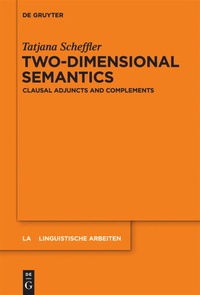
Two-dimensional Semantics
Description

This book argues that in order to account for the compositional behavior of many near-synonymous items, semantic analyses need to pay close attention to at least two semantic dimensions: standard assertions and conventional implicatures, which express additional side comments. The discussed phenomena are clausal adjuncts and complements in German. The new analysis of 'weil' and 'denn' ('because') shows that both contribute the same semantic operator, but one as an assertion, the other as a conventional implicature. This explains why only 'denn' can have speech-act modifying uses. This novel two-dimensional analysis is extended to other sentence adjuncts such as regular vs. relevance conditionals, although - clauses , and sentence adverbs. Further, the book investigates certain complement clauses. It analyzes sliftings as evidential-like parentheticals which contribute their meaning on the conventional implicature dimension. In contrast, German embedded verb-second clauses are shown to be truly embedded and analyzed as operating in the assertion dimension. The verb-second syntax is shown to contribute an additional epistemic component on the conventional implicature dimension.
More details
Other editions
Additional editions
Person
Content
2 - 2 Two-Dimensional Semantics [Seite 14]
2.1 - 2.1 Conventional Implicature [Seite 16]
2.2 - 2.2 Conventional Implicatures vs. Presuppositions [Seite 23]
2.2.1 - 2.2.1 A Discourse Logic [Seite 26]
3 - 3 Sentence Adverbs [Seite 28]
3.1 - 3.1 Types of Sentence Adverbs [Seite 29]
3.2 - 3.2 Semantic Unembeddability [Seite 31]
3.2.1 - 3.2.1 Antecedent of Conditionals [Seite 32]
3.2.2 - 3.2.2 Questions [Seite 32]
3.2.3 - 3.2.3 Negation [Seite 33]
3.2.4 - 3.2.4 Denial [Seite 34]
3.2.5 - 3.2.5 Attitude Verbs [Seite 35]
3.2.6 - 3.2.6 Semantic (Un)embeddability of Sentence Adverbs [Seite 36]
3.3 - 3.3 Properties of German Sentence Adverbs [Seite 37]
3.3.1 - 3.3.1 The probably Type [Seite 38]
3.3.2 - 3.3.2 The unfortunately Type [Seite 39]
3.3.3 - 3.3.3 The frankly Type [Seite 40]
3.3.4 - 3.3.4 Frankly Speaking [Seite 42]
3.3.5 - 3.3.5 Properties of Three Types of Sentence Adverbs [Seite 44]
3.4 - 3.4 Sentence Adverbs on Two Semantic Dimensions [Seite 45]
3.5 - 3.5 Syntax/Semantics Mismatch [Seite 50]
3.5.1 - 3.5.1 An Anaphoric Approach to Utterance Modification [Seite 54]
3.6 - 3.6 Summary [Seite 56]
4 - 4 Denn and Weil - Causal Connectives in Two Dimensions [Seite 58]
4.1 - 4.1 Data [Seite 59]
4.1.1 - 4.1.1 Two German Words for 'Because' [Seite 59]
4.1.2 - 4.1.2 Epistemic and Speech Act Uses [Seite 60]
4.1.3 - 4.1.3 Three Exceptions to the Use of Denn [Seite 62]
4.2 - 4.2 Previous Work [Seite 64]
4.2.1 - 4.2.1 The Performative Analysis [Seite 64]
4.2.2 - 4.2.2 Denn and Antibackgrounding [Seite 68]
4.3 - 4.3 Semantics of denn [Seite 70]
4.3.1 - 4.3.1 Denn as a Conventional Implicature Item [Seite 71]
4.3.2 - 4.3.2 Unembeddability of denn [Seite 72]
4.3.3 - 4.3.3 Formalizing denn's Semantics [Seite 80]
4.4 - 4.4 Syntax of denn [Seite 84]
4.5 - 4.5 The Distribution of denn vs. weil Explained [Seite 87]
4.5.1 - 4.5.1 Denn in Epistemic and Speech Act Causal Sentences [Seite 87]
4.5.2 - 4.5.2 Three Exceptions to the Use of denn [Seite 95]
4.6 - 4.6 Further Issues [Seite 97]
4.6.1 - 4.6.1 Epistemic and Speech Act Uses of weil [Seite 97]
4.6.2 - 4.6.2 English because [Seite 98]
4.6.3 - 4.6.3 Embedding under Non-Restrictive Relative Clauses [Seite 99]
4.7 - 4.7 Summary [Seite 101]
5 - 5 Relevance Conditionals - If on Another Dimension [Seite 102]
5.1 - 5.1 Crucial Properties of Relevance Conditionals [Seite 103]
5.1.1 - 5.1.1 Semantic Unembeddability [Seite 104]
5.1.2 - 5.1.2 Illocutionary Status of the Consequent [Seite 107]
5.1.3 - 5.1.3 Syntactic Unintegration [Seite 109]
5.2 - 5.2 The Analysis: 'If' on Two Dimensions [Seite 111]
5.2.1 - 5.2.1 Proposal [Seite 111]
5.2.2 - 5.2.2 Net Effect of the If-Clause in RCs [Seite 113]
5.2.3 - 5.2.3 Discussion [Seite 118]
5.3 - 5.3 Previous Accounts [Seite 121]
5.3.1 - 5.3.1 Conditional Assertion Accounts [Seite 121]
5.3.2 - 5.3.2 Existential Quantification over Potential Literal Acts [Seite 122]
5.3.3 - 5.3.3 Relevance Conditionals as Topics [Seite 124]
5.4 - 5.4 Summary [Seite 129]
6 - 6 A Paradigm of Adjuncts on Two Dimensions [Seite 131]
6.1 - 6.1 Taking Stock [Seite 132]
6.1.1 - 6.1.1 Syntactic Unintegration [Seite 133]
6.1.2 - 6.1.2 Argument Types of CI Modifiers [Seite 136]
6.2 - 6.2 Although [Seite 139]
6.3 - 6.3 Modifiers on Different Dimensions [Seite 142]
7 - 7 Complement Clauses [Seite 144]
7.1 - 7.1 Attitude Verbs and Their Complements [Seite 145]
7.1.1 - 7.1.1 V2 Embedding [Seite 146]
7.1.2 - 7.1.2 Slifting [Seite 148]
7.1.3 - 7.1.3 Properties of Slifting vs. V2 embedding [Seite 150]
7.2 - 7.2 Verbs that Allow Slifting and V2 Complements [Seite 154]
7.2.1 - 7.2.1 Which verbs allow V2 complements? [Seite 154]
7.2.2 - 7.2.2 Which Verbs do Not Allow V2 Complements? [Seite 156]
7.2.3 - 7.2.3 Slifting Verbs [Seite 160]
7.2.4 - 7.2.4 Generalization: Epistemicity [Seite 162]
7.3 - 7.3 Slifting as Evidentials [Seite 169]
7.3.1 - 7.3.1 Analysis [Seite 169]
7.3.2 - 7.3.2 Slifting and Verb Classes [Seite 171]
7.3.3 - 7.3.3 Slifting and Semantic Embedding [Seite 174]
7.3.4 - 7.3.4 Summary: Slifting [Seite 175]
7.4 - 7.4 V2 Complement Clauses [Seite 176]
7.4.1 - 7.4.1 Analysis [Seite 176]
7.4.2 - 7.4.2 V2 Complement Clauses and Verb Classes [Seite 177]
7.4.3 - 7.4.3 V2 Complement Clauses and Semantic Embedding [Seite 178]
7.4.4 - 7.4.4 Summary: V2 Complement Clauses [Seite 179]
7.5 - 7.5 Summary: V2 Complements & Slifting [Seite 180]
8 - 8 Conclusion [Seite 182]
9 - Bibliography [Seite 185]
10 - Term Index [Seite 191]
11 - Author Index [Seite 195]
