

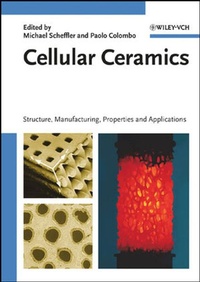
Cellular Ceramics
Structure, Manufacturing, Properties and Applications
1st Edition
Published on 12. May 2006
XXV, 645 pages
978-3-527-60670-2 (ISBN)
Description

Cellular ceramics are a specific class of porous materials which includes among others foams, honeycombs, connected fibers, robocast structures and assembled hollow spheres. Because of their particular structure, cellular ceramics display a wide variety of specific properties which make them indispensable for various engineering applications. An increasing number of patents, scientific literature and international conferences devoted to cellular materials testifies to a rapidly growing interest of the technical community in this topic. New applications for cellular ceramics are constantly being put under development.
The book, authored by leading experts in this emerging field, gives an overview of the main aspects related to the processing of diverse cellular ceramic structures, methods of structural and properties characterisation and well established industrial, novel and potential applications. It is an introduction to newcomers in this research area and allows students to obtain an in-depth knowledge of basic and practical aspects of this fascinating class of advanced materials.
The book, authored by leading experts in this emerging field, gives an overview of the main aspects related to the processing of diverse cellular ceramic structures, methods of structural and properties characterisation and well established industrial, novel and potential applications. It is an introduction to newcomers in this research area and allows students to obtain an in-depth knowledge of basic and practical aspects of this fascinating class of advanced materials.
Reviews / Votes
"This is an excellent book for those starting out in research on porous ceramics, as well as a very valuable reference for those experienced in this field. There is incredible diversity, covered with great thoroughness by the editors." Advanced MaterialsMore details
Other editions
Additional editions
Software
03/2006
Wiley-VCH
€495.66
No shipping information available
Michael Scheffler | Paolo Colombo
Cellular Ceramics
Structure, Manufacturing, Properties and Applications
Book
11/2005
1st Edition
Wiley-VCH
€359.00
Article exhausted; check different version
Persons
Michael Scheffler received his PhD in Inorganic Chemistry from the University of Halle-Wittenberg, Germany, in 1993. In 1994, he joined the Institute of Physical High Technology, Jena, where he was involved in the development of glass fibres for active optical applications. From 1999-2003 he was head of the Polymer Derived Ceramics group of the Department of Materials Science, Glass and Ceramics at the University of Erlangen-Nuremberg. He was awarded a DFG grant and a fellowship as Visiting Scholar at the University of Washington, Seattle, in 2003. Michael Scheffler's research focuses on the fabrication, characterisation and novel applications of inorganic functional materials/multifunctional ceramics.
Paolo Colombo graduated from the University of Padova, Italy, with a degree in chemical engineering. In 1991 he was awarded a Fulbright Scholarship for the Pennsylvania State University. He worked as a research associate at the University of Padova before becoming associate professor at the University of Bologna. He is currently also an adjunct professor of Materials Science and Engineering at the Pennsylvania State University. Paolo Colombo´s research interests include the development of advanced ceramic materials and components from preceramic polymers as well as the use of hazardous industrial and natural wastes as raw materials for glass products such as foams and fibers.
Paolo Colombo graduated from the University of Padova, Italy, with a degree in chemical engineering. In 1991 he was awarded a Fulbright Scholarship for the Pennsylvania State University. He worked as a research associate at the University of Padova before becoming associate professor at the University of Bologna. He is currently also an adjunct professor of Materials Science and Engineering at the Pennsylvania State University. Paolo Colombo´s research interests include the development of advanced ceramic materials and components from preceramic polymers as well as the use of hazardous industrial and natural wastes as raw materials for glass products such as foams and fibers.
Content
Foreword by David J. Green
Preface
1 Introduction
1.1 Cellular Solids - Scaling of Properties
1.2 Liquid Foams - Precursors for Solid Foams
2 Manufacturing
2.1 Ceramic Foams
2.2 Honeycombs
2.3 3D Periodic Strutures
2.4 Connected Fibers: Fiber Felts and Mats
2.5 Microcellular Ceramics from Wood
2.6 Carbon Foams
2.7 Glass Foams
2.8 Hollow Spheres
2.9 Cellular Concrete
3 Structure
3.1 Characterization of Structure and Morphology
3.2 Modelling Structure-Property Relationships in Random Cellular Material
4 Properties
4.1 Mechanical Properties
4.2 Permeability
4.3 Thermal Properties
4.4 Electrical Properties
4.5 Acoustic Properties
5 Applications
5.1 Liquid Metal Filtration
5.2 Gas (Particulate) Filtration
5.3 Kiln Furnitures
5.4 Heterogeneously Catalysed Processes with Porous Cellular Ceramic Monoliths
5.5 Porous Burners
5.6 Acoustic Transfer in Ceramic Surfac Burners
5.6 Solar Radiation Conversion
5.7 Biomedical Applications: Tissue Engineering
5.9 Interpenetrating Composites
5.10 Porous Media in Internal Combustion Engines
5.11 Other Developments and Special Applications
Concluding Remarks
Preface
1 Introduction
1.1 Cellular Solids - Scaling of Properties
1.2 Liquid Foams - Precursors for Solid Foams
2 Manufacturing
2.1 Ceramic Foams
2.2 Honeycombs
2.3 3D Periodic Strutures
2.4 Connected Fibers: Fiber Felts and Mats
2.5 Microcellular Ceramics from Wood
2.6 Carbon Foams
2.7 Glass Foams
2.8 Hollow Spheres
2.9 Cellular Concrete
3 Structure
3.1 Characterization of Structure and Morphology
3.2 Modelling Structure-Property Relationships in Random Cellular Material
4 Properties
4.1 Mechanical Properties
4.2 Permeability
4.3 Thermal Properties
4.4 Electrical Properties
4.5 Acoustic Properties
5 Applications
5.1 Liquid Metal Filtration
5.2 Gas (Particulate) Filtration
5.3 Kiln Furnitures
5.4 Heterogeneously Catalysed Processes with Porous Cellular Ceramic Monoliths
5.5 Porous Burners
5.6 Acoustic Transfer in Ceramic Surfac Burners
5.6 Solar Radiation Conversion
5.7 Biomedical Applications: Tissue Engineering
5.9 Interpenetrating Composites
5.10 Porous Media in Internal Combustion Engines
5.11 Other Developments and Special Applications
Concluding Remarks
