

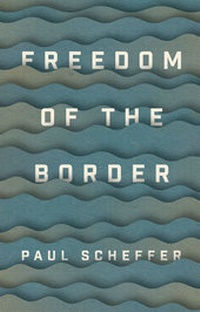
Freedom of the Border
Description

In this book Paul Scheffer takes a different view. Rather than thinking of borders as obstacles to freedom, he argues that borders make freedom possible. Democracy and redistributive justice are only possible with the regulation of access to territories and rights. When liberals ignore an open society's need for borders, people with authoritarian inclinations will begin to erect them. In the context of Europe, the project of removing internal borders can therefore only be successful if Europe accepts responsibility for its external border.
This timely and important book challenges conventional ways of thinking and will be of interest to everyone concerned with the great social and political issues of our time.
More details
Other editions
Additional editions
Persons
Content
Acknowledgements
Introduction: Exploring boundaries
I. The value of proximity
Discovery of the world citizen
Tartars in the suburbs
The revenge of geography
The digital shadow
II. An age of migration
The citizenship bonus
The exodus and our conscience
The critical limits reconsidered
The return of the caliphate
III. The state of Europe
After the Pax Americana
A hidden vitality
Scenarios for the Union
A compulsion to grand politics
Notes
Bibliography
Index
Introduction: Exploring boundaries
I was eighteen when I first stood at the Wall that cut Berlin in two. In the summer of 1973, as one of my country's representatives at the World Festival of Youth and Students, I saw at first hand the ghostly tableau of the East German side. We were housed at the edge of the city and from my window I could see the watchtowers and searchlights at the Wall a short distance away. Its official name was the Antifaschistischer Schutzwall, the Antifascist Protection Rampart, but in reality it had been built to prevent East German citizens from leaving.
One Sunday morning sixteen years later I watched as an excavator removed its first segment of the Wall at the Potsdamer Platz, three days after that historic 9 November 1989 when the Wall fell.1 A huge crowd thronged the square. I leaned on the shoulder of a smiling border guard to get a better view. For twenty-eight years this former traffic intersection at the heart of the city had been an impassable barrier. Now no-man's-land was filling up with a cheerful multitude, and together we experienced the beginnings of a new vision of the old continent.
I well remember the sense of relief in the years that followed the end of the Cold War. At last we were rid of the Iron Curtain that had divided Europe so brutally. The oppression of the Eastern part of the continent was over and the 'peace dividend' was quickly cashed in. Major cuts to defence expenditure became possible, with worries about territorial integrity and border security resolved. After 1989 everything was going to be different.
Now, more than thirty years later, we again find ourselves talking endlessly about borders. The influx of refugees provokes emotional responses. There is apparent agreement about the need to improve the security of Europe's external borders, but still no sign of a real determination to act. In fact European division on this point is greater than ever, partly as a result of moral diffidence: on what grounds can we deny others the right to settle in our part of the world?
This book is about the open society and its borders. I've always been suspicious of the notion that we live in a borderless world. It's a self-image that betokens a rather inward-looking attitude. Because what is left to be discovered if there's no outside world? The value of crossing borders can be understood only by those willing to acknowledge their significance.
My approach to the issue has been shaped in part by the history of my own family. One of my grandfathers, Herman Wolf, was born in Cologne; the other, Lou Scheffer, in Batavia in the Dutch East Indies. It was made clear to me at a very early age that the world is bigger than the country into which I was born. I grew up in a liberal environment in which the novels of Jean-Paul Sartre and Heinrich Böll were venerated (a minor rapprochement between the French and the Germans), while at the same time the jazz of Nina Simone and Stan Getz was embraced (a minor rapprochement between black and white).
Along with curiosity, I inherited anxiety, which manifested itself from an early age. While clearing my mother's flat after she died, I came upon my father's wartime arrest warrant and a couple of letters he had written to his parents from the prison camp in Amersfoort. The war was never a subject of conversation between us at home, since my parents didn't want to see their children burdened by it. All the same, that period in history was a looming presence, all the more so because it was unthinkable that any of us would ever mention it.
For me the border is first of all a childhood memory. There was one border we were never allowed to cross, between the Netherlands and Germany. My mother refused to step beyond it until well into the 1970s, which was strange, because we lived quite close by, in Arnhem. Her refusal was a gesture of respect for her Jewish father, Herman Wolf, who moved to Amsterdam with his parents around the turn of the twentieth century.2 We were not allowed past the border that, many years before, he had crossed in the opposite direction along with his parents.
His life and work in Amsterdam in the 1930s were those of a literary generation, enthusiastic about humanism but at the same time filled with a deep pessimism. Influenced philosophically by Schopenhauer and Nietzsche, yet also marked by the First World War, they were at the start of a century now sometimes described as an age of extremes. Wolf witnessed the rise of totalitarian movements and his opposition to them led him to ask questions about the resilience of humanism.
Shortly after Adolf Hitler's seizure of power, Herman Wolf wrote, 'That is the problematic, indeed tragic situation of the humanist in our time. He is profoundly convinced that faith in the value solely of race, people and party will lead to the most atrocious violation of all that is purely and truly human.' What puts the humanist thinker in such a tragic position? 'He cannot articulate his conviction by means of concrete forms and symbols; again and again he can only watch as others, by appealing to blood, race, folk, church and party, gain millions of followers.'
This is a significant problem in our own day too. We are experiencing once again a clash between openness towards the world and the urge to preserve a specific heritage. The question that has preoccupied me for years is this: are we forced to conclude that identification with a specific people and identification with humanity as a whole are irreconcilable, or is it possible to bridge the gulf between the two?
Today, despite living in a very different time, we realize how hard it is to give shape to a humanism that is robust and that rises above an appeal to our own distinctiveness. I understand humanism to mean making the case for humanity in general, resisting the idea that cultural otherness cannot be overcome. It is a dilemma of Herman Wolf's time and of our own, and it is the subject of this book.
Behind his observation about the tragedy of humanism lies a major question about our belief in progress. Does history present evidence of improvement, step by step, or does the same evil arise repeatedly, taking a different form each time? Do we underestimate progress when we say that the veneer of civilization is thin? Or is the progress we experience largely material, while societies show no improvement in a moral sense?
Wolf's work is imbued with his insight that humanism is always a form of pessimism. He was inspired in this belief by Arthur Schopenhauer, about whom he published a lengthy essay. He was not alone in being strongly influenced by this particular philosopher. Author Thomas Mann, for example, admired in Schopenhauer's work the connection between 'Melancholie und Menschenstolz' (melancholy and human pride). In a time in which human values were being trodden underfoot - this was 1938 - a combination of pessimism and humanism was of incalculable importance. Humility features prominently in a philosophy that contrasts the impermanence of things with an arrogant faith in progress.
My family history, incidentally, never prompted me to condemn everything that tasted or sounded German. I was impressed by the conscientious way in which our neighbours were dealing with their past, and in the 1980s I became convinced that German unification is part of the integration of Europe. In those years many people saw the division of Germany as nothing short of a moral precept, a form of compensation paid to the rest of Europe.
I got to know the work of Martin Walser, and later the writer himself. He convinced me that the oppression of seventeen million people in East Germany could not be tacitly accepted.3 It was impossible to justify the division of his country by regarding it as a war debt. He abhorred the position of his fellow author Günter Grass, who believed that because of Auschwitz the Germans had lost their right to self-determination.4 No amount of wrongdoing can be avenged by making an entire nation a prisoner of its past, Walser said. The often blunt way in which Auschwitz was invoked in every conversation about Germany led him to suspect that its memory was being used for political purposes.5
I came upon a comparable idea in the work of German historian Arnulf Baring, who in a reference to the peace movement wrote about his country's 'new delusions of grandeur'.6 Precisely because a moral low had been reached in the war, he believed, many West Germans thought their country had become Europe's moral benchmark. His criticism confirmed my impression that there was too much well-intended browbeating among the Germans. I've come upon it on several occasions myself, especially in the censorship of unwelcome opinions. If today's Germany causes me any discomfort, then it's precisely because of its moral overestimation of itself.
Longer stays in Paris and Warsaw - two cities in which I worked as a correspondent - taught me a great deal about the historical significance of borders. My time in Poland especially, in the early 1980s, changed my view of the world. From the history of a country that had been wiped off the map by its neighbours on several occasions, and after the war was shifted Westwards, I deduced that borders are bound up with existential fears. To this day people in Poland are extremely sensitive to any perceived infringement of the borders, as evidenced by their greater than average dislike of migrants and...
