

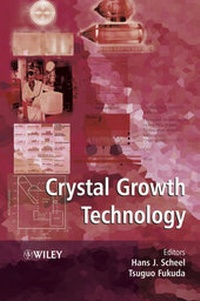
Crystal Growth Technology
Description

More details
Other editions
Additional editions
Persons
Hans J. Scheel started the Scheel Consulting company in 2001 after retiring from the Swiss Federal Institute of Technology. Starting out with a chemical background, he has more than 40 years of experience with crystal growth and epitaxy in university as well as industry. For his achievements in bulk crystal growth and epitaxy technologies, he received awards from IBM and from Swiss, British, Korean Crystal Growth Associations, was elected member of the Russian Academy of Engineering Sciences, and received his D.Sc. from Tohoku University, Japan. He is co-author and editor of 6 books, author of more than 100 publications and patents, has organized international workshops on crystal technology and has been visiting professor at Osaka and Tohoku Universities, Japan, as well as Shandong University, China.
Tsuguo Fukuda is the editor of Crystal Growth Technology, published by Wiley.
Content
Preface.
PART 1: GENERAL ASPECTS OF CRYSTAL GROWTH TECHNOLOGY.
1. The Development of Crystal Growth Technology (H. J. ScheelI).
Abstract.
References.
2. Thermodynamic Fundamentals of Phase Transitions Applied to Crystal Growth Processes (P. Rudolph).
References.
3. Interface-kinetics-driven Facet Formation During Melt Growth of Oxide Crystals (S. Brandon, A. Virozub and Y. Liu).
Abstract.
Acknowledgments.
Note Added in Proof.
References.
4. Theoretical and Experimental Solutions of the Striation Problem (H. J. Scheel).
Abstract.
References.
5. High-resolution X-Ray Diffraction Techniques for Structural Characterization of Silicon and other Advanced Materials (K. Lal).
References.
6. Computational Simulations of the Growth of Crystals from Liquids (A. Yeckel and J. J. Derby).
Acknowledgments.
References.
7. Heat and Mass Transfer under Magnetic Fields (K. Kakimoto).
Abstract.
Acknowledgment.
References.
8. Modeling of Technologically Important Hydrodynamics and Heat/Mass Transfer Processes during Crystal Growth (V. I. Polezhaev).
Acknowledgments.
References.
PART 2: SILICON.
9. Influence of Boron Addition on Oxygen Behavior in Silicon Melts (K. Terashima).
Abstract.
Acknowledgments.
References.
10. Octahedral Void Defects in Czochralski Silicon (M. Itsumi).
References.
11. The Control and Engineering of Intrinsic Point Defects in Silicon Wafers and Crystals (R. Falster, V. V. Voronkov and P. Mutti).
Abstract.
Acknowledgments.
References.
12. The Formation of Defects and Growth Interface Shapes in CZ Silicon (T. Abe).
Abstract.
References.
13. Silicon Crystal Growth for Photovoltaics (T. F. Ciszek).
References.
PART 3: COMPOUND SEMICONDUCTORS.
14. Fundamental and Technological Aspects of Czochralski Growth of High-quality Semi-insulating GaAs Crystals (P. Rudolph and M. Jurisch).
Acknowledgement.
References.
15. Growth of III-V and II-VI Single Crystals by the Verticalgradient-freeze Method (T. Asahi, K. Kainosho, K. Kohiro, A. Noda, K. Sato and O. Oda).
References.
16. Growth Technology of III-V Single Crystals for Production (T. Kawase, M. Tatsumi and Y. Nishida).
References.
17. CdTe and CdZnTe Growth (R. Triboulet).
References.
PART 4: OXIDES AND HALIDES.
18. Phase-diagram Study for Growing Electro-optic Single Crystals (S. Miyazawa).
Abstract.
Acknowledgment.
References.
19. Melt Growth of Oxide Crystals for SAW, Piezoelectric, and Nonlinear-Optical Applications (K. Shimamura, T. Fukuda and V. I. Chani).
References.
20. Growth of Nonlinear-optical Crystals for Laser-frequency Conversion (T. Sasaki, Y. Mori and M. Yoshimura).
References.
21. Growth of Zirconia Crystals by Skull-Melting Technique (E. E. Lomonova and V. V. Osiko).
Acknowledgments.
References.
22. Shaped Sapphire Production (L. A. Lytvynov).
References.
23. Halogenide Scintillators: Crystal Growth and Performance (A. V. Gektin and B. G. Zaslavsky).
References.
PART 5: CRYSTAL MACHINING.
24. Advanced Slicing Techniques for Single Crystals (C. Hauser and P. M. Nasch).
Abstract.
References.
25. Methods and Tools for Mechanical Processing of Anisotropic Scintillating Crystals (M. Lebeau).
References.
26. Plasma-CVM (Chemical Vaporization Machining) (Y. Mori, K. Yamamura, and Y. Sano).
Acknowledgements.
References.
27. Numerically Controlled EEM (Elastic Emission Machining) System for Ultraprecision Figuring and Smoothing of Aspherical Surfaces (Y. Mori, K. Yamauchi, K. Hirose, K. Sugiyama, K. Inagaki and H. Mimura).
Acknowledgement.
References.
PART 6: EPITAXY AND LAYER DEPOSITION.
28. Control of Epitaxial Growth Modes for High-performance Devices (H. J. Scheel).
Abstract.
General References.
References.
29. High-rate Deposition of Amorphous Silicon Films by Atmospheric pressure Plasma Chemical Vapor Deposition (Y. Mori, H. Kakiuchi, K. Yoshii and K. Yasutake).
Abstract.
Acknowledgements.
References.
Index.
