

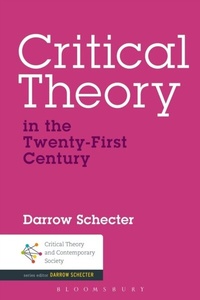
Critical Theory in the Twenty-First Century
1st Edition
Published on 29. August 2013
224 pages
978-1-4411-6636-4 (ISBN)
Description

Critical Theory in the Twenty-First Century provides a thorough overview of critical theory, looking at its history and shortfalls.
First, the book explains the developments from the Frankfurt School and from more recent schools of thought, including Derrida, Deleuze, deconstruction, and post-structuralism. Then it looks at how critical theory has not kept pace with the changes and conflicts brought on by the post-Cold War world and globalization and how its deficits can be addressed. For the author, more than ever critical theory needs to synthesize theoretical perspective and empirical research. It also needs to be reconfigured in the light of the demands of new social movements, post-colonialism, and globalization.
This volume is part of Critical Theory and Contemporary Society, a series that uses critical theory to explore contemporary society as a complex phenomenon and includes works on democracy, social movements, and terrorism. A unique resource, Critical Theory in the Twenty First Century will interest anyone researching issues in political theory, international relations theory, social theory, and critical theory.
First, the book explains the developments from the Frankfurt School and from more recent schools of thought, including Derrida, Deleuze, deconstruction, and post-structuralism. Then it looks at how critical theory has not kept pace with the changes and conflicts brought on by the post-Cold War world and globalization and how its deficits can be addressed. For the author, more than ever critical theory needs to synthesize theoretical perspective and empirical research. It also needs to be reconfigured in the light of the demands of new social movements, post-colonialism, and globalization.
This volume is part of Critical Theory and Contemporary Society, a series that uses critical theory to explore contemporary society as a complex phenomenon and includes works on democracy, social movements, and terrorism. A unique resource, Critical Theory in the Twenty First Century will interest anyone researching issues in political theory, international relations theory, social theory, and critical theory.
Reviews / Votes
Schecter offers not so much an update as a return to the spirit of critical theory--not least its stress on the need for an interdisciplinary and politically engaged approach to the study of contemporary society that is alive to the interconnections between culture, politics, law and economics in maintaining and transforming a given social formation. The result is a powerful manifesto for a new school of critical thought, able to address the challenges posed by globalisation, identity politics and the decline in support for conventional democracy. Any attempt to reinvigorate critical theory must revisit the claim that the critique of knowledge is social critique and vice versa. Critical Theory in the Twenty-First Century does so by exploring the relations between dialectics, mediation, stratification and differentiation today. It is shown that attempts to address issues arising from persistent stratification that do not take functional differentiation into account are likely to offer quantitative solutions to problems that have become qualitative to a significant extent. The book demonstrates that although qualitative reform becomes possible with increased complexity and refined collective learning, it will not arise in the form of automatic systemic adjustment or spontaneous social evolution. New, more flexible mediations will depend on the institutionalisation of de-centred, rather than simply privatised decision-making processes.More details
Series
Edition
1. Auflage
Language
English
Place of publication
New York
United States
Publishing group
Bloomsbury Publishing PLC (Digital)
ISBN-13
978-1-4411-6636-4 (9781441166364)
Copyright in bibliographic data and cover images is held by Nielsen Book Services Limited or by the publishers or by their respective licensors: all rights reserved.
Schweitzer Classification
Other editions
Additional editions
Darrow Schecter
Critical Theory in the Twenty-First Century
Book
10/2013
Bloomsbury Academic USA
€45.00
Shipment within 15-20 days
Person
Darrow Schecter is Reader in the School of History, Art History and Humanities, University of Sussex, UK. He has written books and articles on social and political thought, including Beyond Hegemony (2005); The History of the Left From Marx to the Present: Theoretical Perspectives (2007), and Critique of Instrumental Reason from Weber to Habermas (2010). He teaches history and political theory at the University of Sussex.
Content
1. Introduction
2. Chapter 1: Dialectics, De-Naturalisation and Social Differentiation (I): From the Public Sphere to the Emergence of Civil Society
3. Chapter 2: Dialectics, De-Naturalisation and Social Differentiation (II): From the Cognitive Content of Aesthetics to Critical Theory
4. Chapter 3: Critical Theory and Mediated Non-Identity
5. Chapter 4: Critical Theory and Political Theory
6. Chapter 5: New Paths Beyond the Marx-Freud Synthesis
7. Conclusion: The Mediations of Society
Biblio
Index
2. Chapter 1: Dialectics, De-Naturalisation and Social Differentiation (I): From the Public Sphere to the Emergence of Civil Society
3. Chapter 2: Dialectics, De-Naturalisation and Social Differentiation (II): From the Cognitive Content of Aesthetics to Critical Theory
4. Chapter 3: Critical Theory and Mediated Non-Identity
5. Chapter 4: Critical Theory and Political Theory
6. Chapter 5: New Paths Beyond the Marx-Freud Synthesis
7. Conclusion: The Mediations of Society
Biblio
Index
