

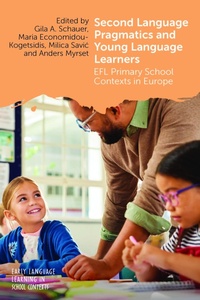
Second Language Pragmatics and Young Language Learners
EFL Primary School Contexts in Europe
Published on 14. October 2025
298 pages
978-1-83668-171-7 (ISBN)
Description

This book brings together research on second language pragmatics in the underexplored context of EFL primary classrooms. Presenting studies from Croatia, Cyprus, Germany, Norway, Spain and the Netherlands, the book offers a rich exploration of different topics, such as learners' pragmatic performance, awareness and development, learners' and teachers' views on pragmatic instruction, and investigations concerning material use and lesson planning. The studies feature a range of data sources including animated films, arts-based instruction, classroom discourse, narrated picture-based tasks, questionnaires and interviews, introducing the reader to a wealth of opportunities for young learners' engagement with pragmatics. Being the first edited volume to provide an overview of the rapidly growing area of young learner pragmatics, it will be of great interest to researchers, graduate students and language teachers.
Reviews / Votes
With increasing numbers of primary school pupils learning English as a foreign language, this volume is an innovative and timely addition to the fields of Second Language Pragmatics and Teaching English to Young Learners. The volume's impressive scope offers insightful analyses of pragmatic production, perception and development, as well as a range of original approaches to and investigations of pragmatic instruction. A must read for foreign language teachers, teacher educators and researchers alike. * Anne Barron, Leuphana University Lueneburg, Germany * This volume represents a multi-authored yet impressively integrated case for heightening European EFL schoolchildren's knowledge about and performance of greetings, invitations, and requests. Schauer and her colleagues demonstrate why language educators need to view pragmatically appropriate speech act interactions among school children as a priority in the burgeoning field of applied pragmatics. * Andrew D. Cohen, Emeritus, University of Minnesota, USA *More details
Series
Language
English
Place of publication
Bristol
United Kingdom
Publishing group
Channel View Publications Ltd
Target group
College/higher education
Product notice
Reflowable
File size
6,47 MB
ISBN-13
978-1-83668-171-7 (9781836681717)
Copyright in bibliographic data and cover images is held by Nielsen Book Services Limited or by the publishers or by their respective licensors: all rights reserved.
Schweitzer Classification
Other editions
Additional editions

Gila A. Schauer | Maria Economidou-Kogetsidis | Milica Savic
Second Language Pragmatics and Young Language Learners
EFL Primary School Contexts in Europe
Book
10/2025
Multilingual Matters
€57.30
Shipment within 3-4 weeks
Persons
Gila A. Schauer is Professor of English and Applied Linguistics at the University of Erfurt, Germany. Her recent publications include Teaching and Learning English in the Primary School: Interlanguage Pragmatics in the EFL context (Springer, 2019) and her research focuses on L2 pragmatics, intercultural competence, and literature in L2 teaching and learning.
Maria Economidou-Kogetsidis is Professor of English and Applied Linguistics at the University of Nicosia, Cyprus. Her research spans L2 and intercultural pragmatics, cross-cultural communication, linguistic politeness and L2 email pragmatics. She is the co-author of Researching and Teaching Speech Acts with Young L2 Learners: Beneath the Linguistic Surface (with Savic and Myrset, Multilingual Matters, 2025).
Milica Savic is Professor of English and Applied Linguistics at the University of Stavanger, Norway. Her main research interests include L2 pragmatics, especially children's (meta)pragmatic development, email communication and, more recently, critical visual literacy and participatory research approaches with children.
Anders Myrset is Associate Professor of ELT Methodology at the University of Stavanger, Norway. His research has mainly focused on children's L2 (meta)pragmatic development, L2 pragmatics instruction and, more recently, aspects related to participatory research with children. He is also an author of ELT textbooks for young language learners.
Maria Economidou-Kogetsidis is Professor of English and Applied Linguistics at the University of Nicosia, Cyprus. Her research spans L2 and intercultural pragmatics, cross-cultural communication, linguistic politeness and L2 email pragmatics. She is the co-author of Researching and Teaching Speech Acts with Young L2 Learners: Beneath the Linguistic Surface (with Savic and Myrset, Multilingual Matters, 2025).
Milica Savic is Professor of English and Applied Linguistics at the University of Stavanger, Norway. Her main research interests include L2 pragmatics, especially children's (meta)pragmatic development, email communication and, more recently, critical visual literacy and participatory research approaches with children.
Anders Myrset is Associate Professor of ELT Methodology at the University of Stavanger, Norway. His research has mainly focused on children's L2 (meta)pragmatic development, L2 pragmatics instruction and, more recently, aspects related to participatory research with children. He is also an author of ELT textbooks for young language learners.
Content
Tables and Figures
Contributors
Acknowledgements
Gila Schauer, Anders Myrset, Milica Savic and Maria Economidou-Kogetsidis: Introduction: Pragmatics and Young EFL Primary School Learners in Europe
Part 1: Young Learners: Production, Perception and Development
Chapter 1. Eva Jakupcevic and Jelena O'Reilly: Young EFL Learners' Development of Discourse Marker Use
Chapter 2. Maria Economidou-Kogetsidis, Anders Myrset and Milica Savic: 'If we are Talking to the Minister of Education...': ?L2 Request Appraisals and Metapragmatic Awareness in Young Learners of English
Chapter 3. Anders Myrset: Giving Young Language Learners a Voice: Learner Feedback on Pragmatics Instruction
Chapter 4. Alicia Martinez-Flor: Exploring In-Service Primary School EFL Teachers' Views on Pragmatics
Part 2: Young Learners: Materials and Pedagogical Considerations
Chapter 5. Veronika Timpe-Laughlin, Tetyana Sydorenko and Judit Dombi: Pragmatics in Primary School: A Look into an English-as-a-Foreign-Language Classroom
Chapter 6. Esther Uso-Juan: The Use of Animated Films as a Resource to Teach Oral Requests and Responses to Young Language Learners: An Evaluative Analysis
Chapter 7. Holger Limberg: Teaching Greetings in Young Learner EFL Classrooms: A Methodological Approach for Primary Pragmatics
Chapter 8. Karen Glaser: Teaching Pragmatics from the Start: Implementing Teaching Units on Greetings in the Primary EFL Classroom
Chapter 9. Gila A. Schauer and Raphaelle Beecroft: An Arts-Based Approach to Pragmatic Instruction: Using Graphic Novels, Drama and Drawing to Teach Basic Speech Acts in Young EFL Learners
Index
Contributors
Acknowledgements
Gila Schauer, Anders Myrset, Milica Savic and Maria Economidou-Kogetsidis: Introduction: Pragmatics and Young EFL Primary School Learners in Europe
Part 1: Young Learners: Production, Perception and Development
Chapter 1. Eva Jakupcevic and Jelena O'Reilly: Young EFL Learners' Development of Discourse Marker Use
Chapter 2. Maria Economidou-Kogetsidis, Anders Myrset and Milica Savic: 'If we are Talking to the Minister of Education...': ?L2 Request Appraisals and Metapragmatic Awareness in Young Learners of English
Chapter 3. Anders Myrset: Giving Young Language Learners a Voice: Learner Feedback on Pragmatics Instruction
Chapter 4. Alicia Martinez-Flor: Exploring In-Service Primary School EFL Teachers' Views on Pragmatics
Part 2: Young Learners: Materials and Pedagogical Considerations
Chapter 5. Veronika Timpe-Laughlin, Tetyana Sydorenko and Judit Dombi: Pragmatics in Primary School: A Look into an English-as-a-Foreign-Language Classroom
Chapter 6. Esther Uso-Juan: The Use of Animated Films as a Resource to Teach Oral Requests and Responses to Young Language Learners: An Evaluative Analysis
Chapter 7. Holger Limberg: Teaching Greetings in Young Learner EFL Classrooms: A Methodological Approach for Primary Pragmatics
Chapter 8. Karen Glaser: Teaching Pragmatics from the Start: Implementing Teaching Units on Greetings in the Primary EFL Classroom
Chapter 9. Gila A. Schauer and Raphaelle Beecroft: An Arts-Based Approach to Pragmatic Instruction: Using Graphic Novels, Drama and Drawing to Teach Basic Speech Acts in Young EFL Learners
Index
