

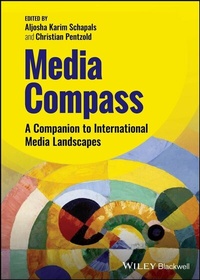
Media Compass
Description

An extensive and inclusive account of the media environments of 45 countries worldwide
In Media Compass: A Companion to International Media Landscapes, an international team of prominent scholars examines both long-term media systems and fluctuating trends in media usage around the world. Integrating country-specific summaries and cross-cutting studies of geopolitical regions, this interdisciplinary reference work describes key elements in the political, social, demographic, cultural, and economic conditions of media infrastructures and public communication.
Enabling the mapping of media landscapes internationally, Media Compass contains up-to-date empirical surveys of individual countries and regions, as well as cross-country comparisons of particular areas of public communication. 45 entries, each guiding readers from a general summary to a more in-depth discussion of a country's specific media landscape, address formative conditions and circumstances, historical background and development, current issues and challenges, and more.
Designed to facilitate quick lookup of individual entries, as well as comparative readings of a country's position in the wider media environment, Media Compass: A Companion to International Media Landscapes is an invaluable addition to libraries and institutions of higher education, and a must-read volume for students, educators, scholars, and practitioners working in communication and media studies, journalism, and media production.
More details
Other editions
Additional editions
Persons
Aljosha Karim Schapals is Senior Lecturer in Journalism, School of Communication, Queensland University of Technology (QUT), Australia, where he is Chief Investigator in the Digital Media Research Centre (DMRC). He is Reviews Editor for Media International Australia and the author of Peripheral Actors in Journalism. He has published articles in journals including Digital Journalism and Journalism Practice, and served as Lead Editor of Digitizing Democracy.
Christian Pentzold is Chair and Professor of Media and Communication, Department for Communication and Media Studies, Leipzig University, Germany. He has published widely in journals such as Media, Culture & Society, New Media & Society, Digital Journalism, and Convergence. He has edited several books including the Handbook of Peer Production, part of the Wiley-Blackwell Handbooks in Communication and Media series.
Content
List of Figures ix
List of Tables x
Notes on Contributors xi
1 Media Compass: Introduction 1
Aljosha Karim Schapals and Christian Pentzold
2 Austria: Losing Long-Term Media Market Stability 8
Josef Seethaler
3 Belgium: Media Ownership and Journalism Cultures at the Crossroads of Three Language Communities in a Complex Political Landscape 18
Hanne Vandenberghe and Karin Raeymaeckers
4 Czech Republic: Still on a Path to Realizing the Importance of Media 28
Lenka Waschková Císarova
5 Denmark: Balancing National Culture and Global Competition 38
Henrik Bodker
6 France: Toward an Illiberal Media Landscape? 47
Pierre-Emmanuel Guigo
7 Germany: A Structurally Differentiated Media Market 58
Johanna Wolleschensky and Annika Sehl
8 Hungary: One Country, Two Media Systems 70
Gábor Polyák and Ágnes Urbán
9 Italy: The Persistence of Political Partisanship in an Evolving Media Landscape 84
Alessio Cornia
10 Netherlands: A Diverse Media Landscape with High Audience Trust 96
Susan Vermeer and Tim Groot Kormelink
11 Norway: Media Welfare in a Small Nation 106
Karoline Andrea Ihlebak, Tine Ustad Figenschou, and Ragnhild Kr. Olsen
12 Poland: A Media System under Pressure from Politicization and Polarization 116
Jacek Mikucki, Katarzyna Gajlewicz-Korab, Maria Loszewska-Olowska, and Lukasz Szurminski
13 Russia: A Dance with Authoritarianism 128
Sofya Glazunova
14 Spain: A Fast-Changing Media Landscape 138
Alfonso Vara-Miguel and Ángel Arrese
15 Switzerland: Mounting Pressure on Journalism in a Small Media System 150
Colin Porlezza
16 Turkey: Rethinking Ideology in Turkey's Media Environment 161
Taner Dogan
17 United Kingdom: Changing Markets, Changing Audiences, and a Changing Product 171
John Jewell
18 Ukraine: Maintaining a Resilient Media Ecosystem in Wartime 181
Olga Boichak and Vadym Miskyi
19 Argentina: Poor Income and Political Interests in the Media System 196
Guillermo Mastrini and Agustín Espada
20 Brazil: From Media Clientelism to Digital Platforms' Threats 207
Mathias-Felipe de-Lima-Santos
21 Canada: A Challenged Media Ecosystem 219
Beth Rochester, Alfred Hermida, and Mary-Lynn Young
22 Chile: Exploring the Media Landscape in the Digital Age 230
David Kimber and Ricardo Leiva
23 Colombia: Media Ownership Concentration and Violence against Journalists in the Landscape 240
Víctor García-Perdomo
24 Mexico: Diversity and Journalistic Resilience amid Propaganda and Violence 250
Julio Juárez-Gámiz
25 United States: Exploring the Implications of Polarization, Platforms, and Private Funding 262
Joy Jenkins
26 Venezuela: Total Collapse and Aftermath of the Media Landscape 276
Monica Marchesi and Jairo Lugo-Ocando
27 Azerbaijan: A Post-Soviet Media in Limbo 285
Ilgar Seyidov
28 China: A Diverse and Complex Media Landscape 292
Shixin Ivy Zhang, Jianan Zhu, and Yijiao Wang
29 Hong Kong: Media Transformations under Democratic Backsliding 302
Dennis Leung and Michael Chan
30 India: Print Media Thrives in the World's Largest Democracy 312
Deb Aikat
31 Indonesia: An Evolving Media Landscape 326
Vidi Sukmayadi
32 Israel: A Media System under Siege 336
Amit M. Schejter
33 Japan: Exploring Historical Legacies, Political Interdependencies, and Digital Transformation 348
Yosuke Buchmeier
34 Lebanon: Media Diversity and Polarization: A Model for Confrontation 360
Zahera Harb
35 Philippines: Media as a Contested Site for Liberation and Domination 370
Carljohnson Anacin and Earvin Charles Cabalquinto
36 United Arab Emirates: Media as Voices of National Consensus 380
Mohammad Ayish
37 Singapore: Navigating Media Regulation and Digitization 390
Zhang Hao Goh, Matthew Chee Han Chew, and Edson C. Tandoc, Jr.
38 Egypt: Paradoxical Media Dynamics of Containment and Instability 398
Hanan Badr
39 Ethiopia: Media Landscape, Emerging Trends, and Future Prospects 411
Téwodros W. Workneh
40 Kenya: From a Checkered Press History to an Ever-Expanding Digital Media Ecology 422
Joy Kibarabara and David Cheruiyot
41 Namibia: A Critical Reflection on the Postapartheid Mediascapes in Namibia 432
Admire Mare
42 Nigeria: A Dynamic Media Space in Africa 444
Adeyanju Apejoye and Bruce Mutsvairo
43 South Africa: Media Freedom, Responsibilities, and Challenges 453
Herman Wasserman
44 Tunisia: An Unfinished Media System Transition 463
Carola Richter
45 Australia: One of the World's Most Concentrated Media Markets 473
Aljosha Karim Schapals
46 New Zealand: An Unregulated, Concentrated, and Financially Fragile Media System 483
Merja Myllylahti
Index 494
Notes on Contributors
Adeyanju Apejoye lectures in the Department of Mass Communication, Plateau State University, Bokkos, Nigeria. His research interests focus on journalism, digital media, and the intersection between democracy and political communication, particularly in the Global South, and media development. He received a PhD in Media and Cultural Studies from the University of Salford, United Kingdom. He has expertise in mixed-methods research, including applying software for qualitative and quantitative data analysis. He has published in journals and presented journalism and media studies papers at international conferences.
Deb Aikat earned his PhD in media and journalism in 1995 from Ohio University's Scripps School of Journalism. Since then, he has been a faculty member in the University of North Carolina (UNC) Hussman School of Journalism and Media at UNC-Chapel Hill. An award-winning scholar, Aikat theorizes the role of digital media in the global sphere. His peers elected him as the 2022-2023 President of the Association for Education in Journalism and Mass Communication (AEJMC), one of the premier scholarly organizations in the field. In 2019, Aikat co-authored the book, Agendamelding: News, Social Media, Audiences, and Civic Community. Prior to joining academia, Aikat worked as a journalist in India for the Ananda Bazar Patrika's The Telegraph newspaper from 1984 through 1992, where he reported on politics, education, and culture. He also reported for the BBC World Service. Originally born in India, Aikat became a naturalized US citizen in 2003.
Carljohnson Anacin completed his PhD at Griffith University, Queensland, Australia, and is currently working as a sessional lecturer, tutor, and researcher at the same university. His doctoral research is on the identity, musicality, and translocality of Filipino migrant musicians in Australia. Carl's research interests include popular music, migration, social media, and interdisciplinary studies. His recent publications include a book chapter on Musical Aspirations and DIY/DIO Practices in Online Communities of Amateur Independent Filipino Songwriters (2022, Palgrave Macmillan). Carl is also a practicing musician, volunteer worker, photographer, and radio host at Radio 4EB, Brisbane.
Ángel Arrese is Professor of Journalism at the School of Communication, University of Navarra, Spain. His research interests are in journalism and society, media management, and economic and financial news. He is the author of La identidad de The Economist [The Economist's identity] (1994), Prensa Económica [Economic and Financial Press] (2002), and ¿Interesa la economía? Economía, medios y ciudadanía [Is Economics interesting? The Economy, media and citizens] (2011). He has published on these topics in journals such as Journalism, Journalism Studies, Journalism Practice, Media History, Mass Communication and Society, Discourse & Society, Language & Communication, and Communication and Society, among others.
Mohammad Ayish is Professor of Media and Communication at the American University of Sharjah, United Arab Emirates (UAE). He holds a PhD in international communication from the University of Minnesota-Twin Cities (1986). Over the past 35 years, he has worked at several universities in Jordan and the UAE, including Yarmouk University, Jordan, UAE University, University of Sharjah, and currently the American University of Sharjah. His 70+ published books, chapters, and journal articles cover topics such as media and national development, Arab World satellite broadcasting, social media and youth, media studies in the Arab world, media and ethics, and the public sphere.
Hanan Badr is Professor at the Department of Communication, University of Salzburg, Austria. Heading the unit Public Spheres and Inequalities, she focuses on de-westernizing communication studies, comparing media systems, activism, digital public spheres, and how globalization and digitization transform journalism. She held positions at Freie Universität Berlin, Cairo University, and Orient-Institut Beirut/Max Weber Foundation. She is the recipient of the Kluge Fellowship at the Library of Congress. She also serves as Chair for the Activism, Communication, and Social Change interest group at the International Communication Association (ICA). She is Associate Editor of the Journal of Communication and Editorial Board member of the International Journal of Communication, Digital Journalism, and the Middle East Journal of Culture and Communication. Her work was published in Digital Journalism, the International Communication Gazette, Media and Communication, and Media, War & Conflict.
Henrik Bødker is Associate Professor at the Media and Journalism Studies Department at Aarhus University, Denmark. Recently, he has turned his interest in temporality and journalism toward environmental issues. In 2021, he co-edited Climate Change and Journalism: Negotiating Rifts of Time (2021, Routledge) and co-authored "Climate Change Journalism in Norway: Working with frequency around the 'green shift'" (Journalism Studies, 2022). He is currently heading the project "Seasonal Journalism as Vernacular Phenology," which has so far resulted in "Seasonal Journalism and Climate Change" in the forthcoming second edition of The Routledge Companion to Digital Journalism Studies, and co-authored "Danish Public Service Online Weather from 2005-2022: From Meteorological Data and Information to Leisurely Commonality" (Media, Culture & Society, 2023). His work appears in Media History, Critical Studies in Media Communication, Media, Culture & Society, Journalism, Digital Journalism, and Journalism Studies.
Olga Boichak is Senior Lecturer in Digital Cultures and serves as the Director of the Computational Social Science Lab at the University of Sydney, Australia. She is an editor of the Digital War journal, and her research interests span networks, narratives, and cultures of activism in the digital age. She writes for a range of academic and popular media on contemporary Ukraine with a particular focus on participatory warfare, influence operations, volunteer, and humanitarian initiatives. Her auto-ethnographic essay, "Hidden Bread and Hidden Histories," has inspired an award-winning Missing Chapter documentary (Vox, 2022). She is currently working on a project that maps topographies of Ukraine's digital sovereignty as part of her Australian Research Council Discovery Early Career fellowship. Prior to becoming an academic, she was the Director of the Centre for Public Opinion Research and Ukraine's youth representative to the United Nations.
Yosuke Buchmeier is Research Associate at the Department of Asian Studies at Ludwig-Maximilians-Universität München (LMU Munich), Germany. Previously he was a research fellow at the German Institute for Japanese Studies in Tokyo, Japan. His research interests include political communication, public service media, digital transformation, and artificial intelligence, and the relationship between media and politics in the context of democratic systems. Buchmeier's latest works have appeared in Journalism Studies, Media, Culture & Society, and Perspectives on Politics.
Earvin Charles Cabalquinto is Australian Research Council DECRA Fellow and Senior Lecturer at Monash University. He is Honorary Visiting Fellow at the Humanities Research Centre at the Australian National University. He is the co-convenor of the Migration and Mobility Research Network (MMRN), supported by the Monash Migration and Inclusion Centre at Monash University. He is the author of (Im)mobile Homes: Family Life at a Distance in the Age of Mobile Media published under the Studies in Mobile Communication series of Oxford University Press. He is a co-author of Philippine Digital Cultures: Brokerage Dynamics on YouTube published as part of the Asian Visual Cultures series of Amsterdam University Press. His expertise lies in the intersecting fields of digital media, migration, mobilities, and aging research. His current projects explore the production of the digital divide in an increasingly transnational and networked era.
Michael Chan is Associate Professor at the School of Journalism & Communication, Chinese University of Hong Kong, where he is also the Graduate Division Head and the Director of the Centre for Communication and Public Opinion Survey (CCPOS). His research examines the uses and impact of communication technologies on individuals and society from a cross-national comparative perspective, focusing on the areas of news, politics, and well-being. His works have appeared in over 50 SSCI journal articles, and he also serves as Associate Editor for Political Communication and Telematics and Informatics as well as Editorial Board Member for eight other journals.
David Cheruiyot is Assistant Professor at the Centre for Media and Journalism Studies at the University of Groningen in the Netherlands. David is interested in non-journalistic actors, for example, mainstream media critics, and how they shape journalistic practice. His research has appeared in Digital Journalism, Journalism Studies, and the International...
