

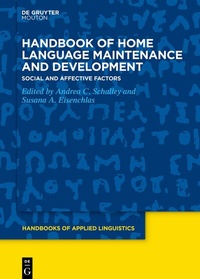
Handbook of Home Language Maintenance and Development
Description

Even a cursory look at conference programs and proceedings reveals a burgeoning interest in the field of social and affective factors in home language maintenance and development. To date, however, research on this topic has been published in piecemeal fashion, subsumed under the more general umbrella of 'bilingualism'. Within bilingualism research, there has been an extensive exploration of linguistic and psycholinguistic perspectives on the one hand, and educational practices and outcomes on the other. In comparison, social and affective factors - which lead people to either maintain or shift the language - have been under-researched.
This is the first volume that brings together the different strands in research on social and affective factors in home language maintenance and development, ranging from the micro-level (family language policies and practices), to the meso-level (community initiatives) and the macro-level (mainstream educational policies and their implementation). The volume showcases a wide distribution across contexts and populations explored. Contributors from around the world represent different research paradigms and perspectives, providing a rounded overview of the state-of-the-art in this flourishing field.
More details
Other editions
Additional editions
Persons
Content
- Intro
- Preface
- Acknowledgements
- Contents
- 1 Social and affective factors in home language maintenance and development: Setting the scene
- Part 1: Terminologies and methodologies
- 2 Making sense of "home language" and related concepts
- 3 Researching social and affective factors in home language maintenance and development: A methodology overview
- Topic area 2.1: Self-conceptions and affective reactions
- 4 Harmonious Bilingualism: Well-being for families in bilingual settings
- 5 Anxiety as a negative emotion in home language maintenance and development
- 6 Identity in home-language maintenance
- 7 Intergenerational challenges: Of handing down languages, passing on practices, and bringing multilingual speakers into being
- Topic area 2.2: Family language policy
- 8 Family language policy: Foundations, theoretical perspectives and critical approaches
- 9 Factors influencing family language policy
- 10 Strategies and practices of home language maintenance
- 11 Child agency and home language maintenance
- 12 Future prospects and visions for family language policy research
- Part 3: Grassroot initiatives
- 13 Social media and the use of technology in home language maintenance
- 14 Transnational grassroots language planning in the era of mobility and the Internet
- 15 Community language schools
- 16 The drivers of home language maintenance and development in indigenous communities
- Topic area 4.1: Social justice and inclusiveness
- 17 Language policy and planning for language maintenance: The macro and meso levels
- 18 Language attitudes and ideologies on linguistic diversity
- 19 Social justice and inclusiveness through linguistic human rights in education
- 20 Disabilities and home language maintenance: Myths, models of disability, and equity
- Topic area 4.2: Formal education
- 21 Models of formal education and minority language teaching across countries
- 22 Teachers' beliefs and attitudes towards home languages maintenance and their effects
- 23 The mainstream classroom and home language maintenance
- About the contributors
- Author Index
- Subject Index
- Language Index
