

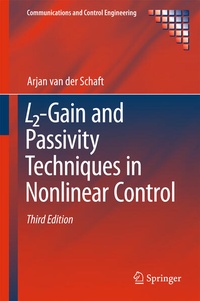
L2-Gain and Passivity Techniques in Nonlinear Control
Description

This standard text gives a unified treatment of passivity and L 2 -gain theory for nonlinear state space systems, preceded by a compact treatment of classical passivity and small-gain theorems for nonlinear input-output maps. The synthesis between passivity and L 2 -gain theory is provided by the theory of dissipative systems. Specifically, the small-gain and passivity theorems and their implications for nonlinear stability and stabilization are discussed from this standpoint. The connection between L 2 -gain and passivity via scattering is detailed.
Feedback equivalence to a passive system and resulting stabilization strategies are discussed. The passivity concepts are enriched by a generalised Hamiltonian formalism, emphasising the close relations with physical modeling and control by interconnection, and leading to novel control methodologies going beyond passivity.
The potential of L 2 -gain techniquesin nonlinear control, including a theory of all-pass factorizations of nonlinear systems, and of parametrization of stabilizing controllers, is demonstrated. The nonlinear H-infinity optimal control problem is also treated and the book concludes with a geometric analysis of the solution sets of Hamilton-Jacobi inequalities and their relation with Riccati inequalities for the linearization.
· L 2 -Gain and Passivity Techniques in Nonlinear Control (third edition) is thoroughly updated, revised, reorganized and expanded. Among the changes, readers will find:
· updated and extended coverage of dissipative systems theory
· substantial new material regarding converse passivity theorems and incremental/shifted passivity · coverage of recent developments on networks of passive systems with examples
· a completely overhauled and succinct introduction to modeling and control of port-Hamiltonian systems, followed by an exposition of port-Hamiltonian formulation of physical network dynamics
· updated treatment of all-pass factorization of nonlinear systems
The book provides graduate students and researchers in systems and control with a compact presentation of a fundamental and rapidly developing area of nonlinear control theory, illustrated by a broad range of relevant examples stemming from different application areas.
Reviews / Votes
"The book presents a well written and systematically organized text focused on a unified treatment of classical input-output stability theory and recent results in nonlinear robust and passivity-based control. . The book will be useful to advanced graduate students, researchers and applied mathematicians interested in this emerging area." (Lubomír Bakule, zbMath 1410.93004, 2019)"This text is sure to continue to be one of the go-to references for nonlinear control researchers and practitioners interested in both the classical and modern interpretations and applications of L2-gain and passivity methods for nonlinear systems." (James Richard Forbes, IEEE Control Systems Magazine, December, 2017)
More details
Other editions
Additional editions
Person
A.J. (Arjan) van der Schaft (1955) received the undergraduate and Ph.D. degrees in Mathematics from the University of Groningen, The Netherlands, in 1979 and 1983, respectively. In 1982 he joined the Department of Applied Mathematics, University of Twente, Enschede, where he was appointed as a full professor in Mathematical Systems and Control Theory in 2000. In September 2005 he returned to Groningen as a full professor in Mathematics.
He has served as Associate Editor for Systems & Control Letters, Journal of Nonlinear Science, SIAM Journal on Control and Optimization, IEEE Transactions on Automatic Control and the European Journal of Control. Currently he is on the Editorial Board for the Journal of Geometric Mechanics and Annual Reviews in Control.
Arjan van der Schaft is Fellow of the Institute of Electrical and Electronics Engineers (IEEE) and of the International Federation of Automatic Control (IFAC). He was Invited Lecturer at the International Congress of Mathematicians, Madrid, Spain, 2006. He is the 2013 recipient of the 3-yearly awarded Certificate of Excellent Achievements} of the IFAC Technical Committee on Nonlinear Systems.
Arjan van der Schaft is (co-)author of the following other books: System Theoretic Descriptions of Physical Systems (1984), Variational and Hamiltonian Control Systems (1987, with P.E. Crouch), Nonlinear Dynamical Control Systems (1990, with H. Nijmeijer), An Introduction to Hybrid Dynamical Systems (2000, with J.M. Schumacher), Modeling and Control of Complex Physical Systems: the Port-Hamiltonian Approach( Geoplex Consortium, 2009), and Port-Hamiltonian Systems Theory: An Introductory Overview (2014, with D. Jeltsema). He (co-)edited five conference proceedings.
He (co-)authored around 125 journal articles and 265 refereed contributions to proceedings or book chapters.
