

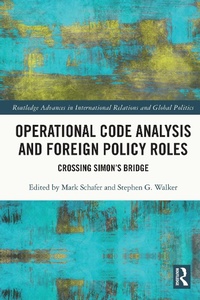
Operational Code Analysis and Foreign Policy Roles
Crossing Simon's Bridge
1st Edition
Published on 22. March 2021
410 pages
978-1-000-34843-9 (ISBN)
Description

In this book, senior scholars and a new generation of analysts present different applications of recent advances linking beliefs and decision-making, in the area of foreign policy analysis with strategic interactions in world politics.
Divided into five parts, Part 1 identifies how the beliefs in the cognitive operational codes of individual leaders explain the political decisions of states. In Part 2, five chapters illustrate progress in comparing the operational codes of individual leaders, including Vladimir Putin of Russia, three US presidents, Bolivian president Evo Morales, Sri Lanka's President Chandrika Kumaratunga, and various leaders of terrorist organizations operating in the Middle East and North Africa. Part 3 introduces a new Psychological Characteristics of Leaders (PsyCL) data set containing the operational codes of US presidents from the early 1800s to the present. In Part 4, the focus is on strategic interactions among dyads and evolutionary patterns among states in different regional and world systems. Part 5 revisits whether the contents of the preceding chapters support the claims about the links between beliefs and foreign policy roles in world politics.
Richly illustrated and with comprehensive analysis Operational Code Analysis and Foreign Policy Roles will be of interest to specialists in foreign policy analysis, international relations theorists, graduate students, and national security analysts in the policy-making and intelligence communities.
Divided into five parts, Part 1 identifies how the beliefs in the cognitive operational codes of individual leaders explain the political decisions of states. In Part 2, five chapters illustrate progress in comparing the operational codes of individual leaders, including Vladimir Putin of Russia, three US presidents, Bolivian president Evo Morales, Sri Lanka's President Chandrika Kumaratunga, and various leaders of terrorist organizations operating in the Middle East and North Africa. Part 3 introduces a new Psychological Characteristics of Leaders (PsyCL) data set containing the operational codes of US presidents from the early 1800s to the present. In Part 4, the focus is on strategic interactions among dyads and evolutionary patterns among states in different regional and world systems. Part 5 revisits whether the contents of the preceding chapters support the claims about the links between beliefs and foreign policy roles in world politics.
Richly illustrated and with comprehensive analysis Operational Code Analysis and Foreign Policy Roles will be of interest to specialists in foreign policy analysis, international relations theorists, graduate students, and national security analysts in the policy-making and intelligence communities.
Reviews / Votes
"This is an indispensable volume to advance the study of political leaders and foreign policy. The chapters individually and collectively push theoretical, methodological, and empirical boundaries to showcase state-of-the-art work on operational codes. I am extremely impressed by the book's rigor, its comparative perspective, and its relevance to significant foreign policy issues. I highly recommend 'crossing Simon's bridge' with this volume that is chock-full of excellent research."Juliet Kaarbo, University of Edinburgh
"Occasionally, there is a "big picture" book that brings together disparate strands of scholarship into a coherent whole that is much greater than the sum of its parts. This is one of those books. Built on decades of data gathering, methodological innovation and theoretical development, Walker, Schafer, and their colleagues skillfully illuminate the complex linkages among leader personality, belief systems, and foreign policy roles. This is a pathbreaking synthesis and a vital contribution to the field of foreign policy analysis."
Paul Kowert, University of Massachusetts Boston
"This excellent volume has taken a huge step toward bridging the study of minds and international relations, showing with great clarity and rigor how leaders' characteristics shape and shove foreign policies and strategic interactions. It represents a watershed moment in the study of agency in international relations, bringing together sophisticated methods and innovative theorising to clarify the role leaders play on the world stage."
Ryan K Beasley, University of St. Andrews
"This major work of scholarship brings together an outstanding team to make advancements in application of operational code analysis to a wide range of leaders around the globe. Comparative case studies, statistical analysis of conflict processes involving the US in particular, and computational game-theoretic models of decision-making are brought together to produce impressive new findings. The theory and findings from this volume will be of great interest to many readers, notably specialists in foreign policy analysis and the policy-making community."
Patrick James, Dornsife Dean's Professor of International Relations, University of Southern California
"Walker, Schafer, and their contributors clear a new theoretical and empirical path between the study of foreign policy and international relations. The authors develop and fully explicate the means to bring behavioral science-through Operational Code-and social science-through Role Theory-together so that we understand the micro-foundations of IR and the meso-effects of the structure on decision-making units. This volume is a must read for students of foreign policy and international relations alike, for to understand our changing world, we must consider both decision-makers and the environments they create."
Cooper Drury, University of Missouri
More details
Series
Edition
1. Auflage
Language
English
Place of publication
London
United Kingdom
Publishing group
Taylor & Francis Ltd
Target group
College/higher education
Product notice
Reflowable
Illustrations
72 Tables, black and white; 54 Line drawings, black and white; 126 Illustrations, black and white
ISBN-13
978-1-000-34843-9 (9781000348439)
Copyright in bibliographic data and cover images is held by Nielsen Book Services Limited or by the publishers or by their respective licensors: all rights reserved.
Schweitzer Classification
Other editions
Additional editions
Mark Schafer | Stephen G. Walker
Operational Code Analysis and Foreign Policy Roles
Crossing Simon's Bridge
Book
09/2022
1st Edition
Routledge
€66.50
Shipment within 15-20 days
Mark Schafer | Stephen G. Walker
Operational Code Analysis and Foreign Policy Roles
Crossing Simon's Bridge
Book
03/2021
1st Edition
Routledge
€263.30
Shipment within 15-20 days
Persons
Mark Schafer is a Professor of Political Psychology in the School of Politics, Security, and International Affairs at the University of Central Florida working primarily in the field of international relations. His research interests include groupthink, the operational code, and psychological correlates of foreign policy behavior. He has published his research in major journals such as Journal of Politics, International Studies Quarterly, and Journal of Conflict Resolution. He received the Erik Erikson Award for Early Career Achievement from the International Society of Political Psychology in 2003, and was honored with the Distinguished Scholar Award from the Foreign Policy Analysis Section of the International Studies Association in 2021.
Stephen G. Walker is Professor Emeritus in the School of Politics and Global Studies at Arizona State University. His research interests focus on conflict management and resolution, foreign policy analysis, and political psychology. His research articles have appeared in Political Psychology, Journal of Conflict Resolution, and International Studies Quarterly. He received the Foreign Policy Section's Distinguished Scholar Award from the International Studies Association in 2003.
Stephen G. Walker is Professor Emeritus in the School of Politics and Global Studies at Arizona State University. His research interests focus on conflict management and resolution, foreign policy analysis, and political psychology. His research articles have appeared in Political Psychology, Journal of Conflict Resolution, and International Studies Quarterly. He received the Foreign Policy Section's Distinguished Scholar Award from the International Studies Association in 2003.
Content
Part 1: Beliefs and Roles in World Politics 1. The Interface between Beliefs and Roles in World Politics 2. The Development of Foreign Policy Roles: Beliefs and Complex Adaptive Systems Part 2: The Operational Codes of World Leaders 3. Revisiting the Operational Code of Vladimir Putin 4. Deciphering Deadly Minds in Their Native Language: The Operational Codes and Formation Patterns of Militant Organizations in the Middle East and North Africa 5. Operational Code Analysis and Civil Conflict Severity 6. Policy Documents and the Beliefs of Foreign Policy Decision-Makers: A Next Step in Operational Code Analysis 7. One Step Forward, Two Steps Back: The Steering Effects of Operational Code Beliefs in the Chilean-Bolivian Rivalry Part 3: The Psychological Characteristics of US Presidents 8. Psychological Correlates and US Conflict Behavior: The PsyCL Data Set 9. Operational Code Beliefs and Threat Perceptions by US Presidents 10. Presidential Personalities and Operational Codes: Learning Effects and Midterm Congressional Election Results 11. US Presidential Belief Systems and the Evolution of Peace in the International System Part 4: Computational Models of Foreign Policy Roles 12. Binary Role Theory and the Evolution of Cooperation in World Politics 13. Binary Role Theory and the Operational Code Analysis of Grand Strategies: Can Balancing Work? 14. Operational Code Analysis: A Method for Measuring Strategic Culture 15. An Operational Code Analysis of Foreign Policy Roles in US-Iran Strategic Dyads Part 5: Beyond Beliefs in World Politics 16. Operational Codes and Foreign Policy Roles: Conceptual Insights and Empirical Results
