

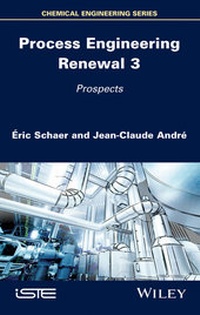
Process Engineering Renewal 3
Prospects
1st Edition
Published on 16. July 2020
368 pages
978-1-119-75124-3 (ISBN)
Description

Process engineering emerged at the beginning of the 20th Century and has become an essential scientific discipline for the matter and energy processing industries. Its success is incontrovertible, with the exponential increase in techniques and innovations.
Rapid advances in new technologies such as artificial intelligence, as well as current societal needs sustainable development, climate change, renewable energy, the environment are developments that must be taken into account in industrial renewal.
Process Engineering Renewal 3 presents a prospective analysis that demonstrates the significant disruptions linked to sustainable development, global warming, etc. These constraints may trigger changes in the social regulation system, which in turn applies pressure on actors of process engineering to evolve and adapt to these developments.
Rapid advances in new technologies such as artificial intelligence, as well as current societal needs sustainable development, climate change, renewable energy, the environment are developments that must be taken into account in industrial renewal.
Process Engineering Renewal 3 presents a prospective analysis that demonstrates the significant disruptions linked to sustainable development, global warming, etc. These constraints may trigger changes in the social regulation system, which in turn applies pressure on actors of process engineering to evolve and adapt to these developments.
More details
Other editions
Additional editions
Book
07/2020
1st Edition
Wiley-ISTE
€164.50
Shipment within 3-4 weeks

Book
Wiley
€156.25
The article will not be published
Persons
Eric Schaer is an engineer at ENSIC (French National School of Chemical Industries) and Professor at the University of Lorraine, France. His research extends to the implementation of homogeneous and heterogeneous chemical reactions.
Jean-Claude Andre is Research Director at CNRS (French National Center for Scientific Research), researcher at the University of Lorraine, France and an ENSIC engineer. He focuses his research on light-matter interactions and associated process engineering.
Jean-Claude Andre is Research Director at CNRS (French National Center for Scientific Research), researcher at the University of Lorraine, France and an ENSIC engineer. He focuses his research on light-matter interactions and associated process engineering.
Content
Foreword vii
Preface xi
Introduction xxxi
Chapter 1. Between Innovation in Process Engineering and Creativity 1
1.1. Innovations and process engineering 5
1.2. Creativity 9
1.2.1. Creativity and pedagogy 18
1.3. Innovation and boundary objects 20
1.4. Teleological approach, convergence, and interdisciplinarity 29
1.5. A look back at the notion of convergence 39
1.6. A look back at interdisciplinarity 47
1.7. The models 51
1.8. A little complexity 53
1.8.1. Hyperobjects 59
1.9. Reaching a decision 60
1.10. Findings and proposals 61
1.10.1. Technology: serve and/or partner 64
1.10.2. How to do or not to do? 72
1.11. Activities initiated from the "base" 76
1.11.1. Framing elements 76
1.11.2. Main results 78
1.11.3. "Scientific excellence" 89
1.11.4. Funding and research orientation 90
1.11.5. Foresight, opportunities for the PE research unit. 91
1.11.6. Collective projects? Risky projects? 93
1.11.7. Difficulties in the functioning of research 97
1.11.8. Concluding elements 101
1.12. Conclusion 107
1.13. References 118
Chapter 2. Prospective Elements Applied to the Transformation of Matter and Energy 149
2.1. From a local to a more global approach 162
2.2. Some reminders 170
2.2.1. General framework 170
2.2.2. In reality... 175
2.3. Influential trends 177
2.3.1. Socio-economic context 178
2.3.2. Innovation and means/ways/needs to support it 192
2.3.3. Exhaustion of reserves 198
2.4. Scenarios for tomorrow 212
2.4.1. Background information 217
2.4.2. Introduction 218
2.4.3. The four scenarios 219
2.4.4. Blocking factors; probable scenario(s) 235
2.4.5. Potential effects on the development of process engineering 238
2.5. Conclusion 244
2.6. References 254
Conclusion 279
Index 317
Preface xi
Introduction xxxi
Chapter 1. Between Innovation in Process Engineering and Creativity 1
1.1. Innovations and process engineering 5
1.2. Creativity 9
1.2.1. Creativity and pedagogy 18
1.3. Innovation and boundary objects 20
1.4. Teleological approach, convergence, and interdisciplinarity 29
1.5. A look back at the notion of convergence 39
1.6. A look back at interdisciplinarity 47
1.7. The models 51
1.8. A little complexity 53
1.8.1. Hyperobjects 59
1.9. Reaching a decision 60
1.10. Findings and proposals 61
1.10.1. Technology: serve and/or partner 64
1.10.2. How to do or not to do? 72
1.11. Activities initiated from the "base" 76
1.11.1. Framing elements 76
1.11.2. Main results 78
1.11.3. "Scientific excellence" 89
1.11.4. Funding and research orientation 90
1.11.5. Foresight, opportunities for the PE research unit. 91
1.11.6. Collective projects? Risky projects? 93
1.11.7. Difficulties in the functioning of research 97
1.11.8. Concluding elements 101
1.12. Conclusion 107
1.13. References 118
Chapter 2. Prospective Elements Applied to the Transformation of Matter and Energy 149
2.1. From a local to a more global approach 162
2.2. Some reminders 170
2.2.1. General framework 170
2.2.2. In reality... 175
2.3. Influential trends 177
2.3.1. Socio-economic context 178
2.3.2. Innovation and means/ways/needs to support it 192
2.3.3. Exhaustion of reserves 198
2.4. Scenarios for tomorrow 212
2.4.1. Background information 217
2.4.2. Introduction 218
2.4.3. The four scenarios 219
2.4.4. Blocking factors; probable scenario(s) 235
2.4.5. Potential effects on the development of process engineering 238
2.5. Conclusion 244
2.6. References 254
Conclusion 279
Index 317
