

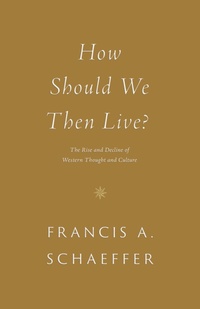
How Should We Then Live?
Description

Francis Schaeffer's Classic Analysis of the Rise and Decline of Western Thought and Culture
Civilizations throughout history have built societies around their own limited value systems including rulers, finite gods, or relativism-only to fail. The absence of a Christian foundation eventually leads to breakdown, and those signs are visible in present-day culture as well. Can modern society avoid the same fate?
In this latest edition of How Should We Then Live?, theologian Francis A. Schaeffer traces the decline of Western culture from the fall of Rome, through the Middle Ages and the Enlightenment, and up to the twentieth century. Studying humanism's impact on philosophy, science, and religion, he shows how this worldview historically results in apathy, chaos, and decline. Schaeffer's important work calls on readers to live instead by Christian ethics, placing their trust in the infinite personal God of the Bible. Originally written in 1976, How Should We Then Live? remains remarkably applicable today.
- A Theology Classic: Written by renowned Christian philosopher Francis A. Schaeffer
- For Those Interested in Philosophy and History: Engages with the ideas of Plato, John Locke, Thomas Jefferson, and Voltaire, and examines the art, architecture, and ideas that shaped modern society
- Explores the Importance of a Christian Worldview: A practical assessment of the evolution of culture and the steadfast alternative offered by the biblical perspective
More details
Other editions
Additional editions
Person
Francis A. Schaeffer (1912-1984) authored more than twenty books, which have been translated into several languages and have sold millions globally. He and his wife, Edith, founded the L'Abri Fellowship international study and discipleship centers. Recognized internationally for his work in Christianity and culture, Schaeffer passed away in 1984 but his influence and legacy continue worldwide.
Content
- Intro
- Cover
- Newsletter Signup
- Endorsements
- Title Page
- Copyright
- Contents
- Illustrations
- Author's Note
- Chapter One Ancient Rome
- Chapter Two The Middle Ages
- Chapter Three The Renaissance
- Chapter Four The Reformation
- Chapter Five The Reformation-Continued
- Chapter Six The Enlightenment
- Chapter Seven The Rise of Modern Science
- Chapter Eight The Breakdown in Philosophy and Science
- Chapter Nine Modern Philosophy and Modern Theology
- Chapter Ten Modern Art, Music, Literature, and Films
- Chapter Eleven Our Society
- Chapter Twelve Manipulation and the New Elite
- Chapter Thirteen The Alternatives
- A Special Note
- Acknowledgments
- Chronological Index
- Notes
- Select Bibliography
- Bibliography of Other Books
- Other Crossway Books
- General Index
