

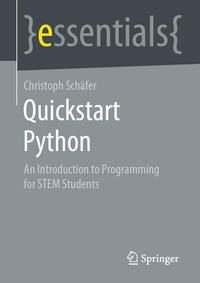
Quickstart Python
Description

Christoph Schäfer introduces the great world of programming with Python and provides a quick introduction to independent script development. He points out how the programming language Python has established itself in recent years alongside MATLAB and R as a standard at scientific workplaces in research and development, and shows that the great popularity of Python is based on its easy extensibility: It is very easy to use modules from other developers in your own scripts and programs. In particular, the author presents the modules NumPy, SciPy and Matplotlib, which offer scientists and engineers a perfect development environment for scientific and technical computing, for applications in physics, chemistry, biology and computer science. Python is also used in the latest applications in the highly topical fields of Big Data Science and Machine Learning.
The author:
Dr. Christoph Schäfer teaches and researches in the Department of Computational Physics at the Institute of Astronomy and Astrophysics at the Eberhard Karls University of Tübingen.
This Springer essential is a translation of the original German 1st edition essentials , Schnellstart Python by Christoph Schäfer, published by Springer Fachmedien Wiesbaden GmbH, part of Springer Nature in 2019. The translation was done with the help of artificial intelligence (machine translation by the service DeepL.com). A subsequent human revision was done primarily in terms of content, so that the book will read stylistically differently from a conventional translation. Springer Nature works continuously to further the development of tools for the production of books and on the related technologies to support the authors.
More details
Other editions
Additional editions
Person
Dr. Christoph Schäfer teaches and researches in the Computational Physics department at the Institute for Astronomy and Astrophysics at the Eberhard Karls University in Tübingen.
Content
Installation of Python and basic structure of a Python program.- data types, variables, lists, strings, dictionaries, operators and functions.- structuring with conditional statements and modules.- extensions for natural scientists: NumPy, SciPy, Matplotlib, pandas.
