

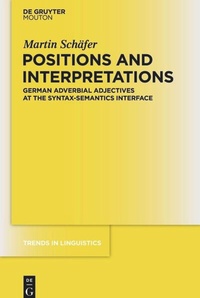
Positions and Interpretations
Description

The structural and semantic properties of adverbials represent a still poorly understood area of sentential syntax and semantics in Germanic languages. In particular, it is an open question which different adverbial usages need to be distinguished, which usages are tied to which syntactic positions, and how these different usage can be formally analyzed. Focussing on adverbial adjectives in German, this study provides detailed answers to these questions. By distinguishing between verb-related adverbials and event-related adverbials, the author provides a new analysis of the large class of adverbials traditionally labelled as manner adverbials. It is shown that the two different classes are linked to different syntactic positions, and formal analyses and derivations for the two different usages are developed. The book is therefore of interest not only to anyone working on the linguistics of German but also to all linguists working on the syntax-semantics interface and the formal analysis of adverbials.
More details
Other editions
Additional editions
Person
Content
1.1 - 1 Scope and aim [Seite 17]
1.2 - 2 On adverbials and adjectives [Seite 19]
1.2.1 - 2.1 Defining adverbials [Seite 20]
1.2.1.1 - 2.1.1 Adverbial vs. subject [Seite 21]
1.2.1.2 - 2.1.2 Adverbial vs. object [Seite 22]
1.2.1.3 - 2.1.3 Adverbial vs. predicative [Seite 28]
1.2.1.4 - 2.1.4 Adverbial vs. particle [Seite 30]
1.2.1.5 - 2.1.5 Summary [Seite 32]
1.2.2 - 2.2 Adverbial adjectives [Seite 33]
1.2.2.1 - 2.2.1 Adjectives [Seite 33]
1.2.2.2 - 2.2.2 Adverbs [Seite 35]
1.2.2.3 - 2.2.3 Adjective or adverb? [Seite 37]
1.2.3 - 2.3 Summary [Seite 39]
1.3 - 3 Basic distinctions [Seite 40]
1.3.1 - 3.1 Class properties of adverbial adjectives [Seite 41]
1.3.2 - 3.2 Set-theoretic classifications of adjectives [Seite 41]
1.3.3 - 3.3 Sentence and non-sentence adverbials [Seite 44]
1.3.4 - 3.4 Other important semantic properties [Seite 45]
1.3.4.1 - 3.4.1 Opacity [Seite 45]
1.3.4.2 - 3.4.2 Veridicality [Seite 46]
1.4 - 4 Structure of the book [Seite 46]
2 - 2 The readings of sentence adverbials [Seite 49]
2.1 - 1 Introduction [Seite 49]
2.2 - 2 Subject-oriented adverbials [Seite 50]
2.2.1 - 2.1 Adverbial adjectives as subject-oriented adverbials [Seite 52]
2.3 - 3 Speaker-oriented adverbials [Seite 53]
2.3.1 - 3.1 Speech-act adverbials [Seite 54]
2.3.2 - 3.2 Epistemic adverbials [Seite 55]
2.3.3 - 3.3 Evaluative adverbials [Seite 58]
2.4 - 4 Domain adverbials [Seite 61]
2.5 - 5 Semantic constraints on possible sentence adverbials [Seite 63]
2.6 - 6 Conclusion [Seite 64]
3 - 3 The readings of verb-related adverbials [Seite 65]
3.1 - 1 Introduction [Seite 65]
3.2 - 2 Manner adverbials [Seite 67]
3.2.1 - 2.1 Introduction [Seite 67]
3.2.2 - 2.2 Pure manner adverbials [Seite 72]
3.2.3 - 2.3 Agent-oriented manner adverbials [Seite 74]
3.2.4 - 2.4 Further orientations [Seite 78]
3.3 - 3 Degree adverbials [Seite 79]
3.3.1 - 3.1 Contexts and constraints for degree modification [Seite 81]
3.3.2 - 3.2 Degree-manner ambiguities [Seite 82]
3.4 - 4 Method-oriented adverbials [Seite 83]
3.5 - 5 Verb-related adverbials and secondary predication [Seite 85]
3.5.1 - 5.1 Resultatives [Seite 85]
3.5.2 - 5.2 Ambiguities and blends [Seite 87]
3.5.3 - 5.3 Depictives [Seite 91]
3.6 - 6 Adverbial adjectives and the verb-adverbial combinatorics [Seite 94]
3.6.1 - 6.1 Statives that allow manner modification [Seite 95]
3.6.2 - 6.2 Mannerless statives [Seite 99]
3.7 - 7 Verb-related adverbials and negation [Seite 101]
3.7.1 - 7.1 Negation, adverbials, and the sentential base [Seite 102]
3.7.2 - 7.2 Verb-related adverbials with scope over negation [Seite 105]
3.8 - 8 Conclusion [Seite 110]
4 - 4 Event-related adverbials [Seite 113]
4.1 - 1 Mental-attitude adverbials [Seite 113]
4.1.1 - 1.1 Mental-attitude adverbials and opacity [Seite 115]
4.1.2 - 1.2 Mental-attitude adverbials vs. secondary predication [Seite 116]
4.1.3 - 1.3 Transparent adverbials [Seite 117]
4.1.4 - 1.4 Transparent adverbials, depictives and negation [Seite 119]
4.2 - 2 Event-external adverbials [Seite 120]
4.2.1 - 2.1 Inchoative readings of schnell and langsam [Seite 121]
4.2.2 - 2.2 Holistic usages [Seite 122]
4.2.2.1 - 2.2.1 Holistic usages and the internal structure of the event [Seite 122]
4.2.2.2 - 2.2.2 Quantified direct objects [Seite 126]
4.2.2.3 - 2.2.3 Modifiers of complex events [Seite 131]
4.3 - 3 The wobei-paraphrase [Seite 133]
4.3.1 - 3.1 Wobei vs. während [Seite 134]
4.3.2 - 3.2 Event-related adverbials and the wobei-paraphrase [Seite 136]
4.3.2.1 - 3.2.1 Mental-attitude adverbials and the wobei-paraphrase [Seite 136]
4.3.2.2 - 3.2.2 The wobei-paraphrase and event-external modification [Seite 137]
4.3.2.3 - 3.2.3 The wobei-paraphrase and associated readings [Seite 139]
4.4 - 4 Summary [Seite 141]
5 - 5 The syntactic position of manner adverbials [Seite 143]
5.1 - 1 Introduction [Seite 143]
5.2 - 2 Establishing syntactic positions [Seite 145]
5.3 - 3 Adverbial modification and information structure [Seite 146]
5.3.1 - 3.1 Focus projection [Seite 146]
5.3.2 - 3.2 Adverbials and normal word order [Seite 150]
5.4 - 4 Eckardt's account: Scrambled indefinite direct objects [Seite 151]
5.4.1 - 4.1 Restricted combinations: Implicit resultatives and verbs of creation [Seite 152]
5.4.2 - 4.2 The readings of indefinites and topicality [Seite 154]
5.4.3 - 4.3 In-group readings [Seite 154]
5.4.4 - 4.4 Problems for Eckardt's account [Seite 156]
5.4.4.1 - 4.4.1 Frey vs Eckardt: The strong reading of indefinites [Seite 156]
5.4.4.2 - 4.4.2 Manner adverbials and verbs of creation [Seite 157]
5.5 - 5 Frey and Pittner: Object integration [Seite 157]
5.5.1 - 5.1 Resultatives and integration [Seite 160]
5.6 - 6 An alternative account: It's the adverbial's reading that is decisive [Seite 161]
5.6.1 - 6.1 Adverbials out of the blue [Seite 161]
5.6.1.1 - 6.1.1 Thetic sentences [Seite 164]
5.6.2 - 6.2 Re-interpreting the controversial examples [Seite 168]
5.6.2.1 - 6.2.1 Existentially interpreted w-phrases [Seite 168]
5.6.2.2 - 6.2.2 W-phrases: Re-interpreting the data [Seite 170]
5.6.3 - 6.3 Theme-rheme condition [Seite 173]
5.7 - 7 More evidence and some subtleties [Seite 176]
5.7.1 - 7.1 Clear minimal pairs [Seite 176]
5.7.2 - 7.2 Lexical semantics and verb-adverbial combinatorics [Seite 179]
5.7.3 - 7.3 Scrambling [Seite 180]
5.8 - 8 Summary [Seite 181]
6 - 6 Adverbials in formal semantics: The classical analyses [Seite 183]
6.1 - 1 The operator approach [Seite 183]
6.1.1 - 1.1 Thomason and Stalnaker [Seite 185]
6.1.2 - 1.2 The operator approach and scope [Seite 186]
6.1.3 - 1.3 The operator approach as a general analysis of modification structures [Seite 188]
6.1.4 - 1.4 Criticism of the operator approach [Seite 189]
6.1.4.1 - 1.4.1 The cognitive inappropriateness of the intensional solution [Seite 189]
6.1.4.2 - 1.4.2 Entailments in the operator approach [Seite 191]
6.2 - 2 The argument approach: McConnell-Ginet [Seite 192]
6.2.1 - 2.1 Entailments in McConnell-Ginet's approach [Seite 194]
6.3 - 3 The predicate approach: Event-based semantics [Seite 194]
6.3.1 - 3.1 Event-based semantics and intuitive plausibility [Seite 197]
6.3.2 - 3.2 The scope of the event-based approach [Seite 198]
6.3.3 - 3.3 Neo-Davidsonian approaches [Seite 198]
6.4 - 4 Possible combinations: Events and the predicate-modifier approach [Seite 199]
6.4.1 - 4.1 Adding events [Seite 199]
6.4.2 - 4.2 Event-based semantics as a refinement [Seite 200]
6.5 - 5 Conclusion [Seite 201]
7 - 7 The semantic analysis of verb-related adverbials [Seite 203]
7.1 - 1 Manners in the ontology [Seite 204]
7.1.1 - 1.1 The history of the idea [Seite 204]
7.1.2 - 1.2 The cognitive status of manners [Seite 206]
7.2 - 2 Manners in the representation [Seite 207]
7.2.1 - 2.1 The technical aspects: Getting manners into the representation and specifying them [Seite 208]
7.3 - 3 Benefits of the analysis [Seite 210]
7.3.1 - 3.1 Differentiating the readings and the link to syntax [Seite 210]
7.3.2 - 3.2 The syntax-semantics interface [Seite 211]
7.3.3 - 3.3 Event-related modification: The difficult cases [Seite 214]
7.4 - 4 Summary [Seite 217]
8 - 8 Summary and outlook [Seite 219]
8.1 - 1 Results [Seite 219]
8.2 - 2 Outlook [Seite 224]
9 - Notes [Seite 227]
10 - References [Seite 239]
11 - Index [Seite 248]
