

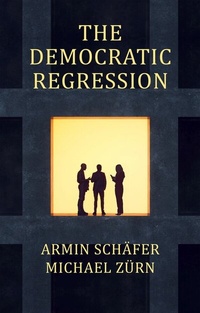
The Democratic Regression
Description

There is a tendency in public debate to downplay the significance of populism by attributing its rise to the inadequacies of those who vote for populist leaders and parties. But this way of thinking prevents us from seeing that the rise of populism may be linked to problems and shortcomings in the way our democracies work.
In this important book, Armin Schäfer and Michael Zürn argue that the rise of authoritarian populism is rooted in two developments that are specifically political in character: first, the unequal responsiveness of parliaments towards less privileged citizens; and second, the growing political role of non-majoritarian institutions, like central banks and international institutions, that remove decisions from public debate and entrust them to experts. Contemporary democracy is increasingly perceived as lacking openness and representativeness. More and more citizens come to feel that politics is made by a closed political class oblivious to the concerns of ordinary people, and those who share this view are more likely to vote for authoritarian populists.
Although contemporary populists keep rubbing salt into the wound of liberal democracy, their responses fail to solve the problems of democratic politics. On the contrary, wherever authoritarian-populist parties have come to power, they have damaged democracy rather than expanding it or reducing existing inequalities.
More details
Other editions
Additional editions

Persons
Michael Zürn is Professor of International Relations at the Free University of Berlin.
Content
1. Introduction
2. Measuring Democracy: From Optimism about Progress to Democratic Backsliding
3. The Ideology of Populism and the New Cleavage
4. The Crisis of Representation and Alienated Democracy
5. Crises in Democracy
6. Opportunities and Dangers
7. Democratic Action in the Face of Regression
Notes
Bibliography
Index
2
Measuring Democracy
From Optimism about Progress to Democratic Backsliding
At least the future looked rosier in 1989 than it does today. Before the fall of the Berlin Wall, an essay appeared in the summer of the same year that gave expression to the optimistic zeitgeist. In 'The End of History?', Francis Fukuyama argued that the reforms introduced in the Soviet Union by Mikhail Gorbachev had brought an end not only to the Cold War but to history as such.1 If up to that point history had been shaped by the struggle between different blueprints for society, it was now emerging that the idea of liberal democracy was undisputed and would remain so.
Fukuyama put forward his argument in the context of the philosophy of history. He followed the Hegelian conception according to which '[w]orld history is progress in the consciousness of freedom, a progress which we must recognize in its necessity'.2 In this sense of a succession of dialectically evolving ideas, then, history came to an end with the Cold War. From then on, neither fascism, defeated in 1945, nor communism, only recently overcome, were able to challenge liberal democracy any more. Fukuyama was certain that the light of democracy loomed even in the earth's darkest corners: sooner or later other countries would turn to this ideal. The endpoint of Hegel's historical eschatology had been reached.
Fukuyama's essay was primarily read as a prognosis of an institutional triumph of democracy. Although his theoretical argument did not necessarily depend on empirical evidence, in the book version of his thesis - a version that dispenses with the question mark in the title - Fukuyama fell back on data intended to substantiate the triumph of democracy.3 In the meantime, democracy had gained a foothold in non-western regions. As far as Fukuyama was concerned, this was a testament to the universal validity of liberal democracy, even though regions such as the Near East and the Middle East were still a long way from experiencing sustainable democratization.4 Progress was not to be halted.5
In tune with the optimistic zeitgeist, people also read Samuel P. Huntington's highly regarded book The Third Wave: Democratization in the Late Twentieth Century as evidence of democracy's unstoppable onward march. The first wave, according to Huntington, rolled in in the 1820s, with the introduction of general suffrage in the United States. After the end of the First World War there were twenty democracies. The countermovement began with Mussolini's seizure of power in Italy in 1922. By 1942 the number of democracies had shrunk to twelve.
Allied victory in the Second World War led to a second wave, which by Huntington's system of counting amounted to thirty-six democracies in 1962. But then the emergence of military dictatorships in Greece and parts of Latin America and the expansion of the Soviet sphere of influence brought another period of withdrawal, until 1975. The third wave of democratization began - again, according to Huntington - with the end of the dictatorship in Portugal in 1974.
Back in the 1990s, Huntington had already recognized the first signs that the third wave had run its course and he had forebodings of a new, reverse wave. But, in spite of all setbacks, the number of democracies still increased in the long run, because only some of the countries fell behind the status they had achieved. The image of waves modified the concept of linear progress, yet by the same move reinforced the basic idea of a secular trend towards democratization. Does such a trend really exist? The answer depends to a significant degree on one's underlying understanding of the nature of democracy.
2.1 What Is Democracy and, if There Is Such a Thing, How Many Are There?
According to David Held,6 democracy is based on a principle of self-determination. Consequently people should be free and equal in determining their own living conditions and the framing of their communal existence, so long as their freedom is not used to negate the rights of others.7 From this perspective, individual and collective self-determination depend on each other. Democracy is a process of public will formation and decision-making in which all those affected have the same opportunity to participate freely and with equal rights. At the same time, democracy must produce normatively justifiable decisions. In particular, it must not affect negatively its own foundations. A double anchoring like this rules out both purely procedural conceptions of democracy, which concentrate solely on decision-making processes, and strictly liberal interpretations, which consider individual rights to have priority over the democratic process. This perspective takes individuals as being endowed with autonomy and the democratic process as being reciprocally constitutive; hence it ties in both with the idea that rights and democracy have the same origin8 and with the neo-republican notion of democracy as the absence of 'domination'.9 The democratic process is characterized by two principles: the principle of affectedness, whereby all persons affected by a decision should have the right to have a say in its making; and the principle of deliberation, which demands that all decisions be publicly discussed and justified through argument. We follow this sophisticated conception of democracy.
Against this yardstick, how many countries can be classified as democracies? To calculate empirically the number of existent democracies is an undertaking with a long tradition; and it is still a growth industry in political science. Many of the current indexes go back to the work of Robert Dahl, who built a series of bridges between the theory of democracy and empirical research. In one early attempt, Dahl called a system of government democratic if it remained permanently responsive to its citizens and treated them equally in the process.10 In order to capture how far these aims are achieved, Dahl11 identified eight conditions, which cover degree of public contestation on the one hand and inclusiveness on the other.12 In Dahl's view, countries can manifest both a high degree of participation without genuine competition and a marked degree of political competition with limited opportunities for participation. Under the apartheid regime in South Africa, for example, there certainly was competition for power, but the opportunities for black South Africans to participate were extremely limited. On the contrary, in countries under state socialism the electoral law was comprehensive and the voter turnout high, but there was no competition for the responsibility to form a government in which opposition parties could win elections. Only countries with an inclusive electoral law and with genuine competition between parties attain the status of a 'polyarchy', as far as Dahl is concerned.13 This concept comes close to a sophisticated understanding of democracy, but still leaves out much of the deliberative component. The extent to which really existing regimes correspond to such a lean conception of democracy can be determined without great difficulty.
The Finnish political scientist Tatu Vanhanen has been working for decades to simplify still further the two dimensions identified by Dahl and to translate them into a concept for measuring democracy. According to Vanhanen, competition can be operationalized by subtracting the proportion of votes gained by the strongest party from the value of 100. The degree of participation is measured by the percentage of the population that took part in the election. To set boundaries, Vanhanen laid down a series of thresholds, freely defined. The degree of competition must be no lower than thirty - in other words, no party should obtain more than 70 per cent of the vote. The degree of participation should amount to at least 10 per cent.14 As a result, this straightforward operationalization of democracy looks only at elections and ignores the legal and social requirements for free and fair elections. It follows that a great many countries are categorized as democratic. Other frequently used indexes of democracy broaden their understanding of the concept somewhat. For example, the Polity IV Index of the Center for Systemic Peace takes elements of the separation of powers into account, and the Democracy Index of Freedom House also covers individual rights to freedom. What these measuring devices have in common, however, is that they work with relatively simple concepts of democracy.
More recent attempts to measure democracy go beyond these lean approaches. Dahl's 1989 conception of the democratic process developed still further and now covers aspects related to deliberative will formation,15 political equality,16 and the population's ability to join in determining the political agenda.17 These more recent efforts also start out from different variants of democracy that, from the normative point of view, may all be of equal value.18
A good example of the more complex attempts to measure democracy can be found in the Democracy Barometer, originally developed by the Berlin Social Science Center (WZB) and the Centre for Democracy in Aarau. It identifies three fundamental principles: freedom, control of power, and equality. Each principle is assigned three requirements, and its implementation is assessed with the help of a total of 100 indicators.19 The authors realize that there are different ways of...
