

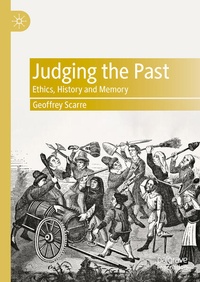
Judging the Past
Description

This book presents an extended argument for the thesis that people of the present day are not debarred in principle from passing moral judgement on people who lived in former days, notwithstanding the inevitable differences in social and cultural circumstances that separate us.
Some philosophers argue that because we can see things only from our own peculiar historical situation, we lack a sufficiently objective vantage point from which to appraise past people and their acts. If they are correct, then the judgements passed by twenty-first-century people must inevitably be biased and irrelevant, grounded on moral standards that would have seemed alien in that 'foreign country' of the past.
This book challenges this relativistic position, contending that it seriously underestimates our ability to engage imaginatively with people who, however much their lifestyles may have differed from our own, were our fellow human beings, endowed with the samebasic instincts, aversions, desires and aspirations.
Taking a stand on a naturalistic theory of human beings, coupled with a Kantian conception of the equal worth of all human members of the Kingdom of Ends, Scarre argues that historical moral judgements can be sensitive to circumstances, fitting and fair, and untainted by anachronism. The discussion ends by examining the implications of this position for the practice of historians and for the ethics of memory and commemoration.
Reviews / Votes
"Can we appropriately make moral judgements about past historical figures? Despite recent controversies that turn on this important issue, philosophers have said relatively little about this. In this engaging and excellently written book, Geoffrey Scarre makes a compelling, timely, and well needed case for why such judgements are appropriate that avoids being either relativistic or pluralistic." (Benjamin Matheson, University of Valencia, Spain)
More details
Other editions
Additional editions
Person
Geoffrey Scarre is Professor Emeritus of Philosophy at Durham University, UK, where he has taught and published extensively in moral philosophy and applied ethics for more than three decades. In recent years he has focused particularly on the topics of death and aging, cultural-heritage ethics, and on the ethics of archaeology. His six monographs include Utilitarianism (1996), Death (2007) and On Courage (2010). He has also co-edited The Ethics of Archaeology (2006) and Appropriating the Past (2013), and edited The Palgrave Handbook of the Philosophy of Aging (2013).
