

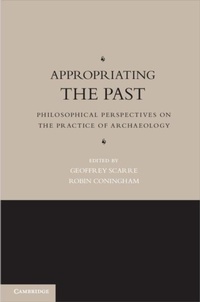
Appropriating the Past
Philosophical Perspectives on the Practice of Archaeology
1st Edition
Published on 1. November 2012
978-1-139-78559-4 (ISBN)
Description

In this book an international team of archaeologists, philosophers, lawyers and heritage professionals addresses significant ethical questions about the rights to access, manage and interpret the material remains of the past. The chapters explore competing claims to interpret and appropriate the past and the major ethical issues associated with them, including handling the sacred; contested rights over sites, antiquities and artifacts; the involvement of local communities in archaeological research; and the legal status of heritage sites. The book covers a range of hotly debated topics in contemporary archaeological practice, focusing particularly on the relationship between academic archaeologists and indigenous communities for whom the material remnants of the past that form the archaeological record may be part of a living tradition and anchors of social identity.
Reviews / Votes
"In our complex world, archaeological work has become a unique focal point for the clash of cultures that occurs when different stakeholders view culturally significant material in very different ways. I highly recommend Appropriating the Past as an essential interdisciplinary volume that addresses the deep and controversial issues that this raises." - Leo Groarke, University of Windsor "Professors Scarre and Coningham have assembled a crack team of lawyers, historians, archaeologists, anthropologists, and philosophers to deal with cutting-edge ethical issues affecting all disciplines that study the human past. What happens, and what should happen, when invasive archeological techniques intrude on sacral objects and sacred ground? When historical research discredits stories that form the basis of cultural identity? When indigenous peoples find their ancestry challenged by population studies? Must we choose between treating the departed as subjects due respect or as objects of research? Is the Enlightenment command, 'dare to know,' a moral imperative or a ruthless warrant for cultural vandalism? This book is a wake-up call that probes the dark sides of scientific work in disciplines that have rarely been exposed to ethical inquiry. The editors are to be congratulated on breaking new ground." - Douglas Lackey, Baruch College and the Graduate Center, City University of New York "This sophisticated volume brings together a stellar and interdisciplinary group of cultural heritage specialists to address ethical issues in contemporary archaeology. However, the contributions of this book go well beyond archaeology, to address issues of ethics, theory, and practice in cultural heritage. Their use of the term 'appropriation' includes the uses, abuses, and control over 'the past' more broadly. The volume makes an important and timely contribution to the burgeoning field of international heritage studies." - Elizabeth S. Chilton, University of Massachusetts AmherstMore details
Language
English
Place of publication
Cambridge
United Kingdom
Publishing group
Cambridge University Press
Target group
Professional and scholarly
College/higher education
Illustrations
5 Halftones, unspecified
File size
2,96 MB
ISBN-13
978-1-139-78559-4 (9781139785594)
Copyright in bibliographic data and cover images is held by Nielsen Book Services Limited or by the publishers or by their respective licensors: all rights reserved.
Schweitzer Classification
Other editions
Additional editions
Geoffrey Scarre | Robin Coningham
Appropriating the Past
Philosophical Perspectives on the Practice of Archaeology
Book
11/2012
Cambridge University Press
€44.00
Shipment within 15-20 days
Geoffrey Scarre | Robin Coningham
Appropriating the Past
Philosophical Perspectives on the Practice of Archaeology
Book
11/2012
Cambridge University Press
€74.30
Shipment within 15-20 days
Persons
Geoffrey Scarre is Professor of Philosophy at Durham University and the co-founder and director of the Durham University Centre for the Ethics of Cultural Heritage. He is the editor (with Chris Scarre) of The Ethics of Archaeology: Philosophical Perspectives on Archaeological Practice and author of several books including, most recently, Death, Mill's 'On Liberty': A Reader's Guide and On Courage. Robin Coningham is Pro-Vice Chancellor and Professor of Archaeology at Durham University and co-founder of the Durham University Centre for the Ethics of Cultural Heritage. Active as a field archaeologist in South Asia and Iran, he currently leads a UNESCO archaeological team which is excavating inside the temple of the Buddha's birth at Lumbini in Nepal.
Content
1. Introduction Geoffrey Scarre and Robin Coningham; Part I. Claiming the Past: 2. The values of the past James O. Young; 3. Whose past? Archaeological knowledge, community knowledge, and the embracing of conflict Piotr Bienkowski; 4. The past people want: heritage for the majority? Cornelius Holtorf; 5. The ethics of repatriation: rights of possession and duties of respect Janna Thompson; 6. On archaeological ethics and letting go Larry J. Zimmerman; 7. Hintang and the dilemma of benevolence: archaeology and ecotourism in Laos Anna Kaellen; Part II. Problems of Meaning and Method: 8. What is a crisis of intelligibility? Jonathan Lear; 9. Contesting religious claims over archaeological sites Elizabeth Burns Coleman; 10. Multivocality and 'wikiality': the epistemology and ethics of a pragmatic archaeology Alexander A. Bauer; 11. 'Do not do unto others ...': cultural misrecognition and the harms of appropriation in an open-source world George P. Nicholas and Alison Wylie; 12. Should ruins be preserved? David E. Cooper; Part III. Problems of Ownership and Control: 13. Legal principles, political processes, and cultural property Tom Allen; 14. Monuments versus movables: state restrictions on cultural property rights David Garrard; 15. Looting or rededication? Buddhism and the expropriation of relics Robin Coningham and Prishanta Gunawardhana; 16. Partitioning the past: India's archaeological heritage after independence Nayanjot Lahiri.
