

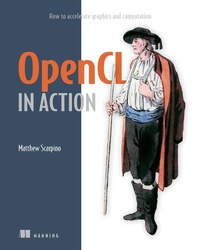
OpenCL in Action
How to accelerate graphics and computations
Published on 13. November 2011
456 pages
978-1-63835-238-9 (ISBN)
Description

Summary
OpenCL in Action is a thorough, hands-on presentation of OpenCL, with an eye toward showing developers how to build high-performance applications of their own. It begins by presenting the core concepts behind OpenCL, including vector computing, parallel programming, and multi-threaded operations, and then guides you step-by-step from simple data structures to complex functions.
About the Technology
Whatever system you have, it probably has more raw processing power than you're using. OpenCL is a high-performance programming language that maximizes computational power by executing on CPUs, graphics processors, and other number-crunching devices. It's perfect for speed-sensitive tasks like vector computing, matrix operations, and graphics acceleration.
About this Book
OpenCL in Action blends the theory of parallel computing with the practical reality of building high-performance applications using OpenCL. It first guides you through the fundamental data structures in an intuitive manner. Then, it explains techniques for high-speed sorting, image processing, matrix operations, and fast Fourier transform. The book concludes with a deep look at the all-important subject of graphics acceleration. Numerous challenging examples give you different ways to experiment with working code.
A background in C or C++ is helpful, but no prior exposure to OpenCL is needed.
Purchase of the print book comes with an offer of a free PDF, ePub, and Kindle eBook from Manning. Also available is all code from the book.
What's Inside
***********
Table of Contents
OpenCL in Action is a thorough, hands-on presentation of OpenCL, with an eye toward showing developers how to build high-performance applications of their own. It begins by presenting the core concepts behind OpenCL, including vector computing, parallel programming, and multi-threaded operations, and then guides you step-by-step from simple data structures to complex functions.
About the Technology
Whatever system you have, it probably has more raw processing power than you're using. OpenCL is a high-performance programming language that maximizes computational power by executing on CPUs, graphics processors, and other number-crunching devices. It's perfect for speed-sensitive tasks like vector computing, matrix operations, and graphics acceleration.
About this Book
OpenCL in Action blends the theory of parallel computing with the practical reality of building high-performance applications using OpenCL. It first guides you through the fundamental data structures in an intuitive manner. Then, it explains techniques for high-speed sorting, image processing, matrix operations, and fast Fourier transform. The book concludes with a deep look at the all-important subject of graphics acceleration. Numerous challenging examples give you different ways to experiment with working code.
A background in C or C++ is helpful, but no prior exposure to OpenCL is needed.
Purchase of the print book comes with an offer of a free PDF, ePub, and Kindle eBook from Manning. Also available is all code from the book.
What's Inside
- Learn OpenCL step by step
- Tons of annotated code
- Tested algorithms for maximum performance
***********
Table of Contents
- Introducing OpenCL
- Host programming: fundamental data structures
- Host programming: data transfer and partitioning
- Kernel programming: data types and device memory
- Kernel programming: operators and functions
- Image processing
- Events, profiling, and synchronization
- Development with C++
- Development with Java and Python
- General coding principles
- Reduction and sorting
- Matrices and QR decomposition
- Sparse matrices
- Signal processing and the fast Fourier transform
- Combining OpenCL and OpenGL
- Textures and renderbuffers
More details
Other editions
Additional editions
Book
11/2011
Manning Publications
€56.00
Shipment within 10-20 days
Person
Matthew Scarpino has over 12 years of experience developing high-performance applications for embedded systems. He's the author of Programming the Cell Processor.
Content
- Intro
- Copyright
- Brief Table of Contents
- Table of Contents
- Preface
- Acknowledgments
- About this Book
- Part 1. Foundations of OpenCL programming
- Chapter 1. Introducing OpenCL
- Chapter 2. Host programming: fundamental data structures
- Chapter 3. Host programming: data transfer and partitioning
- Chapter 4. Kernel programming: data types and device memory
- Chapter 5. Kernel programming: operators and functions
- Chapter 6. Image processing
- Chapter 7. Events, profiling, and synchronization
- Chapter 8. Development with C++
- Chapter 9. Development with Java and Python
- Chapter 10. General coding principles
- Part 2. Coding practical algorithms in OpenCL
- Chapter 11. Reduction and sorting
- Chapter 12. Matrices and QR decomposition
- Chapter 13. Sparse matrices
- Chapter 14. Signal processing and the fast Fourier transform
- Part 3. Accelerating OpenGL with OpenCL
- Chapter 15. Combining OpenCL and OpenGL
- Chapter 16. Textures and renderbuffers
- Appendix A. Installing and using a software development kit
- Appendix B. Real-time rendering with OpenGL
- Appendix C. The minimalist GNU for Windows and OpenCL
- Appendix D. OpenCL on mobile devices
- Index
- List of Figures
- List of Tables
- List of Listings
