

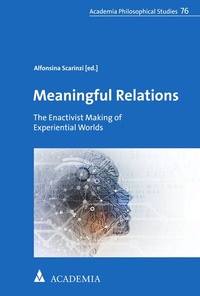
Meaningful Relations
The Enactivist Making of Experiential Worlds
1st Edition
Published on 29. July 2021
321 pages
978-3-89665-993-4 (ISBN)
Description

Diese Sammlung von Aufsätzen leistet einen Beitrag zur Debatte um das Geist-Körper-Problem aus der Sicht des enaktiven Ansatzes mit einem Fokus auf Sinngebungsprozesse und Wahrnehmung. Sie deckt dabei die Fachgebiete der Soziologie, Philosophie des Geistes, Ästhetik, Musikwissenschaft, Human-Robot-Interaction, Medien, Literaturwissenschaft, Kognitionswissenschaft und Computer Science ab. Der Band wendet sich an alle Forschende und Studierende, die sich über die Grenzen des eigenen Faches hinaus mit menschlicher Kognition und der Interaktion von kognitiven Systemen mit ihrer Umwelt auseinandersetzen.
More details
Other editions
Additional editions
Book
08/2021
1st Edition
academia
€69.00
Shipment within 5-7 days
Content
- Cover
- Sense-Making and Representations
- Body-Language Continuity via Non-linguistic Meanings
- Abstract
- 1. Introduction
- 2. Tacit Embodied Meanings in Pragmatism
- 3. Values and Emotions
- 4. Habits as Beliefs
- 5. Thinking with Tacit Meanings and Beliefs
- 6. Tacit Meanings in Art
- 7. Conventional Tacit Meanings
- 8. Language and the World
- References
- "Institutionalized" Imaginary: Language as a Social Construct
- Abstract
- Time, Space, Sign: for an Imaginary of the Word
- Ability to Detach and Subjective Intentions
- Zones of Reality and Accumulations of Meaning: the Social Function of the Symbol
- Symbolism and Imaginary: for a Sociology of the Visible
- Conclusions
- References
- The Role of Representation in Understanding Cognition
- Abstract
- 1. Mental Representation and its Critics
- 1.1 Mental Representation and Classical Cognitivism
- 1.2 Mental Representation under Attack
- 1.2.1 The Form of Mental Representation
- 1.2.2 The Content of Mental Representation
- 1.3 Summary
- 2. A Full Picture of Representation
- 2.1 A Synthetic Picture of Representation
- 2.2 A Diachronic Picture of Representation
- 2.2.1 The Emergence of Representation
- 2.2.2 The Hierarchy of Representations: from Animals to Humans
- 3. Conclusion: Representation and Cognition
- Acknowledgment
- References
- Embodied Meaning as a Challenge to Aesthetics: An Appraisal of Mark Johnson's "Aesthetics of Meaning and Understanding"
- Abstract
- Mind-body: between Idealism and Epicureanism
- Mark Johnson's Approach
- Conclusion
- References
- "Ich liebe dich!" - Aschenbachs Bekenntnis und die Manifestheit der Homoerotik in Thomas Manns Novelle Der Tod in Venedig
- Abstract
- Eindeutig vieldeutig
- Tod, Zucht, Berauschtheit, Homoerotik, Abgrund: Welches Thema für Der Tod in Venedig?
- Soll man beim Titel anfangen? Spurensuche ante textum
- Manifest und skalierbar: Aschenbach zwischen Zucht und feurigen Impulsen
- Was ist mit Abweichung von Erwartungen gemeint?
- "Ich liebe dich!" Aschenbach bricht die Regel und berauscht sich daran
- Es geht um die "Wollust des Untergangs"
- Schlussbetrachtungen
- Bibliographie
- Primärliteratur
- Sekundärliteratur
- Sense-Making and Experience
- The Ecological Dynamics of Musical Creativity and Skill Acquisition
- 1. Introduction
- 2. Connecting Domains
- 3. Towards a Systemic View: Ecological Dynamics
- 4. Hunting for Musical Creativity High and Low
- 4.1 Teleomusicality in Infants
- 4.2 Teleomusical Dynamics
- 4.3 Lessons from Teleomusical Development
- 5 Musicking in Expert Improvisers
- 5.1 Jazz Improvisation
- 5.2 The Roots of Advanced Creativity
- 5.3 Dynamical Creativity
- 6. Interpersonal Co-Creation
- 6.1 Creativity as a Participatory Process
- 6.2 Participatory Music Education and Artistic Development
- 7. Conclusion
- Acknowledgments
- References
- Continuity between Subjective and Objective Feeling as a Stimulus to Creativity and to Sociality
- Abstract
- Introduction
- The Rediscovery of Subjectivity
- Subjectivity and Sociology
- Sensus Communis: a Means of "Broad Thinking"
- Relation between Author and User
- Import of Presentational Symbols
- Conclusions
- References
- Experience of Absence as the Aesthetic Ground of Sense-Making in James
- Introduction
- James's Theory of Mind: A General Review
- Stream of Consciousness
- Sense-Giving Through Fringes
- Feeling of Absence
- References
- The Art of Communal Life: from Tolstoy to Dewey
- References
- Sense-Making and Interactions
- Modelling the Minimal Skills Necessary for Cognitive Development: the iCub Project and the Quest for Cognition
- Abstract
- A Biased View on Human Cognition
- The Phylogeny of iCub
- The Role of iCub in the Quest for Cognition
- The Open Questions: Understanding Humans and Making Robots More Humane
- (i) Perception
- (ii) Motion
- (iii) Learning and Adaptation
- Conclusions
- Acknowledgments
- References
- Enacting Virtual Reality
- Extension and Incorporation
- Ecomedia
- (Post-)phenomenology of Optical Media
- Cognitive Science of Optical Media
- Virtuality as Opportunity: The Zero Mode
- Mediated Cognitive Becoming
- Conclusions
- References
- On the Embodied and Sense-Making Nature of the Artful Mind
- Introduction
- Criticism of Cognitivism and the Re-Turn of the Body
- The Embodied, Enacted, Aesthetic and Artful Mind
- On the Embodied Nature of the Art Mind
- Donald's Seven Governing Cognitive Principles of the Artful Mind
- A More Radically Embodied Reformulation of the Cognitive Principles of the Artful Mind
- Concluding Remarks
- References
- Continuity between the Arts and Society as a Way to Understand Social Phenomena
- Introduction
- I. Continuity and Duality
- II. The Fracture of Continuity in Modernity
- III. Acceptance of the Lack of Continuity in Postmodernity
- IV. The Recapturing of Continuity through Fragments and Everyday Life
- V. Closing Remarks
- References
- Extending Through Thinging. Thinking with Things and the Embodied Mind
- Abstract
- 1. Introduction
- 2. Towards a Post-cognitivist Mind
- 3. Tools Change the Possibilities of Actions
- 4. Remark on Enactive Sense-Making: Can it Extend?
- 5. Conclusion
- Acknowledgment
- References
- Biographies
