

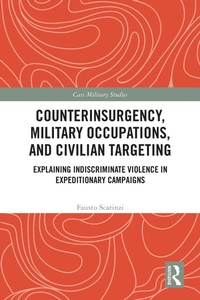
Counterinsurgency, Military Occupations, and Civilian Targeting
Explaining Indiscriminate Violence in Expeditionary Campaigns
Published on 1. April 2026
248 pages
978-1-040-49475-2 (ISBN)
Description

This book addresses the causes of civilian targeting during counterinsurgency campaigns in occupied territories.
It develops a new theoretical framework explaining the level of civilian victimization in expeditionary counterinsurgency as an outcome influenced by state leaders' perceptions of threats and constraints in international and local political contexts. Understanding civilian targeting as risk-taking behaviour, the book pairs Realism's tenets with prospect theory's insight that people, including state leaders, become risk-tolerant to avoid or recoup losses. The book argues that the inclination of the leaders in charge of counterinsurgency to take the risks of civilian targeting will vary according to their local alliance strategy in the occupied society and their perceptions of external threats against the occupied territory. Accordingly, the book identifies four scenarios from combinations of local alliance strategy and external threat perceptions that shape leaders' risk-tolerance and are conducive to specific levels of civilian targeting through distinctive causal pathways. The book tests its arguments against cases of British, French, German, US, Saudi, and Israeli counterinsurgency (including the Gaza War), before considering the policy implications for the protection of civilians.
This book will be of interest to students of counterinsurgency, military and strategic studies, human rights and International Relations.
It develops a new theoretical framework explaining the level of civilian victimization in expeditionary counterinsurgency as an outcome influenced by state leaders' perceptions of threats and constraints in international and local political contexts. Understanding civilian targeting as risk-taking behaviour, the book pairs Realism's tenets with prospect theory's insight that people, including state leaders, become risk-tolerant to avoid or recoup losses. The book argues that the inclination of the leaders in charge of counterinsurgency to take the risks of civilian targeting will vary according to their local alliance strategy in the occupied society and their perceptions of external threats against the occupied territory. Accordingly, the book identifies four scenarios from combinations of local alliance strategy and external threat perceptions that shape leaders' risk-tolerance and are conducive to specific levels of civilian targeting through distinctive causal pathways. The book tests its arguments against cases of British, French, German, US, Saudi, and Israeli counterinsurgency (including the Gaza War), before considering the policy implications for the protection of civilians.
This book will be of interest to students of counterinsurgency, military and strategic studies, human rights and International Relations.
More details
Series
Language
English
Place of publication
London
United Kingdom
Publishing group
Taylor & Francis Ltd
Target group
College/higher education
Professional and scholarly
Illustrations
1 Tables, black and white; 1 Line drawings, black and white; 1 Illustrations, black and white
File size
110,13 MB
ISBN-13
978-1-040-49475-2 (9781040494752)
Copyright in bibliographic data and cover images is held by Nielsen Book Services Limited or by the publishers or by their respective licensors: all rights reserved.
Schweitzer Classification
Other editions
Additional editions
Fausto Scarinzi
Counterinsurgency, Military Occupations, and Civilian Targeting
Explaining Indiscriminate Violence in Expeditionary Campaigns
Book
04/2026
1st Edition
Routledge
€193.50
Shipment within 10-20 days
Person
Fausto Scarinzi is a researcher who holds a PhD in Politics and International Relations from the University of Reading, where he taught and designed modules in IR and Strategic Studies and Insurgency and Counterinsurgency. He is an Associate Fellow of Advance Higher Education, UK.
Content
1. Introduction 2. Political Context and Civilian Targeting in Expeditionary Counterinsurgency 3. The British Campaigns in Kenya (1952-1960) and Cyprus (1955-1959) 4. French Counterinsurgency in Algeria (1954-1962) 5. German Counterinsurgency in South-West Africa (1904-1907) 6. Civilian Targeting in Counterinsurgency After the Cold War (I): The US Campaigns in Iraq and Afghanistan 7. Civilian Targeting in Counterinsurgency After the Cold War (II): Yemen and Palestine 8. Conclusions: The Enduring Challenge of Saving Civilians Appendix
