

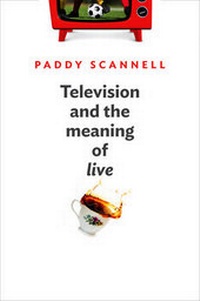
Television and the Meaning of 'Live'
Description

The elementary components of any real-world situation are place,people and time. These are first examined as basic existentialphenomena drawing on Heidegger's fundamental enquiry into thehuman situation in Being and Time. They are then exploredthrough the technological and production care-structures ofbroadcast television which, routinely and exceptionally, displaythe situated experience of being alive and living in the worldtoday. It shows routinely in the live self-enactments of personsbeing themselves and the liveness of their ordinary talk ontelevision. It shows exceptionally in television coverage of greatoccasions and catastrophes as they unfold live and in real time.Case studies reveal the existential role of television in salvagingthe possibility of genuine experience, and in revealing theworld-historical character of life today. To explore thesequestions, the agenda of sociology - its concern with economic,political and cultural life - is set aside. Being in the world isnot, in the first (or last) instance, a social but an existentialquestion, as an existential enquiry into television todaydiscovers.
Passionate and sweeping in scale, this new book from a leadingmedia scholar is a major contribution to our understanding of themedia today.
More details
Other editions
Additional editions
Person
Content
Preface viii
Part one: An introduction to the phenomenology oftelevision
Prologue: Heidegger's teacup 3
1. What is phenomenology? 5
2. Available world 14
3. Available self 27
4. Available time 39
5. Turning on the TV set 60
6. Television and technology 78
Part two: Television and the meaning of live
7. The meaning of live 93
8. How to talk - on radio 107
9. How to talk - on television 128
10. The moment of the goal - on television 153
11. Being in the moment: the meaning of media events 177
12. Catastrophe - on television 191
13. Television and history 209
Notes 225
References 245
Index 253
Preface
I would like to think of this enquiry into radio and television as a contribution to what might be called third-generation media studies. It follows on directly from Media and Communication (Sage 2007) which was written as a textbook to introduce students to the academic study of media and communication. In my accounts there were two key moments: the formation of a sociology of mass communication at Columbia in the 1930s, and of media studies at Birmingham in the 1970s. The book’s focus was not in the first place on media and communication but throughout on how academics engaged with and thought about the media and why. As I will shortly argue, academics go about their task by producing their object of enquiry as an academic object. But radio and television, the internet and mobile phones are simply not academic things – and in fact are resistant to being thought of as such. My aim and purpose here is an attempt to think of radio and television in their terms rather than in academic terms. This means to think of them in situ: as everyday worldly phenomena, as part and parcel of ordinary existence. In what follows, I set aside all critical, theoretical and political approaches in my enquiry into television as disclosive of the human situation today. In so doing I am, to put it another way, bracketing the discourses of sociology and cultural media studies – the first two generations of academic enquiry – of which I gave accounts in Media and Communication.
The provocation of this book is that it sets aside one of the most taken-for-granted, normal and normative assumptions of modern academic thought – namely, the explanatory power of sociology. I do so in order to resuscitate something that it has smothered out of existence and which yet underpins all its discourses. Anthony Giddens has argued, rightly I think, that sociology is perhaps thediscipline of modernity: it is ‘the most generalised type of reflection upon modern social life […] Modernity is itself deeply and intrinsically sociological’ (Giddens 1991: 41, 43). We have all learnt to think sociologically. It has become a second nature to us. In today’s common-sense self-understanding, human being is being social. This book is an enquiry into the meaning of the word ‘life’ and whatever that means it is surely something more than the merely social. Its problem, however, of which I am vividly aware, is that can no longer be taken as a serious question. It has dwindled to the status of an Oxbridge undergraduate joke (Monty Python and the Meaning of Life). The question of existence is, I have come to think, a limit question for the humanities and social sciences today, since it is nowhere recognized, acknowledged or addressed by them – in the fields in which I read, at least. The meaning of ‘the social’ marks the limits of their thinking and, by extension, the limits of modernity’s self-understanding if (as I take it) that question is indeed modernity’s ownmost topic and concern, as Anthony Giddens has argued. It is a foundational assumption of this book that what lies outside ‘the social’ (what determines it)1 is ‘existence’; life itself, life as such.
I begin with a sketch of phenomenology as an interdisciplinary way of thinking, and go on to a consideration of its distinctive, distinguishing topic, as worked out by Martin Heidegger, namely the question of existence, the meaning of (the word) ‘life’. This was the focal concern of Being and Time (hereafter BT), one of the seminal texts of European thinking in the last century. But it was written nearly a hundred years ago, and the world today is not as it was when Heidegger published his life-defining work in 1927. If we are to benefit from its thinking, it must be re-thought in light of its relevance in and for our own times and this is what I try to do. I have undertaken a summary best reading of Being and Time which I hope is true to its central project, while critiquing it at certain points and trying to retrieve its integral unity. For it must be emphasized that it was hastily written (in order to get tenure!) and remains incomplete. In particular, it fails to deliver on what its title promises – namely a clear account of the relationship between the two components of its title – ‘being’ and ‘time’.
The standard introduction to BT, in America especially, is Being-in-the-world, by Hubert Dreyfus. It was first published in 1991 and has since gone through dozens of reprints. By now it has become the classic vade mecum and guide to BT for English-speaking readers. Yet it is only about Division One, the first part of the book. Division Two is ignored. In his preface, Dreyfus tells us that he considers Division One to be ‘the most original and important section of the work’. Division Two, he goes on, has two separate and somewhat independent themes. The first is the ‘existentialist’ topic of resolute, authentic being in face of existential anxiety, guilt and death. The second is the temporality of human existence and of the world, in which Heidegger tries to retrieve an originary ‘ecstatic’ temporality that goes beyond time as succession (the movement from past to present to future). On this Dreyfus comments:
Although the chapters on originary temporality are an essential part of Heidegger’s project, his account leads him so far from the phenomenon of everyday temporality that I did not feel I could give a satisfactory interpretation of the material. Moreover, the whole of Division II seemed to me much less carefully worked out than Division I and, indeed, to have some errors so serious as to block any consistent reading. (Dreyfus 1991: viii)
I agree. Division One has an integral unity, a clear narrative direction to it and a remarkable focused intensity of purpose in pursuit of its goal – the truth of what it is to be, what in fact we are, namely human. It can be read as a stand-alone text, and in many ways it is. But it is incomplete. The topic of the book as a whole, as given in its title – Being and Time – simply has not yet appeared. Division One was intended as a preparation for that topic. It is a long time coming in Division Two, and by the time he gets there Heidegger has lost his way. The topic of temporality is not properly reconnected with the topics of Division One. But without it we cannot grasp the overall unity of the work. This can be summarily stated. It is a fundamental enquiry into the human situation.2 It has three irreducible components: people, place and time. Division One explicates the first two topics (place and people) in preparation for the third: time, the ‘lost’ topic of Division Two.
Dreyfus unerringly identifies the great theme of Division One as being-in-the-world. This has two components. The first (and it is the key to everything that follows) is the being of the world: the ordinary everyday human world of material things, the immediate environment, the umwelt (the topic of place). This is explored in chapter three, the magnificent cornerstone of the whole of the first part of the book. It is followed immediately by the obvious next most relevant topic, namely the being in this ordinary everyday world of ordinary everyday people (the pivotal second component of the human situation). This, the topic of chapter four, is the crux of Division One, and it is at this point, as I will shortly argue, that Heidegger takes a wrong turn that distracts him from his overall project. Nevertheless, the first two components of the human situation are convincingly established in Division One; the being-there of the ordinary everyday world and the being-in-it of ordinary everyday human beings. But the project is radically incomplete without the absolutely crucial question of time. Being-in-(the time of)-the-world: that was the projected but not fully realized integral theme of Heidegger’s exploration of the human situation and its inextricably connected elementary components – place, people, time and in that order.
The world of the 1920s, in Division One, is always the umwelt; the immediate environment in which any individual life is unavoidably situated. But nearly a century later the world today, for anyone living in a post-modern society, is both their own immediate environment (the place where they live) and the world-as-a-whole. This is the world as routinely and daily disclosed by all tele-technologies of communication and, centrally, I will argue, by the two key technologies of radio and television taken together under the rubric of broadcasting. As anyone at all familiar with Heidegger knows, he was, in his later years, much vexed by the question of technology and, as an aspect of his general distaste for its frenzied dominion, he was none too fond of either radio or television. Radio broadcasting, he declared in 1949, ‘has interfered with the essence of the human’ (Figal 2009: 278). As television spread through Germany in the next decade, Heidegger publicly deplored its impact on his fellow Germans while occasionally enjoying watching live TV coverage of soccer (of which he was...
