

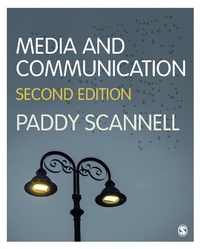
Media and Communication
2nd Edition
Published on 30. September 2020
360 pages
978-1-4739-0112-4 (ISBN)
Description

Media and Communication traces the historical development of media and communication studies in the 20th century.
Paddy Scannell explores how the field formed and developed in both North America and in Europe, expertly introducing and explaining a host of essential media thinkers, ideas and concepts along the way.
Including a new chapter on media events, this second edition of a classic text provides a comprehensive yet personal - and always accessible - analysis of media and communication theory and history. It is an invaluable resource for students across media and communication studies, cultural studies, and sociology.
Paddy Scannell explores how the field formed and developed in both North America and in Europe, expertly introducing and explaining a host of essential media thinkers, ideas and concepts along the way.
Including a new chapter on media events, this second edition of a classic text provides a comprehensive yet personal - and always accessible - analysis of media and communication theory and history. It is an invaluable resource for students across media and communication studies, cultural studies, and sociology.
Reviews / Votes
This is a lucid, generous, and strikingly original account of the emergence of media and communication studies as a vibrant academic field. Moving across sociology, critical theory, and cultural studies, Scannell takes stock of the key concepts and questions that have come to define the field over the past six decades. In this expanded and revised edition, Scannell identifies what is distinctive about the media of the 20th century - the immense power of live broadcasting and unscripted talk in public in shaping both the eventful and the everyday across much of the world. The result is a milestone intellectual history of media and communication studies that sets the conceptual coordinates for our digital present and future. -- Aswin Punathambekar Anyone who wants to understand the intellectual roots of the present study of media and communication needs to read this book. Scannell's achievement is quite unique: he puts the American, the European and the British traditions of inquiry into productive dialogue with each other and shows some surprising affinities between them as well as some prescient foresights. The breadth of his scholarship is invariably enlightening, lucid in its accounts and generous in its judgements. -- Martin MontgomeryMore details
Edition
Second Edition
Language
English
Place of publication
London
United Kingdom
Target group
College/higher education
Product notice
Reflowable
ISBN-13
978-1-4739-0112-4 (9781473901124)
Copyright in bibliographic data and cover images is held by Nielsen Book Services Limited or by the publishers or by their respective licensors: all rights reserved.
Schweitzer Classification
Other editions
Additional editions
Paddy Scannell
Media and Communication
Book
10/2020
2nd Edition
SAGE Publications Ltd
€98.90
Shipment within 15-20 days
Paddy Scannell
Media and Communication
Book
10/2020
2nd Edition
SAGE Publications Ltd
€180.90
Shipment within 15-20 days
Person
Paddy Scannell worked for many years at the University of Westminster (London) where he and his colleagues established, in 1975, the first undergraduate degree program in Media Studies in the UK. He is a founding editor of Media, Culture and Society which began publication in 1979 and is now issued six times yearly. He is the author of A Social History of British Broadcasting, 1922-1939 which he wrote with David Cardiff, editor of Broadcast Talk and author of Radio, Television and Modern Life. He is currently working on a trilogy. The first volume, Media and Communication, was published in June 2007. Professor Scannell is now working on the second volume, Television and the Meaning of 'Live.' The third volume, Love and Communication, is in preparation. His research interests include broadcasting history and historiography, the analysis of talk, the phenomenology of communication and culture and communication in Africa.
Content
Part I The masses
1. Mass communication: Lazarsfeld, Adorno, Merton, USA, 1930s and 1940s
2. Mass culture: Horkheimer, Adorno, Brecht, Benjamin, Germany/USA, 1930s and 1940s
3. The end of the masses: Merton, Lazarsfeld, Riesman, Katz, USA, 1940s and 1950s
Part II Everyday life
4. Culture and communication: Leavis, Hoggart, Williams, England, 1930s-1950s
5. Communication and technology: Innis, McLuhan, Canada, 1950s-1960s
6. Communication as interaction: Goffman and Garfinkel, USA, 1950s-1970s
Part III Communicative rationality and irrationality
7. Communication and language: Austin, Grice, Sacks, Levinson, UK/USA, 1950s-1970s
8. Communication as ideology: Hall, UK, 1960s and 1970s
9. Communication and Publicness: Habermas, Germany (USA/UK), 1950s-1990s
10. Communication and celebration, Dayan (France) and Katz (Israel), 1990s
Conclusion
Afterword (2020)
Index
1. Mass communication: Lazarsfeld, Adorno, Merton, USA, 1930s and 1940s
2. Mass culture: Horkheimer, Adorno, Brecht, Benjamin, Germany/USA, 1930s and 1940s
3. The end of the masses: Merton, Lazarsfeld, Riesman, Katz, USA, 1940s and 1950s
Part II Everyday life
4. Culture and communication: Leavis, Hoggart, Williams, England, 1930s-1950s
5. Communication and technology: Innis, McLuhan, Canada, 1950s-1960s
6. Communication as interaction: Goffman and Garfinkel, USA, 1950s-1970s
Part III Communicative rationality and irrationality
7. Communication and language: Austin, Grice, Sacks, Levinson, UK/USA, 1950s-1970s
8. Communication as ideology: Hall, UK, 1960s and 1970s
9. Communication and Publicness: Habermas, Germany (USA/UK), 1950s-1990s
10. Communication and celebration, Dayan (France) and Katz (Israel), 1990s
Conclusion
Afterword (2020)
Index
