

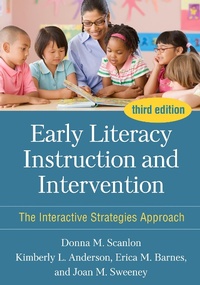
Early Literacy Instruction and Intervention
The Interactive Strategies Approach
3rd Edition
Published on 7. March 2024
532 pages
978-1-4625-5368-6 (ISBN)
Description

Teachers of children ages 5-8 (grades K-3); literacy coaches; school administrators; teacher educators and graduate students. Serves as a text in graduate-level courses such as Early Literacy and Early Reading Intervention.
More details
Other editions
Additional editions
Donna M. Scanlon | Kimberly L. Anderson | Erica M. Barnes
Early Literacy Instruction and Intervention, Third Edition
The Interactive Strategies Approach
Book
05/2024
3rd Edition
Guilford Press
€55.50
Shipment within 15-20 days
Persons
Donna M. Scanlon, PhD, is Professor Emeritus in the Department of Literacy Teaching and Learning at the University at Albany, State University of New York, where she served as director of the Child Research and Study Center. Dr. Scanlon has spent most of her career studying children's reading difficulties and helping families and schools address the needs of students who struggle with literacy development. Her research contributed to the emergence of response to intervention as a process for preventing reading difficulties and avoiding inappropriate and inaccurate learning disability classifications. In recent years, her work has focused on the development of teacher knowledge and teaching skill to help prevent reading difficulties in young children and remediate reading difficulties among older children. Dr. Scanlon has served on the Literacy Research Panel, Response to Intervention Task Force, and Response to Intervention Commission of the International Literacy Association.
Kimberly L. Anderson, PhD, is Associate Professor in the Department of Literacy Studies, English Education, and History Education at East Carolina University. Her research focuses on improving teacher preparation for early literacy instruction and on the development of literacy tutoring protocols that can be used by tutors with limited expertise. Dr. Anderson contributed to research on the Interactive Strategies Approach (ISA) in her past role as a research associate and director of professional development at the Child Research and Study Center, University at Albany, State University of New York. Dr. Anderson has a particular interest in the role of strategy instruction in word solving and has studied the differential impact of professional development that emphasizes the combination of alphabetic decoding and meaning-based strategies, one of the main tenets of the ISA.
Erica M. Barnes, PhD, is Associate Professor in the Department of Literacy Teaching and Learning at the University at Albany, State University of New York. Her research investigates teacher-child interactions in preschool and early elementary classrooms that promote language and literacy growth, with an emphasis on the developmental trajectories of children with varying levels of language abilities from underserved populations. Dr. Barnes is interested in how language facilitates literacy development, and how teachers may differentiate instruction for students to prevent literacy-learning difficulties. She has worked as a special education teacher, a teacher consultant, and a progress-monitoring consultant in K-12 settings.
Joan M. Sweeney, MSEd, is a reading specialist in a Capital District public school in New York State. Previously, she was a research associate in the Child Research and Study Center, University at Albany, State University of New York, where she provided intervention for struggling readers, supervised intervention teachers, and coached classroom teachers utilizing the Interactive Strategies Approach to support children's literacy development.
Kimberly L. Anderson, PhD, is Associate Professor in the Department of Literacy Studies, English Education, and History Education at East Carolina University. Her research focuses on improving teacher preparation for early literacy instruction and on the development of literacy tutoring protocols that can be used by tutors with limited expertise. Dr. Anderson contributed to research on the Interactive Strategies Approach (ISA) in her past role as a research associate and director of professional development at the Child Research and Study Center, University at Albany, State University of New York. Dr. Anderson has a particular interest in the role of strategy instruction in word solving and has studied the differential impact of professional development that emphasizes the combination of alphabetic decoding and meaning-based strategies, one of the main tenets of the ISA.
Erica M. Barnes, PhD, is Associate Professor in the Department of Literacy Teaching and Learning at the University at Albany, State University of New York. Her research investigates teacher-child interactions in preschool and early elementary classrooms that promote language and literacy growth, with an emphasis on the developmental trajectories of children with varying levels of language abilities from underserved populations. Dr. Barnes is interested in how language facilitates literacy development, and how teachers may differentiate instruction for students to prevent literacy-learning difficulties. She has worked as a special education teacher, a teacher consultant, and a progress-monitoring consultant in K-12 settings.
Joan M. Sweeney, MSEd, is a reading specialist in a Capital District public school in New York State. Previously, she was a research associate in the Child Research and Study Center, University at Albany, State University of New York, where she provided intervention for struggling readers, supervised intervention teachers, and coached classroom teachers utilizing the Interactive Strategies Approach to support children's literacy development.
Content
Preface to the Third Edition
Introduction
I. Theoretical and Practical Understandings of Early Literacy Learning and Instruction
1. Early Literacy Learning and the Interactive Strategies Approach
2. Responsive Instruction
3. Motivation to Read and Write
II. Understanding Print and the English (Alphabetic) Writing System
4. Purposes, Concepts, and Conventions of Print
5. Phonemic Awareness
6. Letter Naming and Letter Formation
7. Letter-Sound (Grapheme-Phoneme) Relationships
8. The Alphabetic Principle and the Alphabetic Code: Early Development
9. Rimes and Word Families
10. The Alphabetic Principle and the Alphabetic Code: Later Development
11. Morphological Units and Multisyllabic Words
III. Word Learning
12. Strategic Word Solving, Word Identification, and Word Learning
13. High-Frequency Word Learning and Word Identification
IV. Meaning Construction
14. Text-Reading Fluency
15. Vocabulary and Oral Language Development
16. Comprehension and General Knowledge
V. Integration of the Goals: Putting It All Together
17. Small-Group Instruction
18. Revisiting and Concluding
Glossary
References
Index
Introduction
I. Theoretical and Practical Understandings of Early Literacy Learning and Instruction
1. Early Literacy Learning and the Interactive Strategies Approach
2. Responsive Instruction
3. Motivation to Read and Write
II. Understanding Print and the English (Alphabetic) Writing System
4. Purposes, Concepts, and Conventions of Print
5. Phonemic Awareness
6. Letter Naming and Letter Formation
7. Letter-Sound (Grapheme-Phoneme) Relationships
8. The Alphabetic Principle and the Alphabetic Code: Early Development
9. Rimes and Word Families
10. The Alphabetic Principle and the Alphabetic Code: Later Development
11. Morphological Units and Multisyllabic Words
III. Word Learning
12. Strategic Word Solving, Word Identification, and Word Learning
13. High-Frequency Word Learning and Word Identification
IV. Meaning Construction
14. Text-Reading Fluency
15. Vocabulary and Oral Language Development
16. Comprehension and General Knowledge
V. Integration of the Goals: Putting It All Together
17. Small-Group Instruction
18. Revisiting and Concluding
Glossary
References
Index
