

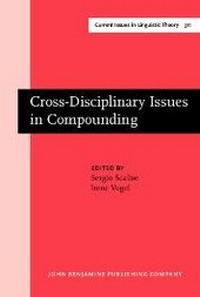
Cross-Disciplinary Issues in Compounding
1st Edition
Published on 28. April 2010
VIII, 382 pages
978-90-272-9089-2 (ISBN)
Description

The study of compounds is currently at the center of attention in many areas of both theoretical and applied linguistics. This volume brings together contributions by experts involved in a wide range of such areas, based on a large number of diverse languages - spoken and signed. The fact that compound constructions are at the interface of the various components of language - morphology, syntax, phonology, and semantics - makes them ideal testing grounds for models of grammatical architecture, as seen in a number of these chapters. The breadth and depth of the coverage of topics, as well as the unified bibliography, make this volume a basic reference source for those interested in current theoretical as well as experimental approaches to compounding, and thus to theoretical linguists as well as psycholinguists and researchers in related fields of cognitive science.
More details
Other editions
Additional editions
Sergio Scalise | Irene Vogel
Cross-Disciplinary Issues in Compounding
Book
04/2010
John Benjamins Publishing Co
€111.30
Shipment within 10-15 days
Persons
Content
- Cross-Disciplinary Issues in Compounding
- Editorial page
- Title page
- LCC data
- Table of contents
- Acknowledgments
- Why compounding?
- 1. Introduction
- 2. The interest of compounds
- 3. Where are compounds formed?
- 4. Definition of compound
- 5. Classification of compounds
- 6. Headedness
- 7. Exocentricity
- 8. Lexical categories
- 9. Input, output and combination of categories
- 10. Conclusion
- 11. Summary of book chapters
- Part I. Delimiting the field
- The role of syntax and morphology in compounding
- 1. Is syntax involved in compounding?
- 2. The structure of synthetic compounds
- 3. The effects of competition
- 4. The effects of mapping
- 5. Synthetic compounds in Saramaccan
- 6. Conclusion
- Acknowledgments
- Constraints on compounds and incorporation
- 1. Introduction
- 2. The constructions
- 3. Internal structure
- 4. Transitivity and argument structure
- 5. The no phrase constraint and syntactically complex constituents
- 6. The lexical integrity hypothesis and sublexical reference
- 7. Wordhood
- 8. Frequency and productivity
- 9. Lexicalization and institutionalization
- 10. Conclusion
- Compounding versus derivation
- 1. The issue - previous literature
- 2. Order of application between derivation and compounding
- 3. Prefixization and the role of dialectal evidence
- 4. Conclusions
- Part II. At the core of compounding
- Units in compounding
- 1. Introduction
- 2. Units in compounding: An overview
- 3. Are compounds words?
- 4. Are compounds made of words?
- 5. Conclusion
- Compound construction: Schemas or analogy?
- 1. Introduction: Rule or analogy?
- 2. Semantic subpatterns in compounding
- 3. Headedness variation
- 4. From compounding to derivation
- 5. Allomorphy
- 6. Analogy or schema?
- The head in compounding
- 1. Preliminary notions: Introducing heads of compounds
- 2. The properties of compound heads
- 3. Problems in the identification of heads: Multiple heads and exocentricity
- 4. Different kinds of heads?
- 5. Conclusions and final remarks
- On the lexical semantics of compounds
- 1. Introduction
- 2. Non-affixal (de)verbal compounds
- 3. A digression on the analysis of verb to noun conversion
- 4. An analysis
- 5. The classification of compounds
- Appendix 1
- Appendix 2
- The phonology of compounds
- 1. Introduction
- 2. Phonological phenomena and the members of compounds
- 3. Compounds and the recursive phonological word
- 4. Phonological constituent structure of compounds
- 5. Other types of compound structures
- 6. Other phenomena
- 7. Conclusions
- Part III. Typology and types of compounds
- The typology of exocentric compounding
- 1. Introduction
- 2. Bahuvrihi
- 3. Synthetic
- 4. Transpositional
- 5. Exocentric co-compounds
- 6. Metaphorical
- 7. Exocentrics as exceptions
- 8. Conclusion
- Coordination in compounding
- 1. Introduction
- 2. The typological approach to co-compounds
- 3. Coordination in NN compounds in East and South-East Asia
- 4. Hyponymic coordinating compounds and the SAE area
- 5. Reference and number in NN coordinating compounds
- 6. Conclusion
- Parasynthetic compounds
- 1. Introduction
- 2. Parasynthesis in compounding
- 3. Recent accounts of (para-)synthetic compounds
- 4. Parasynthesis in Slavic
- 5. Parasynthesis in Romance languages
- 6. Conclusions
- Synthetic compounds
- 1. Introduction
- 2. Incorporation in German?
- 3. Lexical derivation and subsequent compounding
- 4. Lexical derivation via suffixation of a word group
- 5. Conclusion
- Corpus data and theoretical implications
- 1. Introduction
- 2. The corpus
- 3. Overall data on VN formation: Some comparisons with derivation
- 4. The scarcity of verb bases and the role of restrictions
- 5. Corpus data and the Unitary Output Hypothesis
- Part IV. Quantitative and psycholinguistic aspects of compounding
- Frequency effects in compound processing
- 1. Introduction
- 2. Lexical decision and naming latencies
- 3. The eye-tracking record
- 4. General discussion
- Computational issues in compound processing
- 1. Introduction
- 2. Parsing issues: a bird's eye view
- 3. Interpreting NN compounds
- 4. Discussion
- Acknowledgments
- Relational competition during compound interpretation
- 1. Introduction
- 2. Evidence for the use of relational structures
- 3. The nature of the relation priming effect
- 4. Access to relational information is dependent on the constituent's morphological role
- 5. Theoretical framework
- 6. Concluding remarks
- Sign languages and compounding
- 1. Introduction
- 2. Modality
- 2. Language age: Compounding in a new language
- 3. Conclusion
- Appendix
- Acknowledgements
- First language acquisition of compounds
- 1. Introduction
- 2. German compound formation
- 3. The data
- 4. 3 phases of language acquisition
- 5. Emergence of composition
- 6. Amalgams
- 7. Compound noun developments up to 3
- 0
- 8. Frequency distributions in Lena's and Jan's compound noun development 1
- 7 - 3
- 0
- 9. Order of emergence
- 10. Productivity
- 11. Emergence of interfixed compounds
- 12. Phrases vs. compounds
- 13. Morphotactic transparency
- 14. Morphosemantic transparency
- 15. Clark's principles of conventionality and contrast
- 16. Morpheme order
- 17. Recursivity
- 18. Typology
- 19. Innate universals?
- 20. Natural morphology
- 21. Conclusions
- List of abbreviations
- Master list of references
- Language index
- Subject index
- The series CURRENT ISSUES IN LINGUISTIC THEORY
