

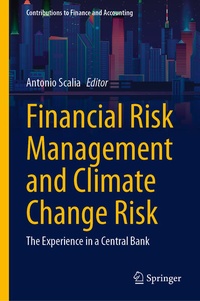
Financial Risk Management and Climate Change Risk
Description

Financial risk management for institutional investors has recently grown in scope to include long-term sustainability considerations and climate change risk concerns. This book shows how a national central bank in the Eurosystem has adapted its financial risk management principles and practices against the background of non-conventional monetary policy measures and following the introduction of sustainability criteria, with a special role for carbon-neutrality. The topics covered include a market-based approach to evaluating credit risk, the development of an independent credit rating system, and the properties and limitations of agencies' sovereign ratings. Furthermore, the book analyzes the integration of sustainability principles into strategic asset allocation and describes the use of machine learning techniques for discerning the role of the E, S and G variables in equity returns. The authors also discuss the growth of the global green bond market and the greenium, as well as the sustainability indicators for large portfolios of corporate and government securities. Given its scope, the book will appeal to all professionals working in the field who would like to know the state-of-the-art in these areas.
Reviews / Votes
"This collection represents a fascinating and timely case study of how one Euro-system central bank - the Banca d'Italia - has approached the quantification and management of these risks. The treatment throughout is sophisticated and draws on the latest academic thinking. Indeed, some of the analysis represents a substantial contribution to the literature in its own right. Both academics and market practitioners seeking a deeper understanding of how central banks are going about evaluating and managing the risks on their bloated balance sheets will find much to enlighten them here." (Professor Sir Charles Bean, Department of Economics, London School of Economics)
More details
Other editions
Additional editions
Person
Antonio Scalia is the Head of the Financial Risk Management Directorate at the Bank of Italy and a member of the ECB's Risk Management Committee. He earned the Laurea in Economics with honours from LUISS University in Rome, an M.Sc. in Economics from the LSE and a Ph.D. in Finance from the London Business School. He has published many articles on leading international economic and finance journals on issues including monetary policy implementation and bank regulation, the sovereign bond market, and the effectiveness of foreign exchange intervention.
Content
Chapter 1. Financial Risk Management and Climate Change Risk.- Part 1. Monetary Policy and Financial Risk Management.- Chapter 2. The Cost of Unconventional Monetary Policy Measures. A Risk Manager's Perspective.- Chapter 3. The Eurosystem Collateral Framework and the Measures Introduced in Response to the Pandemic Emergency.- Chapter 4. Sovereign Ratings.- Chapter 5. The Bank of Italy's In-House Credit Assessment System for Non-Financial Firms.- Chapter 6. The Role of Rating Agencies: Implications for the Financial System and Central Banks' Efforts to Reduce their Reliance.- Chapter 7. The Incorporation of Climate Change Risk in the Eurosystem Monetary Policy Framework and the Decarbonisation of the Corporate Bond Portfolio.- Part 2. The Integration of Climate Change in Financial Risk Management.- Chapter 8. The Commitment to Sustainability in Financial Investments.- Chapter 9. The Strategic Allocation and Sustainability of Central Bank Investments.- Chapter 10. Machine Learning, ESG Indicators, and Sustainable Investment.- Chapter 11. The Global Green Bond Market.- Chapter 12. The Exposure of Investments to Climate and Environmental Risks.
