

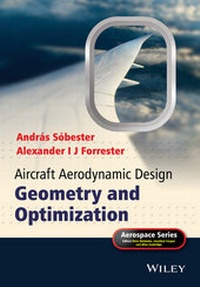
Aircraft Aerodynamic Design
Description

Reviews / Votes
"The book is generally well written and easy to read, with a pleasing use of aircraft photographs to illustrate the text." (The Aeronautical Journal , 1 April 2015) "Aircraft Aerodynamic Design: Geometry and Optimization is a practical guide for researchers and practitioners in the aerospace industry, and a reference for graduate and undergraduate students in aircraft design and multidisciplinary design optimization." (Expofairs.com, 7 January 2015)More details
Other editions
Additional editions
Persons
Content
Preface xiii
1 Prologue 1
2 Geometry Parameterization: Philosophy and Practice 7
2.1 A Sense of Scale 7
2.1.1 Separating Shape and Scale 7
2.1.2 Nondimensional Coefficients 9
2.2 Parametric Geometries 11
2.2.1 Pre-Optimization Checks 13
2.3 What Makes a Good Parametric Geometry: Three Criteria 15
2.3.1 Conciseness 15
2.3.2 Robustness 16
2.3.3 Flexibility 16
2.4 A Parametric Fuselage: A Case Study in the Trade-Offs of Geometry Optimization 18
2.4.1 Parametric Cross-Sections 18
2.4.2 Fuselage Cross-Section Optimization: An Illustrative Example 22
2.4.3 A Parametric Three-Dimensional Fuselage 27
2.5 A General Observation on the Nature of Fixed-Wing Aircraft Geometry Modelling 29
2.6 Necessary Flexibility 30
2.7 The Place of a Parametric Geometry in the Design Process 31
2.7.1 Optimization: A Hierarchy of Objective Functions 31
2.7.2 Competing Objectives 32
2.7.3 Optimization Method Selection 35
2.7.4 Inverse Design 37
3 Curves 41
3.1 Conics and B¿ezier Curves 41
3.1.1 Projective Geometry Construction of Conics 42
3.1.2 Parametric Bernstein Conic 43
3.1.3 Rational Conics and B¿ezier Curves 49
3.1.4 Properties of B¿ezier Curves 50
3.2 B¿ezier Splines 51
3.3 Ferguson's Spline 52
3.4 B-Splines 57
3.5 Knots 59
3.6 Nonuniform Rational Basis Splines 60
3.7 Implementation in Rhino 64
3.8 Curves for Optimization 65
4 Surfaces 67
4.1 Lofted, Translated and Coons Surfaces 67
4.2 B¿ezier Surfaces 69
4.3 B-Spline and Nonuniform Rational Basis Spline Surfaces 74
4.4 Free-Form Deformation 76
4.5 Implementation in Rhino 82
4.5.1 Nonuniform Rational Basis Splines-Based Surfaces 82
4.5.2 Free-Form Deformation 82
4.6 Surfaces for Optimization 84
5 Aerofoil Engineering: Fundamentals 91
5.1 Definitions, Conventions, Taxonomy, Description 91
5.2 A 'Non-Taxonomy' of Aerofoils 92
5.2.1 Low-Speed Aerofoils 93
5.2.2 Subsonic Aerofoils 93
5.2.3 Transonic Aerofoils 93
5.2.4 Supersonic Aerofoils 94
5.2.5 Natural Laminar Flow Aerofoils 94
5.2.6 Multi-Element Aerofoils 95
5.2.7 Morphing and Flexible Aerofoils 98
5.3 Legacy versus Custom-Designed Aerofoils 98
5.4 Using Legacy Aerofoil Definitions 99
5.5 Handling Legacy Aerofoils: A Practical Primer 101
5.6 Aerofoil Families versus Parametric Aerofoils 102
6 Families of Legacy Aerofoils 103
6.1 The NACA Four-Digit Section 103
6.1.1 A One-Variable Thickness Distribution 104
6.1.2 A Two-Variable Camber Curve 105
6.1.3 Building the Aerofoil 105
6.1.4 Nomenclature 106
6.1.5 A Drawback and Two Fixes 107
6.1.6 The Distribution of Points: Sampling Density Variations and Cusps 107
6.1.7 A MATLAB® Implementation 109
6.1.8 An OpenNURBS/Rhino-Python Implementation 111
6.1.9 Applications 112
6.2 The NACA Five-Digit Section 113
6.2.1 A Three-Variable Camber Curve 113
6.2.2 Nomenclature and Implementation 116
6.3 The NACA SC Families 118
6.3.1 SC(2) 118
7 Aerofoil Parameterization 123
7.1 Complex Transforms 123
7.1.1 The Joukowski Aerofoil 124
7.2 Can a Pair of Ferguson Splines Represent an Aerofoil? 125
7.2.1 A Simple Parametric Aerofoil 125
7.3 Kulfan's Class- and Shape-Function Transformation 127
7.3.1 A Generic Aerofoil 128
7.3.2 Transforming a Legacy Aerofoil 130
7.3.3 Approximation Accuracy 132
7.3.4 The Kulfan Transform as a Filter 135
7.3.5 Computational Implementation 137
7.3.6 Class- and Shape-Function Transformation in Optimization: Global versus Local Search 139
7.3.7 Capturing the Shared Features of a Family of Aerofoils 140
7.4 Other Formulations: Past, Present and Future 142
8 Planform Parameterization 145
8.1 The Aspect Ratio 145
8.1.1 Induced Drag 148
8.1.2 Structural Efficiency 150
8.1.3 Airport Compatibility 150
8.1.4 Handling 151
8.2 The Taper Ratio 152
8.3 Sweep 153
8.3.1 Terminology 153
8.3.2 Sweep in Transonic Flight 155
8.3.3 Sweep in Supersonic Flight 157
8.3.4 Forward Sweep 158
8.3.5 Variable Sweep 159
8.3.6 Swept-Wing 'Growth' 161
8.4 Wing Area 162
8.4.1 Constraints on the Wing Area 162
8.5 Planform Definition 167
8.5.1 From Sketch to Geometry 167
8.5.2 Introducing Scaling Factors: A Design Heuristic and a Simple Example 168
8.5.3 More Complex Planforms and an Additional Scaling Factor 169
8.5.4 Spanwise Chord Variation 171
9 Three-Dimensional Wing Synthesis 175
9.1 Fundamental Variables 175
9.1.1 Twist 175
9.1.2 Dihedral 176
9.2 Coordinate Systems 177
9.2.1 Cartesian Systems 177
9.2.2 A Wing-Bound, Curvilinear Dimension 181
9.3 The Synthesis of a Nondimensional Wing 181
9.3.1 Example: A Blended Box Wing 183
9.3.2 Example: Parameterization of a Blended Winglet 187
9.4 Wing Geometry Scaling. A Case Study: Design of a Commuter Airliner Wing 189
9.5 Indirect Wing Geometry Scaling 196
10 Design Sensitivities 199
10.1 Analytical and Finite-Difference Sensitivities 199
10.2 Algorithmic Differentiation 201
10.2.1 Forward Propagation of Tangents 201
10.2.2 Reverse Mode 203
10.3 Example: Differentiating an Aerofoil from Control Points to Lift Coefficient 204
10.4 Example Inverse Design 212
11 Basic Aerofoil Analysis: AWorked Example 217
11.1 Creating the .dat and .in files using Python 218
11.2 Running XFOIL from Python 219
12 Human-Powered Aircraft Wing Design: A Case Study in Aerodynamic Shape Optimization 223
12.1 Constraints 225
12.2 Planform Design 225
12.3 Aerofoil Section Design 226
12.4 Optimization 226
12.4.1 NACA Four-Digit Wing 227
12.4.2 Ferguson Spline Wing 229
12.5 Improving the Design 230
13 Epilogue: Challenging Topological Prejudice 237
References 239
Index 243
Preface
In July 1978 the Journal of Aircraft published a paper titled 'Wing design by numerical optimization'. The authors, Raymond Hicks of the NASA Ames Research Center and Preston Henne of the Douglas Aircraft Company, had identified a set of functions with 'aerofoil-like' shapes, which, when added to a baseline aerofoil in various linear combinations, generated other 'sensible' aerofoil shapes.
This, as a principle, was not new. After all, the National Advisory Committee for Aeronautics was already experimenting with parametric aerofoils in the 1930s. The formulation described by Hicks and Henne (1978) was a new aerofoil family generated in a novel way - building an aerofoil out of weighted shapes, much like one might build a musical sound from multiple harmonics. But this was not the real novelty; how they proceeded to use it was.
Combining the incipient technology of numerical flow simulation (they used a two-dimensional model) with a simple optimization heuristic and their new parametric geometry they performed an automated computational search for a better aerofoil shape.
Here is the idea that thus began to take shape and commence its ascent along the technology readiness level (TRL) ladder of the aerospace industry. A parametric geometry is placed at the heart of the aircraft design process. The design variables influencing its shape are adjusted in some systematic, iterative way, as dictated by an optimization algorithm. The latter is guided by a design performance metric, resulting from a physics-based simulation run on an instance of the parametric geometry.
The TRL rise was to be a slow one, for two reasons. First, because in a world largely reliant on drawing boards for years to come, this was a disruptive idea that would encounter much resistance in this notoriously risk-averse industry. Second, none of the links in the chain of tools required (numerical flow analysis, computational geometry and efficient optimization techniques) would be really ready for some fast optimization action until well into the 1990s.
There is a maxim known by most practitioners of the art, which states that an optimization algorithm will find the slightest flaws in the analysis code (usually comprising a mesher and a partial differential equation solver) and in the geometry model; that is, it will steer the design process precisely towards their weak areas.
This is not (only) due to Sod's law - more fundamental effects are at play. Most computational analyses have a domain of 'safe' operation, outside of which they will either predict unphysically good or unphysically bad performance. Straying into the latter type of area will thus be a self-limiting deviation, but the former will lure the optimizer into 'discovering' amazingly good solutions that do not actually exist in 'real' physics. Sometimes these are obvious (what rookie optimization practitioner has not 'discovered' aerofoils that generate thrust instead of drag?), but more subtle pitfalls abound, and highlighting these remains a challenge in the path of the ubiquitous use of this technology.
Along similar lines, parametric geometry modelling has its own pitfalls, deceptions and hurdles in the path of effective optimal design, and how to avoid (at least some of) them is the subject of this book.
Some of the principles discussed over the pages that follow can be applied to the geometry of any engineering product, but we focus on those aspects of geometry parameterization that are specific to external aircraft surfaces wetted by airflow. Some of the ideas are therefore linked to aerodynamics, and so we will touch upon the relevant aspects of aircraft aerodynamic design - from an engineering perspective. However, this is not a book on aircraft aerodynamics, and, for that matter, nor will it provide the reader with a recipe on how to design an aeroplane. Instead, it is an exposition of concepts necessary for the construction of aircraft geometry that can exploit the capabilities of an optimization algorithm.
The reader may wish to peruse the text simply to gain a theoretical appreciation of some of the issues of aircraft geometry parameterization, but there is plenty to get started with for the more practically minded too. All key concepts are illustrated with code, which can be run 'as is' or can form a building block in the reader's own code. After lengthy deliberations we selected two software platforms to use for this: Mathworks MATLAB® and Python. Some of the Python code calls methods from the OpenNURBS framework, which can be accessed through Robert McNeel & Associates Rhino, a powerful, yet easy to use, lightweight CAD package. Some of the code is reproduced in the text to help illustrate some of the formulations - in each case we selected one of the platforms mentioned above, but in most cases implementations in the others are available too on the website [www.wiley.com/go/sobester] accompanying the book.
Here is a brief sketch of the structure of this book.
After discussion of the general context of aircraft shape description and parameterization (Prologue), in the following chapter (Geometry Parameterization: Philosophy and Practice) we discuss the place of parametric geometries in aircraft design in general and we start the main threads that will be running through this book: the guiding principles of parametric geometry construction and their impact on the effectiveness of the optimization processes we might build upon them.
We next tackle the fundamental building blocks of all aircraft geometries, first in two dimensions (the chapter titled Curves), then in three (Surfaces). Two-dimensional sections through wings (and other lifting surfaces) are perhaps the most widely known and widely discussed aerodynamic geometry primitive, and we dedicate three chapters to them: a general introduction (Aerofoil Engineering: Fundamentals), a review of some of the key Families of Legacy Aerofoils and, arriving at the concept at the heart of this book, Aerofoil Parameterization.
Another classic two-dimensional view of aerodynamics is tackled in the chapter titled Planform Parameterization, thus completing the discussion of all the primitives needed to build a three-dimensional wing geometry - which we do in the chapter Three-Dimensional Wing Synthesis.
The ultimate point of geometry parameterization is, of course, the optimization of objective functions that measure the performance of the object represented by the geometry. Recent years have seen a strong push towards making this process as efficient as possible, and one of the enablers is the efficient computation of the sensitivities of the objective function with respect to the design variables controlling the shape. A number of ways of achieving this are discussed in the chapter titled Design Sensitivities.
The most important concepts are illustrated via examples throughout the book, but there are two more substantial such examples, which warrant chapters of their own: Basic Aerofoil Analysis: A Worked Example and Human-Powered Aircraft Wing Design: A Case Study in Aerodynamic Shape Optimization.
We then bring matters to a close by looking ahead and discussing the area where geometry parameterization is most acutely in need of further development - this is the chapter titled Epilogue: Challenging Topological Prejudice.
Parametric geometry is a vast subject, and a book dedicated even to one of its subsets - in this case, the parametric geometry of the external shape of fixed-wing aircraft - is unlikely to be comprehensive. We hope that, beyond a discussion of the formulations we felt to be the most important, this book succeeds in setting out the key principles that will enable the reader to 'discover', critically evaluate and deploy other formulations not discussed here. Moreover, it should assist in creating new models - essential building blocks of the design tools of the future.
Finally, we would like to acknowledge some of those who helped shape this text through discussions and reviews: Jennifer Forrester, Brenda Kulfan, Andy Keane, Christopher Paulson, James Scanlan, Nigel Taylor, David Toal and Sebastian Walter. We are also indebted to Tom Carter and Eric Willner at Wiley, whose patience and support made the long years of writing this book considerably easier.
Disclaimer: The design methods and examples given in this book and associated software are intended for guidance only and have not been developed to meet any specific design requirements. It remains the responsibility of the designer to independently validate designs arrived at as a result of using this book and associated software. To the fullest extent permitted by applicable law John Wiley & Sons, Ltd. and the authors (i) provide the information in this book and associated software without express or implied warranties that the information is accurate, error free or reliable; (ii) make no and expressly disclaim all warranties as to merchantability, satisfactory quality or fitness for any particular purpose; and accept no responsibility or liability for any loss or damage occasioned to any person or property including loss of income; loss of business profits or contracts; business interruption; loss of the use of money or anticipated savings; loss...
