

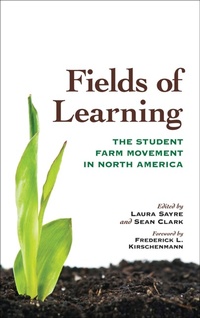
Fields of Learning
The Student Farm Movement in North America
Published on 15. November 2022
376 pages
978-0-8131-4029-2 (ISBN)
Description

"Essays from staff on 15 farms... illustrate the trials, tribulations and sheer joys of establishing and maintaining such enterprises." -
USA Today
Originally published in 2011 , Fields of Learning remains the single best resource for students, faculty, and administrators involved in starting or supporting campus farms. Featuring detailed profiles of fifteen diverse student farms on college and university campuses across North America, the book also serves as a history of the student farm movement, showing how the idea of campus farms has come in and out of fashion over the past century and how the tenacious work of students, faculty, and other campus community members has upheld and reimagined the objectives of student farming over time. Ranging in size from less than an acre to hundreds of acres, supplying food to campus dining halls or community food banks, and hosting scientific research projects or youth education programs, student farms highlight the interdisciplinary richness and multifunctionality of agriculture, supporting academic work across a range of fields while simultaneously building community engagement and stimulating critical conversations about environmental and social justice. As institutions of higher learning face new challenges linked to the global climate crisis and public health emergency, this book holds continued relevance for readers in North America and beyond.
"A timely and hopeful book." -Jason Peters, editor of Wendell Berry: Life and Work
"The opportunity for students to spend time learning on campus farms is not just a good idea-it should be mandatory." -Gary Hirshberg, President & CEO, Stonyfield Farm
"An excellent book, useful for anyone interested in the past, or the future, of the student farm movement." - Journal of Agricultural & Food Information
Originally published in 2011 , Fields of Learning remains the single best resource for students, faculty, and administrators involved in starting or supporting campus farms. Featuring detailed profiles of fifteen diverse student farms on college and university campuses across North America, the book also serves as a history of the student farm movement, showing how the idea of campus farms has come in and out of fashion over the past century and how the tenacious work of students, faculty, and other campus community members has upheld and reimagined the objectives of student farming over time. Ranging in size from less than an acre to hundreds of acres, supplying food to campus dining halls or community food banks, and hosting scientific research projects or youth education programs, student farms highlight the interdisciplinary richness and multifunctionality of agriculture, supporting academic work across a range of fields while simultaneously building community engagement and stimulating critical conversations about environmental and social justice. As institutions of higher learning face new challenges linked to the global climate crisis and public health emergency, this book holds continued relevance for readers in North America and beyond.
"A timely and hopeful book." -Jason Peters, editor of Wendell Berry: Life and Work
"The opportunity for students to spend time learning on campus farms is not just a good idea-it should be mandatory." -Gary Hirshberg, President & CEO, Stonyfield Farm
"An excellent book, useful for anyone interested in the past, or the future, of the student farm movement." - Journal of Agricultural & Food Information
More details
Other editions
Additional editions
Book
07/2011
The University Press of Kentucky
€40.50
Shipment within 10-20 days
Persons
Laura Sayre is a writer and translator (French to English). A part-time farmer, she manages twenty acres in western Massachusetts and is on the board of the North Amherst Community Farm. Sean Clark is Clarence M. Clark Chair in Mountain Agriculture and professor of agriculture and natural resources at Berea College in Kentucky.
Content
- Intro
- Cover
- Half title
- Title
- Copyright
- Dedication
- Contents
- List of Illustrations
- Foreword
- Preface
- Acknowledgments
- Introduction: The Student Farm Movement in Context
- Part 1 Roots
- 1. Berea College (1871): The Work College Legacy
- 2. Wilmington College (1946): Balancing Education and Profitability
- 3. Sterling College (1962): Working Hands, Working Minds
- Part 2 Back to the Land
- 4. Evergreen State College (1972): Interdisciplinary Studies in Sustainable Agriculture
- 5. University of Oregon (1976): Designing for Change
- 6. University of California, Davis (1977): Moving from the Margins toward the Center
- 7. Hampshire College (1978): The Agricultural Liberal Arts
- Part 3 Coming of Age
- 8. University of Maine (1994): Majoring in Sustainable Ag
- 9. Central Carolina Community College (1995): Growing New Farmers
- 10. Prescott College (1996): Agroecology as the Cultivation of Soil and Mind
- 11. University of Montana (1997): Agriculturally Supported Community
- Part 4 New Directions
- 12. University of British Columbia (2000): The Improbable Farm in the World City
- 13. New Mexico State University (2002): Planting an OASIS
- 14. Michigan State University (2003): Four-Season Student Farming
- 15. Yale University (2003): A Well-Rounded Education
- Conclusion: Starting a Student Farm
- Appendix: An Inventory of Student Farm Projects in the United States and Canada
- Further Reading
- List of Contributors
- Index
