

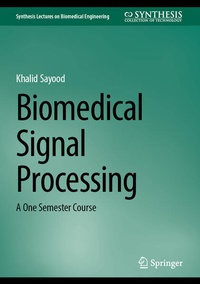
Biomedical Signal Processing
Description

This textbook covers the basic principles behind signal processing tools for biomedical applications. Readers will learn hands-on how to analyze datasets from various, different modalities. Coverage includes signals that originate from within the body, e.g., the electrical signals generated by the heart, or the electrocardiogram (EKG), and the signals generated by the brain, or the electroencephalogram (EEG), as well as those that we generate in order to examine the state of the body, e.g., magnetic resonance imaging (MRI), and Xrays used to generate Computed Tomography (CT) images.
This book is designed for use in a one semester course on the subject. The language is user friendly enough that it can be used for self-study.
More details
Other editions
Additional editions
Person
Khalid Sayood received the B.S. and M.S. degrees in electrical engineeringfrom the University of Rochester, Rochester, NY, in 1977 and 1979, respectively, and the Ph.D. degree in electrical engineering from Texas A&M University, College Station, in 1982. From 1995 to 1996, he served as the Founding Head of the Computer Vision and Image Processing Group at the Turkish National Research Council Informatics Institute. From 1996 to 1997, he served as a Visiting Professor at Bogaziçi University, Istanbul, Turkey. He served on the faculty of the Department of Electrical and Computer Engineering at the University of Nebraska - Lincoln, from 1982 to 2024. He is currently an Emeritus Professor in the Department. He is also a partner at Nebraska R&D.
He is the author of Introduction to Data Compression, 5th ed. (Morgan Kaufmann, 2017), Understanding Circuits: Learning Problem Solving Using Circuit Analysis (Morgan Claypool, 2005), and Learning Programming Using MATLAB (Morgan Claypool, 2006), Joint Source Channel Coding Using Arithmetic Codes (Morgan Claypool, 2010), Computational Genomic Signatures (Morgan Claypool, 2011), Signals and Systems: A one semester course (Springer 2021), Bioinformatics: A one semester course (Springer 2023), and the Editor of Lossless Compression Handbook (Academic Press, 2002). His research interests include bioinformatics, data compression, and biological signal processing.
Content
Introduction.- Signal Representation.- Discrete Time Filters.- Feature Selection.- Feature Classification.- Neuronal Signaling.- The Electrocardiogram.- The Electroencephalogram.- Computed Tomography.- Magnetic Resonance Imaging.
