

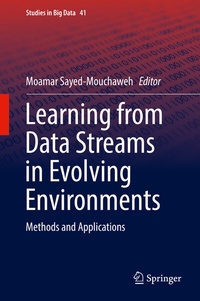
Learning from Data Streams in Evolving Environments
Description

This edited book covers recent advances of techniques, methods and tools treating the problem of learning from data streams generated by evolving non-stationary processes. The goal is to discuss and overview the advanced techniques, methods and tools that are dedicated to manage, exploit and interpret data streams in non-stationary environments. The book includes the required notions, definitions, and background to understand the problem of learning from data streams in non-stationary environments and synthesizes the state-of-the-art in the domain, discussing advanced aspects and concepts and presenting open problems and future challenges in this field.
-
Provides multiple examples to facilitate the understanding data streams in non-stationary environments;
-
Presents several application cases to show how the methods solve different real world problems;
-
Discusses the links between methods to help stimulate new research and application directions.
More details
Other editions
Additional editions
Person
Moamar Sayed-Mouchaweh received his PhD from the University of Reims-France. He was working as Associated Professor in Computer Science, Control and Signal processing at the University of Reims-France in the Research centre in Sciences and Technology of the Information and the Communication. In December 2008, he obtained the Habilitation to Direct Research (HDR) in Computer science, Control and Signal processing. Since September 2011, he is working as a Full Professor in the High National Engineering School of Mines Telecom Lille Douai (France), Department of Computer Science and Automatic Control. He edited and wrote several Springer books and served as a guest editor of several special issues of international journals. He also served as IPC Chair and conference Chair of several international workshops and conferences. He is serving as a member of the Editorial Board of several international Journals.
Content
Chapter1: Transfer Learning in Non-Stationary Environments.- Chapter2: A new combination of diversity techniques in ensemble classifiers for handling complex concept drift.- Chapter3: Analyzing and Clustering Pareto-Optimal Objects in Data Streams.- Chapter4: Error-bounded Approximation of Data Stream: Methods and Theories.- Chapter5: Ensemble Dynamics in Non-stationary Data Stream Classification.- Chapter6: Processing Evolving Social Networks for Change Detection based on Centrality Measures.- Chapter7: Large-scale Learning from Data Streams with Apache SAMOA.- Chapter8: Process Mining for Analyzing Customer Relationship Management Systems A Case Study.- Chapter9: Detecting Smooth Cluster Changes in Evolving Graph Sequences.- Chapter10: Efficient Estimation of Dynamic Density Functions with Applications in Data Streams.- Chapter11: A Survey of Methods of Incremental Support Vector Machine Learning.- Chapter12: On Social Network-based Algorithms for Data Stream Clustering.
