

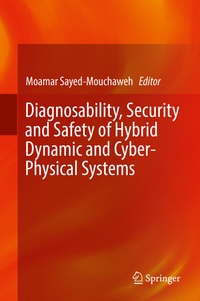
Diagnosability, Security and Safety of Hybrid Dynamic and Cyber-Physical Systems
Description

Cyber-physical systems (CPS) are characterized as a combination of physical (physical plant, process, network) and cyber (software, algorithm, computation) components whose operations are monitored, controlled, coordinated, and integrated by a computing and communicating core. The interaction between both physical and cyber components requires tools allowing analyzing and modeling both the discrete and continuous dynamics. Therefore, many CPS can be modeled as hybrid dynamic systems in order to take into account both discrete and continuous behaviors as well as the interactions between them. Guaranteeing the security and safety of CPS is a challenging task because of the inherent interconnected and heterogeneous combination of behaviors (cyber/physical, discrete/continuous) in these systems. This book presents recent and advanced approaches and tech-niques that address the complex problem of analyzing the diagnosability property of cyber physical systems and ensuring their securityand safety against faults and attacks. The CPS are modeled as hybrid dynamic systems using different model-based and data-driven approaches in different application domains (electric transmission networks, wireless communication networks, intrusions in industrial control systems, intrusions in production systems, wind farms etc.). These approaches handle the problem of ensuring the security of CPS in presence of attacks and verifying their diagnosability in presence of different kinds of uncertainty (uncertainty related to the event occurrences, to their order of occurrence, to their value etc.).
More details
Other editions
Additional editions
Person
Moamar Sayed-Mouchaweh received his PhD from the University of Reims-France. He was working as Associated Professor in Computer Science, Control and Signal processing at the University of Reims-France in the Research center in Sciences and Technology of the Information and the Communication. In December 2008, he obtained the Habilitation to Direct Researches (HDR) in Computer science, Control and Signal processing. Since September 2011, he is working as a Full Professor in the High National Engineering School of Mines Department of Computer Science and Automatic Control. He edited the Springer book 'Learning in Non-Stationary Environments: Methods and Applications', in April 2012 and wrote two SpringerBriefs 'Discrete Event Systems: Diagnosis and Diagnosability', and 'Learning from Data Streams in Dynamic Environments'. He was a guest editor of several special issues of international journals. He was IPC Chair of conference Chair of several international workshops and conferences (IEEE International Conference on Machine Learning and Applications IEEE International Conference on Evolving and Adaptive Intelligent Systems). He is working as a member of the Editorial Board of Elsevier Journal "Applied Soft Computing" and Springer Journals "Evolving systems" and "Intelligent Industrial Systems".
