

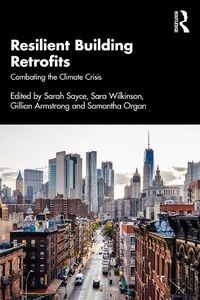
Resilient Building Retrofits
Combating the Climate Crisis
1st Edition
Published on 20. September 2022
228 pages
978-1-000-64724-2 (ISBN)
Description

This radical book aims to inject new insight and urgency into the discourse on the retrofitting of commercial and residential buildings in the face of the climate emergency. It is about the why, how and who should take the lead in revolutionising buildings in the face of serious climate and social change.
Buildings contribute very significantly to the output of carbon, particularly in developed countries where the stock is old, but it is neither feasible nor desirable to demolish them all and start again! If existing buildings cannot in be replaced in the short-term by new zero carbon stock, retrofitting and adaptation of the existing building stock is critical and urgent. This book explains why and how the improvement of buildings requires a complex, holistic approach that brings all stakeholders together with respect and understanding. Yet to do this against a limited time frame is challenging. The book analyses what must be done, explores how it could be achieved and sets out a manifesto for action by all those engaged: from policy makers, to educationalists, designers, constructors, investors, funders and occupiers.
By bringing together authors from across the built environment disciplines, the book stimulates debate within policy, practice and education circles which must lead to action if we are to avoid catastrophe. This is a unique addition to the literature on the sustainability of existing buildings and their retrofitting for the benefit of all.
Buildings contribute very significantly to the output of carbon, particularly in developed countries where the stock is old, but it is neither feasible nor desirable to demolish them all and start again! If existing buildings cannot in be replaced in the short-term by new zero carbon stock, retrofitting and adaptation of the existing building stock is critical and urgent. This book explains why and how the improvement of buildings requires a complex, holistic approach that brings all stakeholders together with respect and understanding. Yet to do this against a limited time frame is challenging. The book analyses what must be done, explores how it could be achieved and sets out a manifesto for action by all those engaged: from policy makers, to educationalists, designers, constructors, investors, funders and occupiers.
By bringing together authors from across the built environment disciplines, the book stimulates debate within policy, practice and education circles which must lead to action if we are to avoid catastrophe. This is a unique addition to the literature on the sustainability of existing buildings and their retrofitting for the benefit of all.
Reviews / Votes
"We have needed this book for many years but the Climate Emergency and the growing popular unrest among students and young professionals makes this comprehensive approach a must-read book for the whole industry." - Robin Nicholson CBE, RIBA, Hon FIStructE, Hon FCIBSE, Convenor of the Edge and a long-standing Partner of Cullinan Studio"Across the globe, climate emergency declarations cover more than 1bn people in 2000 jurisdictions and local governments. Many of these overlay our urban areas where the built environment is an important contributor to carbon emissions. Retrofitting the 70% of buildings that will still be here in 2050 is crucial to tackling the climate emergency, creating a resilient built environment, and bending the curve to keep temperature rise to within 1.5 degrees. This impressive, international, multi-scale and interdisciplinary-based book shows how the many and varied buildings that make up the built environment can be made more energy, waste, and water efficient and tackles vitally important questions: the 'how', the 'what', and the 'why' of retrofitting. The authors have written an eloquent and authoritative guide to these fundamental issues, and this is underpinned by a passionate manifesto, or call to arms, for professionals of all disciplines to tackle these issues right now and at scale. Finally, the book is an especially poignant testament to the late Sarah Sayce's excellent and well-respected work in this field." - Professor Timothy J. Dixon, School of the Built Environment, University of Reading "We have needed this book for many years but the Climate Emergency and the growing popular unrest among students and young professionals makes this comprehensive approach a must-read book for the whole industry." - Robin Nicholson CBE, RIBA, Hon FIStructE, Hon FCIBSE, Convenor of the Edge and a long-standing Partner of Cullinan Studio
"Across the globe, climate emergency declarations cover more than 1 billion people in 2000 jurisdictions and local governments. Many of these overlay our urban areas where the built environment is an important contributor to carbon emissions. Retrofitting the 70% of buildings that will still be here in 2050 is crucial to tackling the climate emergency, creating a resilient built environment, and bending the curve to keep temperature rise to within 1.5 degrees. This impressive, international, multi-scale and interdisciplinary-based book shows how the many and varied buildings that make up the built environment can be made more energy, waste, and water efficient and tackles vitally important questions: the 'how', the 'what', and the 'why' of retrofitting. The authors have written an eloquent and authoritative guide to these fundamental issues, and this is underpinned by a passionate manifesto, or call to arms, for professionals of all disciplines to tackle these issues right now and at scale. Finally, the book is an especially poignant testament to the late Sarah Sayce's excellent and well-respected work in this field." - Professor Timothy J. Dixon, School of the Built Environment, University of Reading
More details
Edition
1. Auflage
Language
English
Place of publication
London
United Kingdom
Publishing group
Taylor & Francis Ltd
Target group
College/higher education
Professional and scholarly
Illustrations
12 Tables, black and white; 12 Line drawings, black and white; 10 Halftones, black and white; 22 Illustrations, black and white
ISBN-13
978-1-000-64724-2 (9781000647242)
Copyright in bibliographic data and cover images is held by Nielsen Book Services Limited or by the publishers or by their respective licensors: all rights reserved.
Schweitzer Classification
Other editions
Additional editions
Sarah Sayce | Sara Wilkinson | Gillian Armstrong
Resilient Building Retrofits
Combating the Climate Crisis
Book
09/2022
1st Edition
Routledge
€186.00
Shipment within 15-20 days
Sarah Sayce | Sara Wilkinson | Gillian Armstrong
Resilient Building Retrofits
Combating the Climate Crisis
Book
09/2022
1st Edition
Routledge
€63.20
Shipment within 15-20 days
Persons
Sarah Sayce was Professor of Sustainable Real Estate at Henley Business School, University of Reading, and Visiting Professor the Royal Agricultural University, UK. For many years she headed the School of Surveying and Planning at Kingston University, UK. She recently worked on two EU funded projects in the field of energy efficiency and property values and is the co-author of Developing Property Sustainably, and co-editor of the Routledge Handbook of Sustainable Real Estate, both published by Routledge.
Sara Wilkinson is a Professor in the School of Built Environment at the University of Technology Sydney, Australia. Her research focuses on sustainability and adaptation in the built environment, user satisfaction, retrofit of green roofs and conceptual understanding of sustainability. Sara is on the editorial board of five international refereed journals and is the co-author of Developing Property Sustainably, and co-editor of the Routledge Handbook of Sustainable Real Estate, both published by Routledge.
Gill Armstrong is a chartered architectural technologist and a UK registered architect. Gill is a post-doctoral researcher at University Technology Sydney. Her research crosses architecture, surveying, and planning disciplines and focuses on building regulation, and sustainable design and management of existing buildings. Gill has also published on built environment pedagogies & crisis narratives in education, having taught university built environment programs in Australia & the UK.
Samantha Organ is a chartered surveyor leading nationally on sustainability for the built estate for Europe's largest conservation charity, the National Trust. She is the MSc Programme Leader and Senior Lecturer in Building Surveying at the University of the West of England, Bristol. Her research focuses primarily on sustainability in the built environment. Sam has written numerous publications for a range of audiences and is a reviewer for a number of peer-reviewed academic journals. She won the RICS Matrics Young Building Surveyor of the Year in 2020.
Sara Wilkinson is a Professor in the School of Built Environment at the University of Technology Sydney, Australia. Her research focuses on sustainability and adaptation in the built environment, user satisfaction, retrofit of green roofs and conceptual understanding of sustainability. Sara is on the editorial board of five international refereed journals and is the co-author of Developing Property Sustainably, and co-editor of the Routledge Handbook of Sustainable Real Estate, both published by Routledge.
Gill Armstrong is a chartered architectural technologist and a UK registered architect. Gill is a post-doctoral researcher at University Technology Sydney. Her research crosses architecture, surveying, and planning disciplines and focuses on building regulation, and sustainable design and management of existing buildings. Gill has also published on built environment pedagogies & crisis narratives in education, having taught university built environment programs in Australia & the UK.
Samantha Organ is a chartered surveyor leading nationally on sustainability for the built estate for Europe's largest conservation charity, the National Trust. She is the MSc Programme Leader and Senior Lecturer in Building Surveying at the University of the West of England, Bristol. Her research focuses primarily on sustainability in the built environment. Sam has written numerous publications for a range of audiences and is a reviewer for a number of peer-reviewed academic journals. She won the RICS Matrics Young Building Surveyor of the Year in 2020.
Content
Part 1: The Why: Challenge and a need to change 1. The Climate Crisis: why it matters for the built environment 2. The philosophy and definition of retrofitting for resilience 3. An inadequate building stock 4. Understanding Vacancy in the office stock Part 2: The What: Exploring solutions 5. A governance response: from coercion to persuasion to embracing diversity? 6. Financing Retrofits 7. Low Tech vs High Technological solutions for a pandemic adaptable Society 8. Repurposing and adaptation 9. Heritage: learning from and preserving the past Part 3: Conclusions, the future, and a manifesto for Change 10. Conclusions and a Manifesto to Retrofit for the Future
