

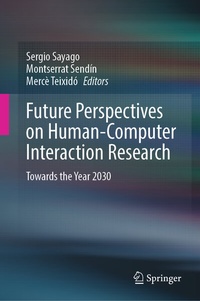
Future Perspectives on Human-Computer Interaction Research
Description

This edited book provides some future perspectives on Human-Computer Interaction research and serves as a crucial nexus for reflecting on the paths that have led us here. Technologies are increasingly becoming active agents capable of learning, adapting, and making decisions. The classic User-Centred Design approach that positions the user strictly at the centre may no longer suffice. Putting the human-in-the-loop are crucial elements for trusting AI technologies and building better, more human-centred, ones.
Offering a comprehensive overview of current research and future directions in this field it addresses important topics such as Human-Centred Artificial Intelligence, Augmented and Virtual Reality, User-Centred Design, and Children-Computer Interaction, providing insights into how these areas will continue to influence and transform our interaction with technologies. The chapters are enriched with case studies and examples that illustrate the practical application of methodological approaches and ideas.
More details
Other editions
Additional editions
Persons
Sergio Sayago is passionate about the human side of digital technologies. His previous research includes web accessibility, usability, and eLearning. Since 2010, a great deal of his interdisciplinary research examines the coexistence of older people with interactive technologies with the aim of facilitating and improving it. As of April 2021, he is a Lecturer (Assistant Professor) in Human-Computer Interaction in Computer Science at the University of Lleida. Prior to that, he was a postdoctoral researcher at the University of Dundee (Scotland, 2010-2012, Beatriu de Pinós fellowship) and Universidad Carlos III de Madrid (Spain, 2012-2014, Alliance 4 Universities fellowship), and a visiting lecturer at the University of Lleida (2014-2016) and University of Barcelona (2016-2019). He is author of more than 50 international publications (in most of them, the first one). He serves as Associate Editor in the International Journal of Human-Computer Studies and Interacting with Computers. He holds a Ph.D. cum laude in Computer Science and Human-Computer Interaction from Universitat Pompeu Fabra (Barcelona, 2009).
Montserrat Sendín is an Associate Professor at the Department of Computer Science and Digital Design and member of Research Group in Human-Computer Interaction and Data Integration (GRIHO) of the University of Lleida. She holds a Ph.D. cum laude in Computer Science from University of Lleida (2006). Her research career is focused on the field of user interface adaptation and, in particular, on plasticity of user interfaces. The proposed approach is called the 'Dichotomic View of Plasticity', which is the basis for the development of her PhD. From 2012, her research area was expanded to include Mobile Usability Evaluation. In particular, the application of eyetracking techniques in usability testing for mobile applications. She was co-chair in the organization committee of the XXIII International Congress on Human-Computer Interaction (September 2023, Lleida).
Mercè Teixidó received her M.Sc. in Computer Science (2009) and Ph.D. in Engineering (2013) from the University of Lleida (UdL), Lleida, Spain. She is currently a Researcher in Interactive Systems and Languages in the Department of Computer Science and Digital Design at the University of Lleida. Her research encompasses a broad spectrum of interests, notably in Human-Computer Interaction and Blockchain, where she explores the intersection of technology and user experience. Additionally, she delves into innovative studies involving STEAM (Science, Technology, Engineering, Arts, and Mathematics) and drones, demonstrating her commitment to interdisciplinary approaches. Her expertise further extends to addressing challenges related to DeepFakes, ethics and Artificial Intelligence, showcasing a keen interest in the evolving landscape of digital media and its implications. Her prolific academic output includes 43 journal articles, 28 in indexed journals. She has presented papers at 46 conferences, including 15 international and 31 national ones. Her scientific articles focus on Human-Computer Interaction, blockchain, AI, innovative teaching methods, and Smart Cities. Her last publication in HCI in December of 2023, "Analyzing the Metaverse: Computer Games, Blockchain, and 21st-Century Challenge" explores the rapidly evolving Metaverse, particularly its relationship with computer games and blockchain technology.
Content
Introduction.- Past, present and future of user-centred design methodologies that empathise with the user and generate better accessible experiences. From theory to practice.- An analysis of videogames to compose an adapted heuristic evaluation.- Towards trustworthy and human-centred AI explanations.- Interactive human-in-the-loop topic modelling.- Mobile augmented reality gamification strategies to promote social skills: Case studies and future challenges.- From past to present: Human-machine interfaces evolve towards adaptivity.- The future of midwife training: Towards a virtual reality haptic obstetric simulator with two points of contact.- Flipping the reality of young children's technology through the 4Cs: Create, connect, communicate, and control.- Conclusion.
