

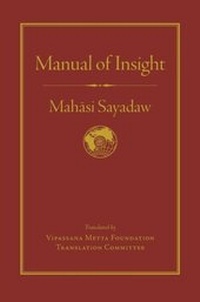
Manual of Insight
1st Edition
Published on 17. May 2016
744 pages
978-1-61429-291-3 (ISBN)
Description

The most comprehensive manual of the practice of insight meditation (vipassana), written by one of its foremost 20th century proponents, is translated into English for the first time.
Manual of Insight is the magnum opus of Mahasi Sayadaw, one of the originators of the "vipassana movement" that has swept through the Buddhist world over the last hundred years. The manual presents a comprehensive overview of the practice of insight meditation, including the foundational aspects of ethical self-discipline, understanding the philosophical framework for the practice, and developing basic concentration and mindfulness. It culminates with an in-depth exploration of the various types of insight and spiritual fruits that the practice yields.
Authored by the master who brought insight meditation to the West and whose students include Joseph Goldstein, Jack Kornfield, and Sharon Salzberg, Manual of Insight is a veritable Bible for any practitioner of vipassana.
Manual of Insight is the magnum opus of Mahasi Sayadaw, one of the originators of the "vipassana movement" that has swept through the Buddhist world over the last hundred years. The manual presents a comprehensive overview of the practice of insight meditation, including the foundational aspects of ethical self-discipline, understanding the philosophical framework for the practice, and developing basic concentration and mindfulness. It culminates with an in-depth exploration of the various types of insight and spiritual fruits that the practice yields.
Authored by the master who brought insight meditation to the West and whose students include Joseph Goldstein, Jack Kornfield, and Sharon Salzberg, Manual of Insight is a veritable Bible for any practitioner of vipassana.
More details
Other editions
Additional editions
Mahasi Sayadaw | Vispassana Metta Foundation Translation Committee
Manual of Insight
Book
05/2016
Wisdom Publications,U.S.
€76.95
Article exhausted; check different version
Persons
The Venerable Mahasi Sayadaw (1904-82), U Sobhana Mahathera, was one of the most eminent meditation masters of modern times and a leader in the contemporary resurgence of Vipassana meditation. He quickly distinguished himself after ordination as a scholar and teacher of the Buddhist scriptures. Placing himself under the guidance of Venerable U Narada Sayadaw and undertaking intensive training in Vipassana meditation, he mastered the technique and went on to popularize vipassana as a systematic practice beneficial for monks and laity alike.
Ven. Mahasi Sayadaw held Burma's highest scholastic honor, the title of Agga Mahapandita, awarded to him in 1952. During the Sixth Buddhist Council, held in Rangoon from 1954 to 1956, he performed the duties of Questioner (pucchaka), a role performed at the First Buddhist Council by the Venerable Mahakassapa. Ven. Mahasi
Sayadaw was also a member of the executive committee that was responsible, as the final authority, for the codification of all the texts edited at the Council.
Thousands of people have been trained at his Thathana Yeiktha Meditation Centre in Yangon and many more have benefited from his clear-cut approach to meditation practice available through his voluminous writings and through the teachings abroad of his disciples, including Joseph Goldstein, Jack Kornfield, Sharon Salzberg, Rodney Smith, and many others. More than a hundred branch centers of the Thathana Yeiktha Centre have been established in Burma and his method has spread widely to other countries, East and West.
Ven. Mahasi Sayadaw is the author of numerous works on both meditation and the Buddhist scriptures in his native Burmese.
Ven. Mahasi Sayadaw held Burma's highest scholastic honor, the title of Agga Mahapandita, awarded to him in 1952. During the Sixth Buddhist Council, held in Rangoon from 1954 to 1956, he performed the duties of Questioner (pucchaka), a role performed at the First Buddhist Council by the Venerable Mahakassapa. Ven. Mahasi
Sayadaw was also a member of the executive committee that was responsible, as the final authority, for the codification of all the texts edited at the Council.
Thousands of people have been trained at his Thathana Yeiktha Meditation Centre in Yangon and many more have benefited from his clear-cut approach to meditation practice available through his voluminous writings and through the teachings abroad of his disciples, including Joseph Goldstein, Jack Kornfield, Sharon Salzberg, Rodney Smith, and many others. More than a hundred branch centers of the Thathana Yeiktha Centre have been established in Burma and his method has spread widely to other countries, East and West.
Ven. Mahasi Sayadaw is the author of numerous works on both meditation and the Buddhist scriptures in his native Burmese.
Content
- Intro
- Contents
- Foreword by Joseph Goldstein
- Foreword by Daniel Goleman
- Managing Editor's Preface
- Introduction
- 1. Purification of Conduct
- The Purification of Conduct for Monks
- Observing the Monastic Precepts
- Pursuing a Pure Livelihood
- Wisely Using Requisites
- Carefully Restraining the Senses
- Practicing Restraint Prior to the Practice of Meditation
- Restraint that Comes from Meditation
- Restraint as a Prerequisite for Meditation
- The Purification of Conduct for the Laity
- Comparisons to Monastic Morality
- The Five Spiritual Obstacles
- The Enlightenment of Immoral Laypeople
- How Different Types of People Are Suited to Different Trainings
- Purifying Conduct with Meditation
- Morality by Means of Abandonment
- Morality by Means of Abstinence
- Morality by Means of Mental Volition
- Morality by Means of Restraint
- Morality by Means of Nontransgression
- Morality as Remote and Immediate Conditions for Concentration and Knowledges
- The Power of Meditation to Purify Morality for Monastics
- Nota Bene: The Practice of Morality Is Essential
- 2. Purification of Mind
- Mental Purification
- Three Types of Mental Purification
- Two Vehicles for Going to Enlightenment
- Methods for Taking the Two Vehicles toEnlightenment
- Insight with Momentary Concentration
- Methods for Developing Insight
- Mental Purification for Those Who Take the Vehicle of Insight to Enlightenment
- Liberations and Hindrances
- Helpful Contemplationsto Dispel Hindrances
- Obstacles to Concentration and the Methods to Overcome Them
- States of One-Pointedness
- 3. Absolute and Conventional Realities
- What Is Reality?
- Ultimate Reality
- Conceptual Illusions
- Hearsay and Such
- Description vs. Experience
- The Correct Definition of Ultimate Reality
- Transience
- The Two Meanings of Activity
- The Meaning that Ordinary People Know
- The Meaning that Insight Meditators Know
- Two Kinds of Insight
- Appropriate Objects for Meditation
- The Present Moment
- Inferential Insight: Knowledgeby Comprehension
- Lessons to Learn from Those Who Take the Vehicle of Tranquility to Enlightenment
- Observation of the In- and Out-Breath
- To What Extent Must Insight Be Purified?
- Venerable Sariputta's Method
- Venerable Moggallana's Method
- A Note of Caution
- 4. The Development of Mindfulness
- Checking Meditation against the Pa?i Texts
- Five Kinds of Phenomena
- Contemplation of the Body
- The Case of Seeing
- The Case of Hearing
- The Case of Smell
- The Case of Taste
- The Case of Touch
- Mindfulness of Breathing
- The Four Primary Material Elements
- How to Observe Thought
- How to Note General Activities
- Clear Comprehension
- Accurate Awareness
- Contemplation of Feeling
- Pleasant Feeling
- Unpleasant Feeling
- Neither-Unpleasant-nor-Pleasant Feeling
- Worldly Pleasure
- Unworldly Pleasure
- Worldly Displeasure
- Unworldly Displeasure
- Worldly Neither Displeasure nor Pleasure
- Unworldly Neither Displeasure nor Pleasure
- Realizing Feelings
- Contemplation of Mind
- Mental States
- Realizing Mind
- Contemplation of Mental Objects
- The Five Hindrances
- Wise Attention
- Unwise Attention
- The Five Aggregates
- The Six Senses
- The Ten Fetters
- The Seven Factors of Enlightenment
- Balancing Spiritual Faculties
- The Seven Types of Suffering
- The Four Noble Truths
- Mindfulness of the Four Noble Truths
- Truths in the Round of Existence and Truths Beyond It
- How Suffering Is Realized
- How the Origin of Suffering IsRealized
- How Cessation and Path Are Realized
- Cultivating Mundane Understanding
- Cultivating Supramundane Understanding
- How to Develop the Noble Eightfold Path
- The Moment of Path Knowledge
- Other Objects of Meditation
- The Benefits of Mindfulness
- The Only Way
- The Buddha's Acknowledgment
- Suitable Contemplations
- 5. Practical Instructions
- Preparations for Practice
- The Basic Practice
- The Primary Object
- Distracting Thoughts
- Physical Discomfort
- Odd Experiences
- Getting a Drink
- Going to Bed
- Getting Up
- Eating a Meal
- Increasing the Number of Objects
- General Objects
- Mental States
- Diligence
- Insight
- Mind and Body
- Cause and Effect
- Effects of Concentration
- Seeing the ThreeCharacteristics
- Distractions from the Path
- Disappearance
- Disillusionment
- Looking for Relief
- Equanimity
- The Experience of Nibbana
- Entering Fruition
- Clarifying the Insight Knowledges
- Practicing for Higher Paths and Fruitions
- A Note on Parami
- A Word of Advice
- 6. Stages of Insight Knowledge
- Insight Knowledge that Discerns Mental and Physical Phenomena: Purification of View
- Awareness of Phenomena
- Discerning Mental and PhysicalPhenomena
- Seeing Things as They Really Are
- Insight Knowledge that Discerns Conditionality: Purification by Overcoming Doubt
- The First Way of Seeing Conditionality
- The Second Way of Seeing Conditionality
- The Third and Fourth Ways of Seeing Conditionality
- The Fifth Way of Seeing Conditionality
- The Lesser Stream Enterer
- Insight Knowledge by Comprehension
- Comprehension of Impermanence
- Comprehension of Suffering
- Comprehension of Not-Self
- Contemplation of Mental Phenomena
- Other Types of Contemplation
- Strengthening the Mental Faculties
- Seven Ways to Contemplate Physical Phenomena
- Seven Ways to Contemplate the Mind
- Practical Advice
- Insight Knowledge of Arising and Passing Away
- Eliminating Attachment
- Continuity of Processes vs. Momentary Phenomena
- The Characteristics of Arising and Passing Away
- Observing True Arising and Passing Away
- The Ten Corruptions of Insight
- Purification by Knowledge and Vision of What Is Path and Not Path
- Purification by Knowledge and Vision of the Way
- Insight Knowledge of Dissolution
- Insight and Counter-Insight
- Inferential Knowledge
- Mature Knowledge
- The Three Aspects of Disillusionment: Insight Knowledges of Fear, of Danger, and of Disenchantment
- Insight Knowledge of Fear
- Insight Knowledge ofDanger
- Insight Knowledge of Disenchantment
- Insight Knowledge that Desires Deliverance
- Insight Knowledge of Reobservation
- The Ten Aspects of Insight into Impermanence
- The Twenty-Five Aspects of Insight into Unsatisfactoriness
- The Five Aspects of Insight into Not-Self
- Mature Reobservation
- Insight Knowledge of Equanimity toward Phenomena
- How Phenomena Are Observed from Two Aspects
- How Phenomena Are Observed from Four Aspects
- How Phenomena Are Observed from Six Aspects
- How Phenomena Are Observed from Eight Aspects
- Phenomena Are Observed from Ten Aspects
- How Phenomena Are Observed from Twelve Aspects
- The Three Stages of Equanimity
- Peak Insight Knowledge of Equanimity toward Phenomena
- Knowledge that Leads to Emergence
- Adaptation
- Knowledge of Change-of-Lineage
- Path Knowledge and Fruition Knowledge
- A Word of Caution
- Reviewing Knowledge
- Five Subjects to Consider
- Abandonment of Defilements
- Confirming Stream Entry
- The Great Reviewing Knowledges (Mahapaccavekkha?aña?a)
- Attainment of Fruition
- Three Types of Insight
- The Benefit of Attaining Fruition
- Entering the Attainment of Fruition
- The Experience of the Attainment of Fruition
- Emerging from the Attainment of Fruition
- Unstable Attainment
- Varying Degrees of Mastery
- Nibbana
- Definitions of Nibbana
- Two Types of Nibbana
- Experiencing Nibbana
- 7. The Eighteen Great Insight Knowledges
- The Seven Main Contemplations
- Contemplation of Impermanence
- Contemplation of Unsatisfactoriness
- Contemplation of Not-Self
- Contemplation of Disenchantment
- Contemplation of Dispassion
- Contemplation of Cessation
- Contemplation of Relinquishment
- The Remaining Contemplations
- Contemplation of Destruction
- Contemplation of Fall
- Contemplation of Change
- Contemplation ofthe Signless
- Contemplation of the Desireless
- Contemplation of Emptiness
- Insight into Phenomena that Is Higher Wisdom
- Knowledge and Vision of Things as They Really Are
- Contemplation of Danger
- Contemplation of Reflection
- Contemplation of Turning Away
- Mahasi Sayadaw's Closing Words
- List of Abbreviations
- Notes
- Pa?i-English Glossary
- English-Pa?i Glossary
- Bibliography
- Index
- About Vipassana Metta Foundation
- Appendix 1: The Progress of Insight
- Appendix 2: Mental Factors Present in Each Consciousness
- Appendix 2a: Mental Factors Present in Each Consciousness (Continued)
- Appendix 3: Stream of Consciousness
- Appendix 4: Uprooting Defilements
- Appendix 5: Materiality
- Appendix 6: Planes of Existence
- Appendix 7: Mental Process Functions
