

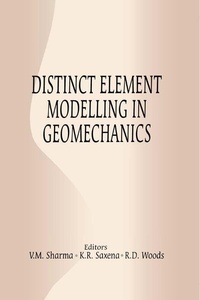
Distinct Element Modelling in Geomechanics
1st Edition
Published on 20. December 2018
234 pages
978-1-351-45472-8 (ISBN)
Description

Linear mathematical assumptions for procedures in other branches of engineering have little relevance for geoengineering, which must accommodate non-linear behaviors. Contributors to eight papers apply the breakthrough numerical modeling Distinct Element Method (Cundall, late 1960s).
The design philosophy for structures or excavations in geotechnical engineering is different from that followed for fabricated materials like steel and concrete. The designer has little data both with regard to geological weaknesses and strength and deformation characteristics of materials before finalizing the designs. Also these characteristics vary from place to place. In-situ stresses due to gravity and tectonics and transient forces imposed due to rainfall and earthquakes make the matter more complicated. The pore waters carry the load initially before passing it on to the solids. For the analytical procedure, to be realistic, it should account for large displacements and non-linear behaviour including strain-softening.
Because of these considerations, the designers have followed procedures based on simplifying assumptions such as linear, small strain, elastoplastic behaviour. Numerical procedures based on such assumptions, though very popular in other branches of engineering, have made little impact in geo-engineering.
An attempt has been made in this book to compile the recent use of distinct element codes for solutions of some of the problems in geomechanics aEUR" particularly those involving excavations. It is hoped that it will provide an opportunity for the fraternity of geotechnical engineers to appreciate the opening of new frontiers in the use of computers for solving more challenging geotechnical problems.
The design philosophy for structures or excavations in geotechnical engineering is different from that followed for fabricated materials like steel and concrete. The designer has little data both with regard to geological weaknesses and strength and deformation characteristics of materials before finalizing the designs. Also these characteristics vary from place to place. In-situ stresses due to gravity and tectonics and transient forces imposed due to rainfall and earthquakes make the matter more complicated. The pore waters carry the load initially before passing it on to the solids. For the analytical procedure, to be realistic, it should account for large displacements and non-linear behaviour including strain-softening.
Because of these considerations, the designers have followed procedures based on simplifying assumptions such as linear, small strain, elastoplastic behaviour. Numerical procedures based on such assumptions, though very popular in other branches of engineering, have made little impact in geo-engineering.
An attempt has been made in this book to compile the recent use of distinct element codes for solutions of some of the problems in geomechanics aEUR" particularly those involving excavations. It is hoped that it will provide an opportunity for the fraternity of geotechnical engineers to appreciate the opening of new frontiers in the use of computers for solving more challenging geotechnical problems.
More details
Edition
1. Auflage
Language
English
Place of publication
London
United Kingdom
Publishing group
Taylor & Francis Ltd
Target group
College/higher education
Product notice
Reflowable
File size
6,24 MB
ISBN-13
978-1-351-45472-8 (9781351454728)
Copyright in bibliographic data and cover images is held by Nielsen Book Services Limited or by the publishers or by their respective licensors: all rights reserved.
Schweitzer Classification
Other editions
Additional editions
K.R. Saxena | V.M. Sharma | Richard Woods
Distinct Element Modelling in Geomechanics
Book
01/1999
1st Edition
A A Balkema Publishers
€270.80
Shipment within 15-20 days
Persons
K.R. Saxena
Content
Preface, The Contributors, 1. The Excavation Damage Zone - An International Perspective
2. Improved Design in Rock and Soil Engineering with Numerical Modelling
3. Micromechanical Modelling of Granular Media: The Power of Discrete Element Modelling
4. Discrete Element Analysis of Dam Foundations
5. Earthquake Analysis of Concrete Gravity Dams on Jointed Rock Foundations
6. Considerations for Three-dimensional Modelling in Analysis of Underground Excavations
7. Predicting Performance of the 62 m Span Ice Hockey Cavern in Gjovik, Norway
8. Numerical Modelling of Underground Power Houses in India
2. Improved Design in Rock and Soil Engineering with Numerical Modelling
3. Micromechanical Modelling of Granular Media: The Power of Discrete Element Modelling
4. Discrete Element Analysis of Dam Foundations
5. Earthquake Analysis of Concrete Gravity Dams on Jointed Rock Foundations
6. Considerations for Three-dimensional Modelling in Analysis of Underground Excavations
7. Predicting Performance of the 62 m Span Ice Hockey Cavern in Gjovik, Norway
8. Numerical Modelling of Underground Power Houses in India
