

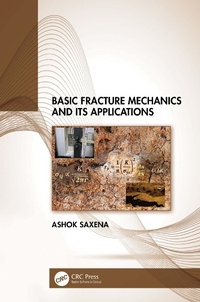
Basic Fracture Mechanics and its Applications
1st Edition
Published on 27. December 2022
342 pages
978-1-000-82374-5 (ISBN)
Description

This textbook provides a comprehensive guide to fracture mechanics and its applications, providing an in-depth discussion of linear elastic fracture mechanics and a brief introduction to nonlinear fracture mechanics. It is an essential companion to the study of several disciplines such as aerospace, biomedical, civil, materials and mechanical engineering. This interdisciplinary textbook is also useful for professionals in several industries dealing with design and manufacturing of engineering materials and structures.
Beginning with four foundational chapters, discussing the theory in depth, the book also presents specific aspects of how fracture mechanics is used to address fatigue crack growth, environment assisted cracking, and creep and creep-fatigue crack growth. Other topics include mixed-mode fracture and materials testing and selection for damage tolerant design, alongside in-depth discussions of ensuring structural integrity of components through real-world examples. There is a strong focus throughout the book on the practical applications of fracture mechanics. It provides a clear description of the theoretical aspects of fracture mechanics and also its limitations. Appendices provide additional background to ensure a comprehensive understanding and every chapter includes solved example problems and unsolved end of chapter problems. Additional instructor support materials are also available.
Beginning with four foundational chapters, discussing the theory in depth, the book also presents specific aspects of how fracture mechanics is used to address fatigue crack growth, environment assisted cracking, and creep and creep-fatigue crack growth. Other topics include mixed-mode fracture and materials testing and selection for damage tolerant design, alongside in-depth discussions of ensuring structural integrity of components through real-world examples. There is a strong focus throughout the book on the practical applications of fracture mechanics. It provides a clear description of the theoretical aspects of fracture mechanics and also its limitations. Appendices provide additional background to ensure a comprehensive understanding and every chapter includes solved example problems and unsolved end of chapter problems. Additional instructor support materials are also available.
More details
Edition
1. Auflage
Language
English
Place of publication
London
United Kingdom
Publishing group
Taylor & Francis Ltd
Target group
College/higher education
Illustrations
27 Tables, black and white; 183 Line drawings, black and white; 19 Halftones, black and white; 202 Illustrations, black and white
ISBN-13
978-1-000-82374-5 (9781000823745)
Copyright in bibliographic data and cover images is held by Nielsen Book Services Limited or by the publishers or by their respective licensors: all rights reserved.
Schweitzer Classification
Other editions
Additional editions
Ashok Saxena
Basic Fracture Mechanics and its Applications
Book
12/2022
1st Edition
CRC Press
€122.00
Shipment within 10-20 days
Person
Dr. Ashok Saxena currently serves as President and CEO of WireTough Cylinders, a position he has held since January of 2018. Dr. Saxena also serves as Dean Emeritus and Distinguished Professor (Retired) in the Department of Mechanical Engineering at the University of Arkansas, Fayetteville and as Adjunct Professor in the School of Materials Science and Engineering at Georgia Institute of Technology. At University of Arkansas, he had previously served as the Provost and Vice-Chancellor of Academic Affairs, the Dean of Engineering, the Raymond and Irma Giffels' Chair, the Head of Biomedical Engineering, and the Billingsley Endowed Chair. At Georgia Tech, he held the position of Regents' Professor and Chair of the School of Materials Science and Engineering. Prior to that he was a Fellow Scientist at the Westinghouse Research and Development Center in Pittsburgh. He also served as the Vice-Chancellor of Galgotias University in Greater Noida, India from 2012-2014. Dr. Saxena served the American Board of Engineering and Technology (ABET) as Program Evaluator, member of the Engineering Accreditation Commission, and member of the ABET Board. He was a Director and the Vice-President of the International Congress on Fracture and the Executive Chair of the Fifteenth International Conference on Fracture in Atlanta, Georgia, during June 11 to 14, 2023. He is one of the founders of the Indian Structural Integrity Society (InSIS) and served as its President from 2015 - 2018. He has also been a Visiting Professor/ Visiting Scientist in several institutions/research organizations around the world over his professional career spanning five decades.
Dr. Saxena received his MS and PhD degrees from University of Cincinnati in 1972 and 1974, respectively in Materials Science and Metallurgical Engineering and his B. Tech degree from the Indian Institute of Technology, Kanpur in 1970 in Mechanical Engineering. Dr. Saxena's area of expertise is mechanical behavior of materials. He has published over 250 research papers, authored/edited 10 books. He is the recipient of numerous national and international awards and recognitions in the field of fracture research that include the George Irwin Medal, the Fracture Mechanics Medal from ASTM, the Wohler Fatigue Medal from the European Structural Integrity Society, Outstanding Research Author Award from Georgia Tech, Paul Paris Gold Medal from the International Congress on Fracture. He is a Fellow of American Society for Testing and Materials, ASM International, International Congress of Fracture, and the Indian Structural Integrity Society. He was an elected member of the European Academy of Sciences.
Dr. Saxena received his MS and PhD degrees from University of Cincinnati in 1972 and 1974, respectively in Materials Science and Metallurgical Engineering and his B. Tech degree from the Indian Institute of Technology, Kanpur in 1970 in Mechanical Engineering. Dr. Saxena's area of expertise is mechanical behavior of materials. He has published over 250 research papers, authored/edited 10 books. He is the recipient of numerous national and international awards and recognitions in the field of fracture research that include the George Irwin Medal, the Fracture Mechanics Medal from ASTM, the Wohler Fatigue Medal from the European Structural Integrity Society, Outstanding Research Author Award from Georgia Tech, Paul Paris Gold Medal from the International Congress on Fracture. He is a Fellow of American Society for Testing and Materials, ASM International, International Congress of Fracture, and the Indian Structural Integrity Society. He was an elected member of the European Academy of Sciences.
Content
1. Fracture in Structural Components
2. Early Theories of Fracture
3. Theoretical Basis for Linear Elastic Fracture Mechanics
4. Crack Tip Plasticity
5. Fracture Toughness and Its Measurement
6. Fatigue Crack Growth
7. Environment-Assisted Cracking
8. Fracture Under Mixed-Mode Loading
9. Fracture and Crack Growth under Elastic/Plastic Loading
10. Creep and Creep-Fatigue Crack Growth
11. Case Studies in Applications of Fracture Mechanics
2. Early Theories of Fracture
3. Theoretical Basis for Linear Elastic Fracture Mechanics
4. Crack Tip Plasticity
5. Fracture Toughness and Its Measurement
6. Fatigue Crack Growth
7. Environment-Assisted Cracking
8. Fracture Under Mixed-Mode Loading
9. Fracture and Crack Growth under Elastic/Plastic Loading
10. Creep and Creep-Fatigue Crack Growth
11. Case Studies in Applications of Fracture Mechanics
