

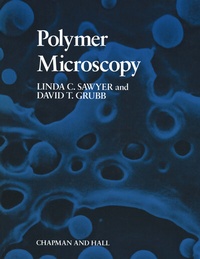
Polymer Microscopy
Published on 6. December 2012
318 pages
978-94-009-3139-8 (ISBN)
Description

Modern materials include a vast array of polymers and plastics which are found in applications such as housing, appliances, clothing and household textiles and automotive and aerospace industries. Thus research scientists, engineers and materials science graduate students need to be aware of the methods and techniques required to understand the structure-property relations of polymer materials. This book will review the field of the microscopy of polymers. There is a vast literature which describes the research results obtained by study of polymer materials using microscopy and other complementary analytical techniques and such studies are best left to journals on specific topics. The major objective of this text is to provide the basic microscopy techniques and specimen preparation methods applicable to polymers. The book will attempt to provide enough detail so that the methods described can be applied, and also to reference appropriate publications for the investigator interested in more detail. The selection of two authors for this text came from the desire for a comprehen sive review of polymer microscopy with emphasis on methods and techniques, rather than on research results. The synergism provided by two authors with widely varied backgrounds was thought to be important: one author (LCS) has an industrial focus and a background in chemistry whilst the other (DTG) has an academic environment and offers a background in polymer physics.
More details
Other editions
New editions
Linda Sawyer | David T. Grubb
Polymer Microscopy
E-Book
03/2013
2nd Edition
Springer
€85.59
Available for download
Additional editions

Linda C. Sawyer | David T. Grubb
Polymer Microscopy
Book
06/1987
Chapman and Hall
€89.28
Article exhausted; check different version
Content
1 Introduction to polymer morphology.- 1.1 Polymer materials.- 1.2 Polymer morphology.- 1.3 Polymer processes.- 1.4 Polymer characterization.- 2 Fundamentals of microscopy.- 2.1 Introduction.- 2.2 Optical microscopy.- 2.3 Scanning electron microscopy (SEM).- 2.4 Transmission electron microscopy (TEM).- 2.5 Microscopy of radiation sensitive materials.- 2.6 Analytical microscopy.- 2.7 Quantitative microscopy.- 2.8 Dynamic microscopy.- 3 Imaging theory.- 3.1 Imaging with lenses.- 3.2 Imaging by scanning.- 3.3 Polarizing microscopy.- 3.4 Radiation effects.- 4 Specimen preparation methods.- 4.1 Simple preparation methods.- 4.2 Polishing.- 4.3 Microtomy.- 4.4 Staining.- 4.5 Etching.- 4.6 Replication.- 4.7 Conductive coatings.- 4.8 Yielding and fracture.- 4.9 Freezing and drying methods.- 5 Polymer applications.- 5.1 Fibers.- 5.2 Films and membranes.- 5.3 Engineering resins and plastics.- 5.4 Composites.- 5.5 Emulsions and adhesives.- 5.6 Liquid crystalline polymers.- 6 Problem solving summary.- 6.1 Where to start.- 6.2 Instrumental techniques.- 6.3 Interpretation.- 6.4 Supporting characterizations.- Appendixes.- Appendix I Abbreviations of polymer names.- Appendix II List of acronyms - techniques.- Appendix III Manmade polymeric fibers.- Appendix IV Common commercial polymers and tradenames for plastics, films and engineering resins.- Appendix V General suppliers of EM accessories.- Appendix VI Suppliers of optical and electron microscopes.- Appendix VII Suppliers of x-ray microanalysis equipment.
